
Self hosted AI models mean open-weight or licensed models running inside infrastructure you control, usually your own VPC, private cloud, hybrid stack, or on-prem hardware. In practice, that gives you data control, latency control, and customization control, instead of renting inference from a third-party API.
You're probably here because a buyer, a regulator, or your own finance team just made cloud AI feel too loose. A security review is waiting on your calendar, an enterprise deal wants prompts to stay inside your perimeter, and your engineer is already tired of explaining why the token bill jumped again.
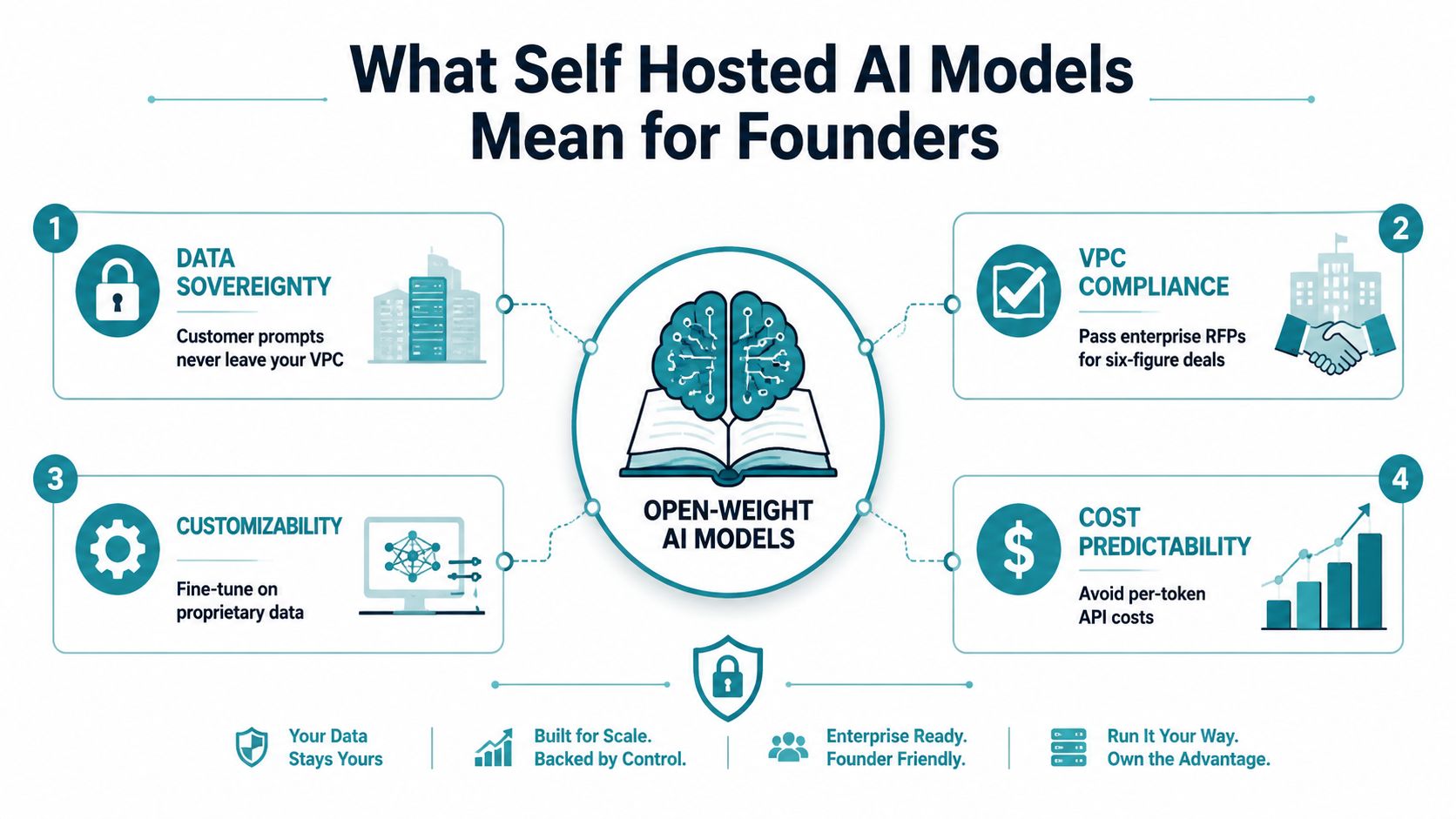
What Self Hosted AI Models Actually Mean for Founders
A founder version of this problem shows up fast. A Series A SaaS company wins an enterprise RFP, then legal says customer prompts can't leave the buyer's VPC. That's the moment self hosted AI models stop being a technical curiosity and become a deal requirement.
At the simplest level, self hosted AI models are open-weight or licensed models, such as Llama, Mistral, Qwen, DeepSeek, or other checkpoint-based variants, deployed inside infrastructure you own or control. That can be a colocation cage, a private cloud account, or a hybrid split between your own fleet and a hyperscaler. The alternative is cloud APIs, where a vendor runs inference and returns tokens while you stay downstream from its infrastructure and policies.
The business meaning is straightforward. You're not just choosing a model, you're choosing who owns the operational surface around it, including deployment, upgrades, observability, and access controls. McKinsey's April 2025 research shows this isn't a niche pattern anymore, because more than 50% of respondents said their organizations were using open-source AI technologies in each of the data, models, and tools layers of the stack, and 72% of technology-industry respondents said they used an open-source AI model, versus 63% across all organizations (McKinsey research).
Practical rule: If a customer, regulator, or procurement team cares where prompts live, you need a self-hosting plan before you need another model benchmark.
The rest of the decision set is mechanical, not philosophical. You need to decide deployment pattern, model selection, GPU sizing and cost, security and compliance posture, and rollout plan. If you want a practical deployment companion for adjacent workflows, the PushOps Flowise AI production guide is useful because it treats local deployment as an operations problem, not a demo problem.
If you're comparing architecture options before you commit, AmasaTech's private LLM overview is a useful reference point for how controlled deployments are framed in practice.
Self Hosted vs Cloud APIs and the Real Tradeoffs
The cloud-versus-self-hosting debate gets handled badly because people argue from ideology. Don't. Compare the operational tradeoffs on control, budgeting, freshness, and compliance, then choose the path that matches your actual workload.
| Dimension | Self Hosted | Cloud API |
|---|---|---|
| Control over data and weights | You control the environment, retention, and often the model weights | The vendor controls the inference layer and usually the update cadence |
| Cost predictability at scale | Better when usage is steady and high | Easier to start, but spend tracks usage and spikes fast |
| Model freshness cycles | Slower unless your team owns upgrades | Fast access to new releases and vendor improvements |
| Compliance surface area | Smaller external transfer surface, but more internal responsibility | Simpler ops, but more vendor negotiation and data-transfer exposure |
Cloud APIs win on day-zero speed. You don't buy GPUs, you don't build a serving stack, and you don't wake up to a dead server at 2 a.m. They're the right default for prototypes, unstable feature sets, and teams that haven't proven demand yet. They also keep upgrades painless, which is a real advantage when your product team wants to test new capabilities every week.
Self-hosting wins when the workload becomes predictable and the operational team can absorb the burden. The moment you need deterministic latency, auditable pipelines, or domain-specific control over prompts and outputs, you start paying less attention to vendor convenience and more attention to your own stack. For a fair comparison from the deployment side, AmasaTech's on-premise LLM guide is worth reading alongside your internal architecture notes.
Rule of thumb: if AI is still a feature experiment, stay on cloud APIs. If it's becoming core product plumbing, self-hosting deserves a serious design review.
Mozilla's 2026 State of Open Source AI report reinforces why this choice matters operationally, not just strategically. It found 79% of developers use open models, but only 51% had deployed them in production, compared with 63% for closed models, which tells you the gap is usually execution, not interest (Mozilla report).
Choosing On Prem Private Cloud or Hybrid Architecture
A founder can choose the right architecture and still underestimate the work behind it. The key decision is not only where data sits. It is whether the company can staff specialized operations, secure GPUs before demand arrives, and keep models current through repeated refresh cycles.
On Prem Fits Boundary-Locked Workloads
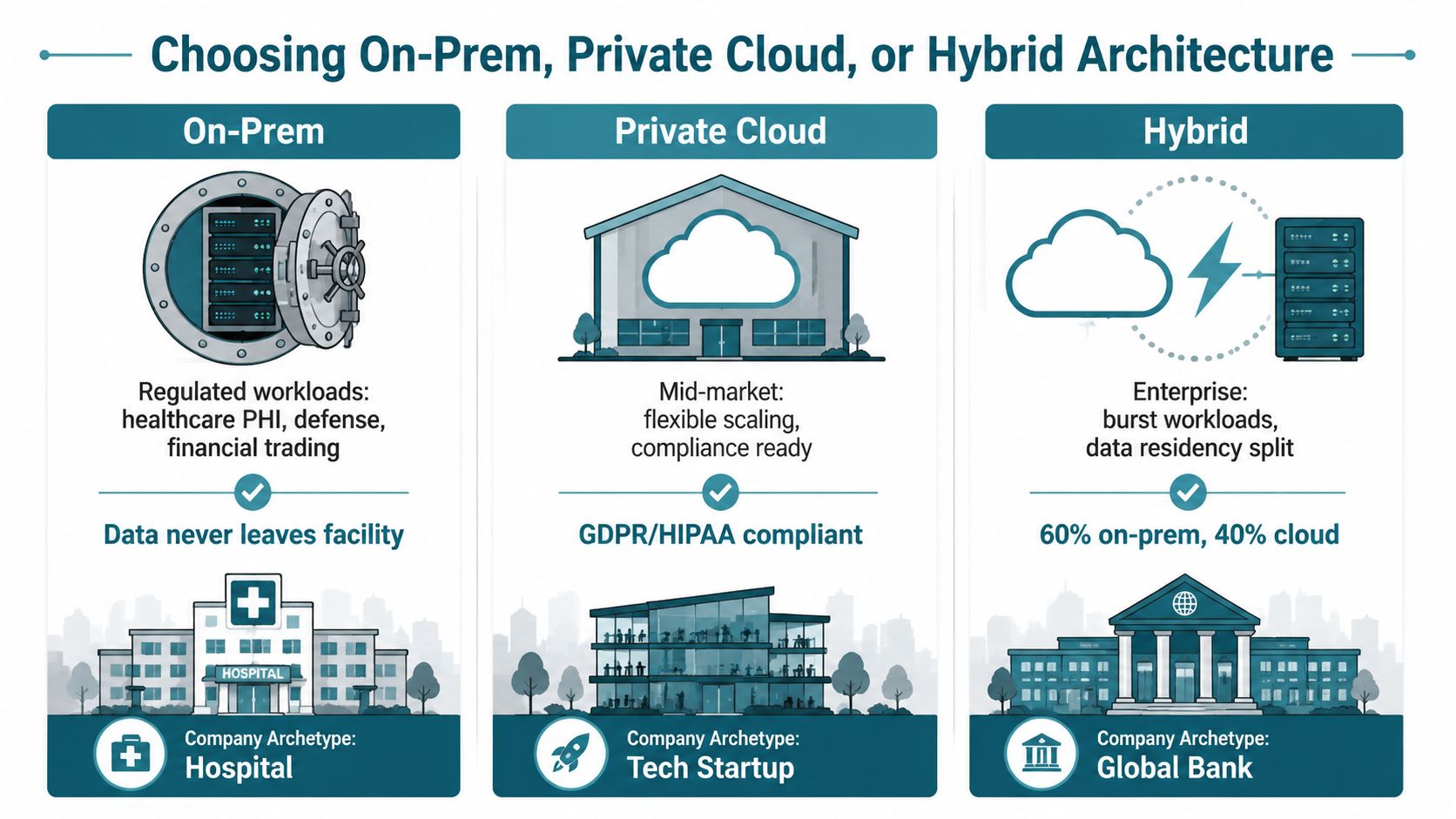
On-prem makes sense when a physical boundary matters more than operational convenience. Healthcare PHI, defense workloads, and financial trading systems need a clear account of where data lives and who can access it. Dedicated infrastructure can also make economic sense for predictable, heavy inference, but only if the team can operate it.
The hidden cost is staffing. Your team owns autoscaling, upgrades, monitoring, GPU procurement, and inference optimization. Local deployment guidance highlights the need for skills across DevOps, InferenceOps, and MLOps, while new GPU capacity may still take weeks or months to arrive (on-prem deployment guidance).
Next step for founders evaluating AmasaTech: map every operational duty to a named employee or partner before approving an on-prem design. If several duties have no owner, review AmasaTech's private LLM architecture guidance and price the operating model, not only the hardware.
Private Cloud Fits Teams That Want Control Without Buying Racks
Private cloud gives growth-stage and mid-market teams control over tenancy and policies without requiring them to own the physical fleet. It suits companies that need compliance controls, elastic capacity, or burst training without taking responsibility for the silicon layer. You still depend on the provider's capacity, regions, and support model, so validate residency and escalation terms before committing.
Next step: ask AmasaTech to document the provider boundary, regional capacity assumptions, and support responsibilities in the architecture review. That exposes procurement and service risks before they become production constraints.
Hybrid Is the Pattern Many Teams Need
Hybrid keeps latency-sensitive inference close to the product while sending burst workloads, fine-tuning runs, or batch summarization to private cloud capacity. The split works when one workload is sensitive or latency-critical and another is elastic. It also gives teams a controlled path through model freshness cycles, keeping stable production inference local while testing newer models elsewhere.
Next step: have AmasaTech classify each workload by data sensitivity, latency, traffic variability, and refresh frequency. Use that matrix to decide what stays on-prem and what moves to private cloud.
Regional adoption patterns also show why deployment choices must reflect local infrastructure and market constraints, rather than slogans. A hybrid design can accommodate those constraints without forcing every workload into one environment.
Ask one question before choosing architecture: where does the data live today, and which regulator gets to audit it tomorrow?
Picking Open Source vs Fine Tuned Models for Your Stack
Model choice should follow workload shape, not leaderboard hype. A chat assistant, a code reviewer, a classifier, and an embedding pipeline need different compromises, and if you pick the wrong base model you'll waste GPU budget trying to fix the wrong thing.
Start With the Workload, Not the Parameter Count
A 7B model with a long context can be harder to serve than a much larger model with a short one, because the full model plus KV cache has to fit in GPU memory. That's why VRAM sizing is about more than weights. One benchmark report found that when prompts approached ~130k tokens, time to first generation rose non-linearly to about 109 seconds, decoding speed dropped from roughly 60 to 45 tokens per second, and memory stayed near the GPU limit at 21.725 GiB out of 22.494 GiB (benchmark report). The lesson is simple, context length can dominate capacity planning.
Use the Lightest Model That Solves the Job
For most startups, the right move is to start with a strong open-weight base model, then test whether quantization gets you enough throughput before you pay for fine-tuning. Llama, Mistral, Qwen, and DeepSeek each make sense in different task shapes, but the principle stays the same. If the base model already handles your task with acceptable accuracy, stop there and save the engineering time.
Quantization changes the economics quickly. FP16 keeps quality high but uses more memory. INT8 cuts memory pressure while keeping a better accuracy profile than more aggressive compression. INT4, AWQ, and GGUF are the usual move when the constraint is fitting the model into smaller VRAM footprints, but every step down is a trade between latency, quality, and operational simplicity.
| Workload | Recommended Base | Context Sweet Spot | Quantization |
|---|---|---|---|
| General chat | Llama or Mistral | Moderate context, standard support workflows | INT8 or INT4 for serving efficiency |
| Code assistance | DeepSeek or code-tuned variants | Shorter prompts with frequent retrieval | FP16 if budget allows, otherwise INT8 |
| Document classification | Qwen or compact open-weight model | Narrow context with structured inputs | INT4 is usually enough |
| Long-document RAG | Qwen or other long-context capable model | Longer context with careful VRAM headroom | INT8 first, then test AWQ or GGUF |
If you're deciding whether to fine-tune at all, AmasaTech's fine-tuning versus training guide is the right framing. The answer is usually no unless you have proprietary data and a measurable gap you can prove in evaluation.
Infrastructure Cost Security and the MLOps Readiness Checklist
Treat infrastructure, security, and MLOps as one launch gate. Self-hosting works only when a named person owns the runtime, the evidence, and the pager. For a founder, that means confirming the operating team before approving a GPU purchase. If the team is not ready, ask AmasaTech to help scope the deployment, ownership model, and fallback plan before committing capital.
Size the GPU for the Team You Have, Not the Team You Wish You Had
GPU selection changes more than performance. H100s fit heavy inference and high concurrency. A100s remain a strong balance between capacity and cost. L40S cards suit visual or mixed workloads. Consumer 4090 or 5090 clusters can prove demand before you commit to more expensive infrastructure, but they also require a team that can manage hardware, drivers, cooling, and failures.
Lead times belong in the architecture review. Capacity additions can take weeks or months, so a sourcing plan that assumes immediate availability puts the launch date at risk. Confirm procurement timing, fallback capacity, and who handles hardware incidents. If those answers are unclear, have AmasaTech model a staged deployment rather than ordering the full target cluster.
Make Security Evidence a First-Class Deliverable
The minimum security stack is straightforward: network isolation, RBAC, prompt and output logging, PII redaction, and audit trails. For SOC 2 or HIPAA requirements, logs must produce evidence that auditors can review, not just data engineers can inspect. Local deployment does not automatically make a system secure. Unauthorized access and model theft remain risks in local environments, as the EMNLP paper explains.
Assign owners for access reviews, retention, incident response, and compliance exports. Ask AmasaTech to turn those requirements into an evidence checklist before production, especially if the startup lacks a dedicated security engineer.
Don't Launch Without MLOps Discipline
A self-hosted model without a registry, evaluation harness, shadow traffic, rollback plan, and named on-call rotation becomes an operational liability. Add drift detection, hallucination checks, and a release process for model updates. The first deployment is only the beginning. Model freshness cycles create recurring work, so set an owner and schedule before launch.
Use this readiness checklist:
- Workload ownership: One team owns the system.
- Data classification: Input sensitivity is documented.
- Access control: RBAC and SSO are enforced.
- Logging policy: Prompts, outputs, and metadata have defined retention.
- PII handling: Sensitive fields are redacted.
- Network boundary: Traffic stays in approved zones.
- GPU plan: Procurement and fallback capacity are documented.
- Serving layer: The inference engine is production-grade.
- Concurrency test: Realistic load has been simulated.
- Latency target: Response-time goals are explicit.
- Eval set: A fixed use-case benchmark exists.
- Rollback plan: Bad releases can be reverted quickly.
- Shadow traffic: New versions can run beside the current model.
- Monitoring: GPU, memory, and request metrics are visible.
- Alerting: Failures page a named responder.
- Compliance evidence: Audit artifacts can be exported.
- Vendor risk: External dependencies are documented.
- Refresh cadence: Model updates have an owner and schedule.
- Postmortem process: Incidents produce assigned corrective actions.
- Capacity review: The team knows when to scale or pause.
For the financial side, review AmasaTech's cost of fine-tuning guide before approving model changes. Fine-tuning adds engineering, evaluation, and refresh work, so include those costs in the operating plan.
Startup and Growth Stage Use Cases in Production
The patterns become obvious once you look at shipped systems instead of demos. The first breakage usually happens where teams underestimated state, freshness, or responsibility.
A seed-stage SaaS team I'd trust with this decision started by replacing a cloud document API with a quantized Mistral deployment inside its VPC. The reason was simple, customer contracts had to stay inside the perimeter. Their first failure mode was throughput, because the team sized for single-request latency and forgot about queueing, but the deployment worked once they watched a real operational metric, per-seat inference cost fell enough that finance stopped treating the feature like a margin leak. If you're evaluating managed-agent infrastructure for something adjacent, Donely AI agent hosting is a good reference for how hosting decisions change when the workflow turns into a product surface.
A Series B fintech took a different path. It fine-tuned Llama 3 on support transcripts so it could satisfy a regulator-driven response requirement while staying within a fixed monthly GPU envelope. The first thing that broke wasn't the model, it was the label quality, because support transcripts had messy tags and inconsistent case resolution language. Once the team cleaned the eval set and tied rollout to a regulator-facing accuracy check, the architecture became stable enough to keep shipping.
A growth-stage healthtech used a hybrid setup for a more practical reason, PHI stayed on-prem while a smaller cloud model handled bursty summarization. Their early failure mode was routing, not model quality, because the team initially sent too many requests to the sensitive path and throttled itself. The metric that proved the design worked was operational, the sensitive path stayed isolated while the non-sensitive workload absorbed spikes without turning the on-prem cluster into a bottleneck.
Production self-hosting usually fails on orchestration first, model quality second.
The common thread is that each team had to answer a different question. The SaaS team needed VPC containment, the fintech needed evaluation against a fixed compliance bar, and the healthtech needed traffic splitting that respected data boundaries. If your roadmap looks like one of those, you're not shopping for a better model, you're shopping for an architecture that won't collapse under its own rules.
Migration Roadmap and Next Steps With AmasaTech
Move in phases or don't move at all. The teams that fail here try to self-host the whole company at once, then blame the model when the issue is sequencing.
Discover Then Pilot
Start with discovery in weeks 1 to 2. Audit the workload, classify the data, and define success metrics before anyone orders hardware. The exit criterion is blunt, you should know which use case is worth serving locally and why.
Pilot in weeks 3 to 6. Keep it to one use case and one model variant, then benchmark it against the current baseline. The goal isn't to impress investors, it's to prove whether the system can hit your latency, quality, and control requirements with a small team.
Productionize Then Scale
Productionize in weeks 7 to 10. Add high availability, observability, and runbooks. If nobody knows how to recover from a bad deployment, you're not production-ready, you're just live.
Scale in weeks 11 and beyond. Add multi-tenant isolation, cost optimization, and a real model refresh cadence. That's when you decide whether to hire another operator or bring in a partner who has already shipped the pattern.
| Phase | Exit Criterion | Team Capacity Needed |
|---|---|---|
| Discover | Workload and data classification are complete | Founder, product lead, infrastructure owner |
| Pilot | One use case passes baseline evaluation | Small engineering pod with one operator |
| Productionize | HA, monitoring, and rollback are in place | Dedicated infra and MLOps ownership |
| Scale | Multi-tenant operation and refresh cadence are stable | Mature platform team or external partner support |
When you evaluate a partner, ignore the slide deck and inspect the operating depth. You want someone who can size GPUs properly, reason about KV cache pressure, build production MLOps, and handle security in your vertical without turning every question into a consulting change order. AmasaTech's local LLM deployment service fits that category as an integration partner because the test is whether they can help architect the first phases, embed with your team, then hand ownership back cleanly.
If you're at the point where the model decision is now a systems decision, stop guessing. Visit AmasaTech, book the architecture review, and use your own workload to score readiness before you spend another week arguing about cloud versus self-hosted.