
Your team already wants AI in production. Sales wants account research. Support wants faster resolutions. Ops wants a searchable brain for policies, contracts, and customer history. Then someone asks the obvious question: are you really going to paste sensitive company data into a public model and hope your controls are enough?
That moment is where most founders stop treating AI like a productivity toy and start treating it like infrastructure.
A Private LLM is the answer many teams move toward when they need AI to work on proprietary data inside an environment they control. But the decision isn't as simple as “public is risky, private is safe.” That's the beginner view. The core decision involves control, governance, architecture, and whether the system can produce reliable business value without creating a new security problem.
What Is a Private LLM and Why Does It Matter Now
A founder usually arrives here for one of three reasons. The company handles regulated data. The team has built unique internal knowledge they don't want leaving the business. Or leadership has realized that generic AI output isn't enough for the next stage of growth.
A Private LLM is a large language model deployed in an environment your organization controls, such as your own infrastructure, a private cloud, or a tightly governed hybrid setup. In business terms, that means your team decides where data lives, which systems the model can access, how prompts are logged, who can use it, and what guardrails sit around it.
That matters because the market is moving from experiments to infrastructure. The enterprise LLM market is projected to grow 10× from $6.7 billion in 2023 to $71.1 billion by 2034, with private and custom models becoming central as organizations move from tools to production-grade AI infrastructure, according to this private LLM market projection.
The business definition matters more than the technical one
Most technical definitions focus on hosting. That's too narrow.
A private LLM is really about data sovereignty and operational control. If your customer success team wants AI to summarize churn risk from CRM notes, support tickets, renewal history, and internal meeting transcripts, the question isn't just which model performs best. It's whether the system can do that without exposing strategic context, violating policy, or creating governance debt you'll regret later.
For founders, the practical use cases are usually things like:
- Internal knowledge assistants that answer questions from SOPs, contracts, product docs, and ticket history
- Domain-specific copilots for legal review, healthcare workflows, claims handling, or compliance research
- Workflow automation where the model drafts, classifies, extracts, or routes work using private business context
Teams exploring AI language models for enterprise productivity usually discover the same pattern. Public tools are great for fast experimentation. Private systems become necessary when the task touches sensitive data, repeatable operations, or competitive knowledge.
A good private LLM isn't just a sealed-off chatbot. It's a controlled decision layer attached to your business data.
Why founders care now
The timing isn't accidental. General LLM adoption matured fast. What changed is the standard for success. Leaders aren't asking whether AI is interesting. They're asking whether it can be trusted inside real operations.
That's why private LLM strategy now sits at the intersection of product velocity, compliance, and defensibility. If the model can reason over the data your competitors can't access, and do it inside your own control boundary, it stops being a novelty and starts becoming an asset.
Understanding Core Differences Between Private and Public LLMs
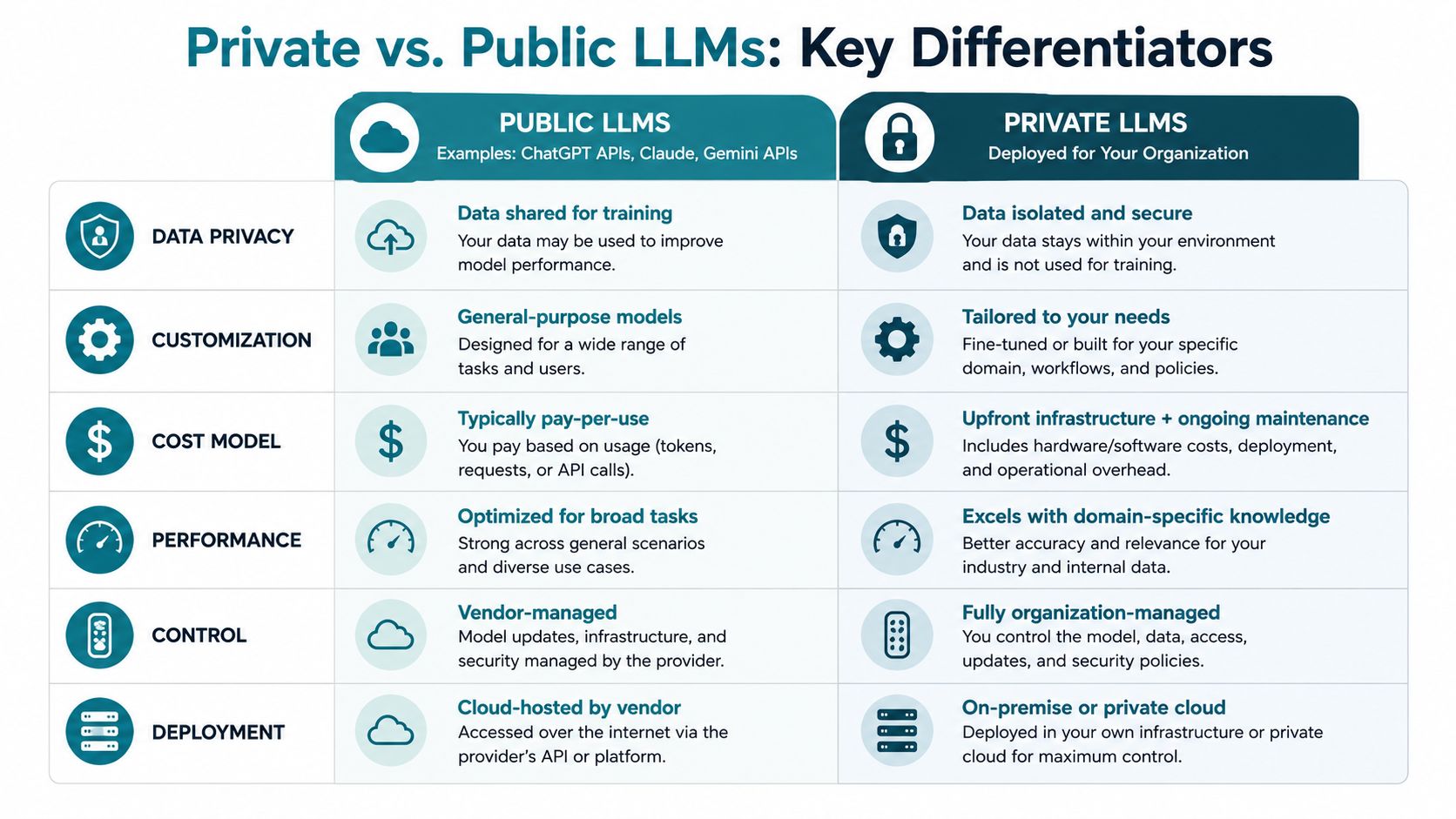
The simplest way to think about this is renting versus owning.
A public LLM is like renting a high-end apartment in a well-run building. It's fast to move into, easy to scale, and someone else handles the plumbing. A private LLM is closer to building or buying your own home. You get far more control, but you're responsible for the systems, upkeep, and security decisions.
Where the two approaches diverge
| Area | Public LLMs | Private LLMs |
|---|---|---|
| Data handling | Vendor-managed environment | Organization-controlled environment |
| Customization | General-purpose by default | Tailored to internal workflows and data |
| Cost shape | Usage-based API spend | Infrastructure, maintenance, and engineering overhead |
| Reliability model | Dependent on external provider policies and changes | Dependent on your architecture and team operations |
| Governance | Shared responsibility with vendor | Primarily your responsibility |
Privacy is the first difference, but not the only one
Founders usually focus on privacy first. That's valid, but incomplete. The larger strategic difference is control.
With a public API, your team gets speed. You can prototype fast, swap prompts quickly, and avoid standing up infrastructure. That's useful for marketing drafts, generic summarization, or low-risk assistants. For many companies, this is the right starting point.
With a private LLM, you gain the ability to shape the system around your actual business. You can isolate data access, tie the model into internal identity systems, define retrieval boundaries, and build task-specific evaluation. If your use case touches legal memos, underwriting notes, PHI, or sensitive support records, this control isn't optional. It's part of the product.
A strong set of AI security best practices becomes more important the moment you stop treating the model like a standalone chat interface and start connecting it to company systems.
Cost is less intuitive than most teams expect
Public models look cheap because they remove upfront friction. Private models look expensive because you can see the infrastructure bill and engineering work immediately.
But the pertinent comparison isn't “API cost versus server cost.” It's variable convenience versus owned capability. If your use case is high-volume, steady, and tied to sensitive internal workflows, private deployment can become strategically cleaner even if it takes longer to set up. If the use case is sporadic, broad, and low-risk, a public API often stays more rational.
The wrong comparison is technical. The right comparison is whether you're buying fast access or building durable capability.
Customization changes the quality ceiling
Public LLMs are broad. That's their strength and their limitation.
A private LLM can be adapted to your taxonomy, document structure, workflow states, and business language. In practice, that means fewer generic answers and more responses shaped around how your company operates. That doesn't guarantee success, but it raises the ceiling for domain-specific performance in a way generic tools often can't.
Choosing Your Private LLM Deployment Strategy
A founder approves a "private LLM" project, expecting one clean infrastructure decision. Two months later, the team is arguing about GPU capacity, cloud isolation, vendor lock-in, and whether half the workload should have stayed on a public API. That pattern is common because deployment strategy is not a hosting preference. It is an operating model decision.
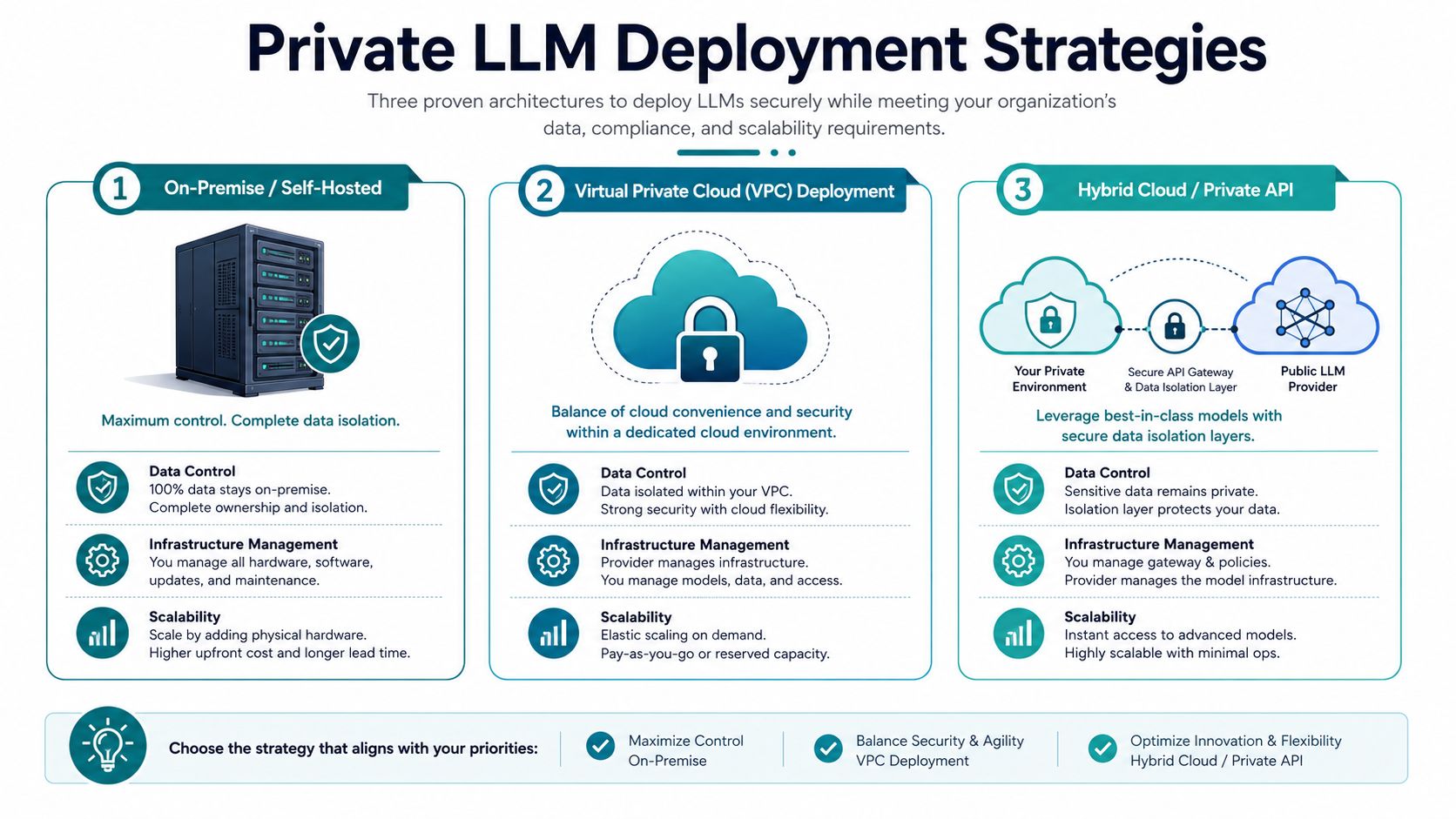
The practical choices are on-premises, virtual private cloud, and hybrid. The right one depends on where your risk sits: in data exposure, uptime requirements, procurement constraints, or the simple fact that your team may not be ready to operate model infrastructure well.
On-premises fits teams that already run high-control systems
On-premises puts the model inside infrastructure you own and manage directly. That approach makes sense when legal, regulatory, or customer requirements force strict network isolation, data residency, or very tight review of every system that touches sensitive information.
The benefit is control over the full stack. The cost is that you inherit the full stack too.
Your team has to handle GPU procurement, capacity planning, patching, failover, observability, access controls, and incident response. For a company without mature platform engineering, this route often creates a hidden problem: the AI initiative becomes an infrastructure program. Founders should choose on-prem because the business requires it, not because "private" sounds safer on paper.
VPC is often the strongest first deployment
A VPC deployment gives you isolated networking, controlled access policies, and better separation from general public cloud traffic, without forcing your company to run its own data center footprint.
For many growth-stage companies, this is the practical middle path. The team gets meaningful control over where data flows, how systems are segmented, and who can access the environment. At the same time, cloud elasticity makes testing, iteration, and scaling far easier than on-prem.
It is still real infrastructure work. A VPC does not remove the need for MLOps discipline, logging policies, IAM design, and cost controls. It just keeps those problems at a level a smaller team can usually manage.
Hybrid is often the honest answer
Hybrid deployments reflect how AI work manifests in the business. One workflow may involve sensitive customer records and require private inference. Another may be low-risk drafting, classification, or summarization that does not justify private capacity.
So the system routes requests by sensitivity, latency, and cost.
This is also where the "private means perfectly secure" assumption starts to break down. A hybrid model can reduce unnecessary exposure by keeping sensitive tasks in a private environment, but it also adds routing rules, policy enforcement, and more places where mistakes can happen. Used well, hybrid architecture improves risk control. Used poorly, it spreads accountability across too many systems.
Analysts at Flexera found in its 2024 State of the Cloud Report that hybrid cloud remains the most common cloud strategy for enterprises. That matters here because private LLM programs usually follow the same pattern. Companies rarely move every AI workload into one environment. They segment based on what the workload is worth and what would happen if it failed or leaked.
A hybrid model tends to work well when:
- Only part of the workflow is sensitive
- The team needs fast experimentation on lower-risk tasks
- Budget pressure makes full private deployment hard to justify
- Different business units have different compliance requirements
A founder's decision table
| Deployment model | Best fit | Main upside | Main risk |
|---|---|---|---|
| On-premises | Regulated environments with existing infrastructure maturity | Direct control over data path and environment | High operational burden and slower iteration |
| VPC | Growth-stage teams building serious internal AI products | Strong balance of isolation, speed, and manageability | Cloud complexity can still outpace a small team |
| Hybrid | Companies with mixed-sensitivity workflows | Better cost and risk matching by use case | Routing, governance, and architecture get harder fast |
What usually works in practice
Match the deployment model to your operating maturity, not your ambition.
A lean team with one high-value internal use case usually gets further with a VPC than with a rushed on-prem rollout. A company with hard residency requirements and an experienced infrastructure team may have a real case for on-prem. A business with mixed workflows often gets the best result from hybrid, but only if someone owns the routing rules and policy decisions clearly.
Teams building enterprise AI workflow and model deployment systems usually make better decisions when they separate three questions: where the model runs, which data it can touch, and which workloads deserve private infrastructure at all. That separation prevents an expensive mistake I see often. Founders buy private capacity for every use case, then discover only a small share of those workloads needed it.
Navigating Security and Governance in Private LLMs
A private LLM keeps your data away from a third-party public model. That's useful. It does not mean the system is automatically secure.
This is the security paradox that catches founders off guard. They assume self-hosting or private deployment closes the main risk. In reality, it often shifts the risk inward.
Private LLMs still face significant internal attack vectors and data leakage risks. Research summarized by Skyflow on private LLM limitations notes that while private systems prevent data transfer to third parties, they don't solve problems like model inversion attacks, prompt leakage within the organization, or the inability to detect adversarial inputs without external monitoring tools.
What “private” still doesn't solve
A few examples make this concrete:
- Insider misuse: An employee with broad access can probe the system for information they shouldn't see.
- Prompt leakage: Sensitive material can surface in logs, tool traces, cached context, or downstream app layers.
- Adversarial input: A user or malicious internal actor can craft prompts that push the model to reveal restricted content.
- Model inversion and extraction risk: A determined attacker may infer or extract sensitive patterns if the system is poorly designed.
Security for a private LLM starts after hosting. Not before it.
Differential privacy isn't a magic shield
Some teams hear “differential privacy” and assume the privacy problem is solved. It isn't that simple.
Research on private LLM adaptation found that in moderate privacy regimes using ε = 8, sensitive adaptation data still showed meaningful vulnerability to both membership inference attacks and direct data extraction attacks. The paper argues that stricter privacy budgets or additional safeguards such as secure enclaves are needed for stronger confidentiality in high-stakes domains. See the OpenReview paper on privacy vulnerability in private LLM fine-tuning.
The lesson for founders is straightforward. A privacy technique is one layer, not the whole answer.
Governance has to be designed, not added later
A workable governance model usually includes these controls:
- Access segmentation: Separate who can query the system, who can administer it, and who can inspect logs.
- Data flow boundaries: Define which repositories can feed retrieval, which can't, and what redaction happens before prompts are assembled.
- Prompt and response logging policy: Log enough for oversight, but don't create a new archive of sensitive prompts that broad teams can access.
- Human review for risky actions: Keep approval steps around outputs that trigger business decisions, customer communications, or compliance workflows.
If your architecture spans retrieval, agents, and multiple models, an AI orchestration platform can help enforce policy boundaries across tools and prompts, not just at the model layer.
The operating principle
Treat your private LLM like any other sensitive internal system. It needs identity controls, monitoring, segmentation, auditability, and abuse assumptions. If your team says “it's private, so we're covered,” governance hasn't started yet.
RAG vs Fine-Tuning The Real Decision Matrix
Most private LLM advice gets this wrong by oversimplifying it.
You'll often hear: use RAG for company knowledge, use fine-tuning for specialized behavior. That's directionally useful, but it leaves out the fundamental question. What kind of data are you working with, and what kind of reasoning do you need?
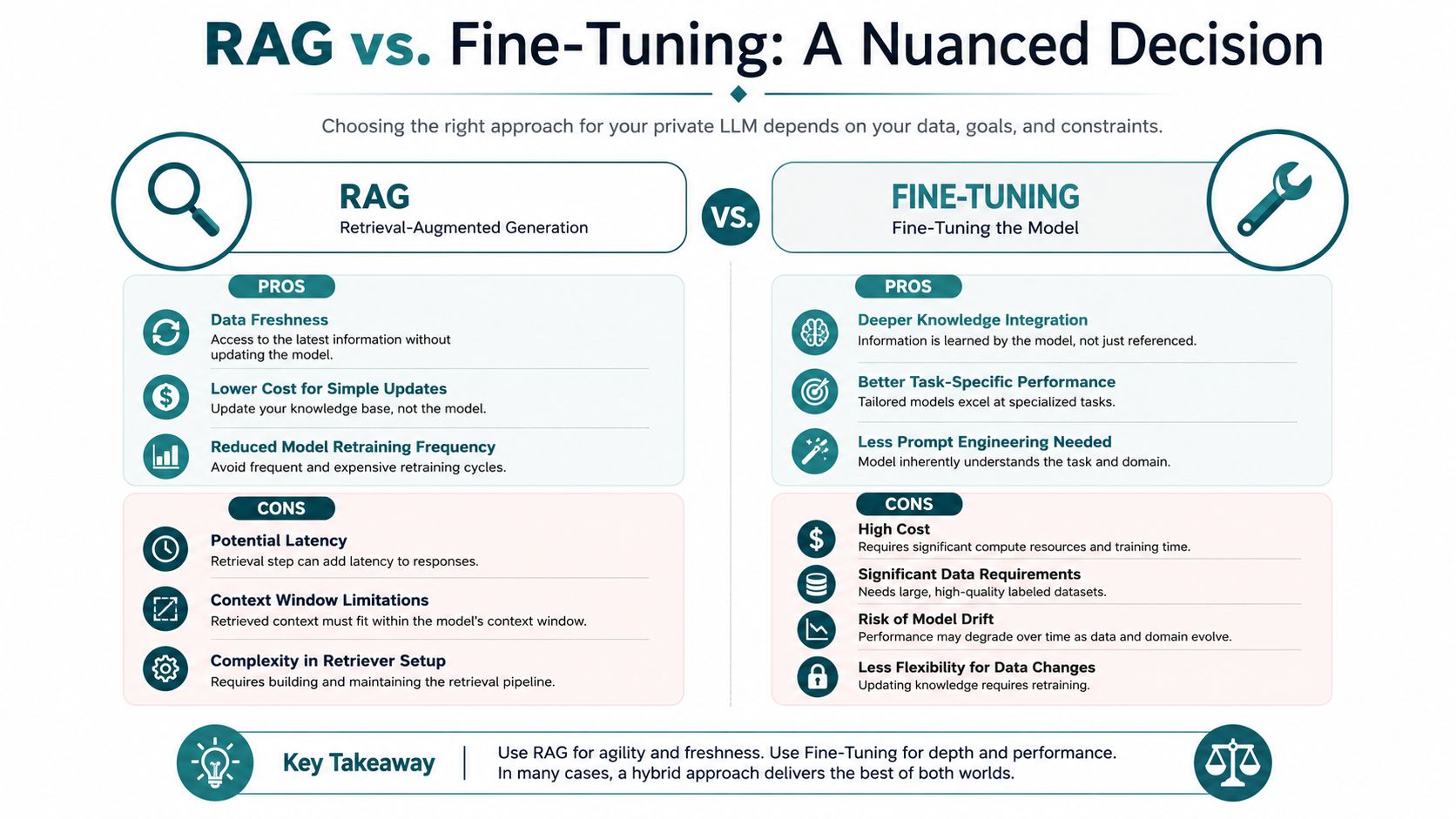
RAG gives the model access to external knowledge at inference time. Fine-tuning changes how the model behaves based on training. One adds context. The other changes the model's tendencies.
Start with the data, not the technique
If your company knowledge is mostly discrete facts, standard documents, FAQs, product manuals, and policy references, baseline RAG is often the right first move. It keeps knowledge fresh and avoids retraining the model whenever the source content changes.
If your data is full of narrative complexity, cross-document relationships, case history, exceptions, and non-linear context, standard RAG often breaks down. That's where many private LLM projects disappoint leadership. The system retrieves text, but it still can't answer the question that matters.
Microsoft's 2024 GraphRAG study found that baseline RAG cannot answer important discovery questions on narrative private data and requires LLM-generated knowledge graphs to derive value. The same source notes that 90% of enterprises still use standard RAG. See Microsoft's GraphRAG research discussion.
If your data tells stories instead of listing facts, basic RAG may retrieve relevant text and still miss the answer.
A practical decision lens
Use this matrix to avoid the common mistake.
| Situation | Better first move |
|---|---|
| Policies, manuals, product docs, FAQ libraries | Standard RAG |
| Rapidly changing knowledge base | RAG |
| Consistent domain tone or formatting requirements | Fine-tuning |
| Complex narrative data across many related documents | Advanced RAG, such as graph-based retrieval |
| Repeated task behavior that needs stable output style | Fine-tuning |
| Need both proprietary knowledge and controlled behavior | Combined approach |
What founders should ask before choosing
- Are answers mostly retrieved or inferred? If retrieval solves most of the task, start there.
- Does the business need fresh knowledge daily? Fine-tuning is a poor fit for constantly changing facts.
- Is the failure mode factual omission or behavioral inconsistency? Omission points to retrieval problems. Inconsistency points to behavior and tuning.
- Do documents reference each other in messy ways? That often signals a need for more advanced retrieval structure, not just bigger context windows.
Teams designing a RAG pipeline architecture usually do better when they test representative business questions before committing to one pattern. If your most important queries involve investigation, synthesis, or hidden relationships, don't assume standard chunk-and-search RAG will carry the load.
The most realistic answer
For many production systems, the choice isn't RAG or fine-tuning. It's RAG first, then selective tuning if the workflow needs stronger task behavior. Founders should treat this as a design sequence, not a tribal identity.
Balancing Performance and Cost in Your Private LLM
Every private LLM decision eventually hits the same wall. The model works in a demo. Then the team asks how fast it is, how much it costs per workload, and whether users will tolerate the experience.
In this context, technical metrics become business metrics.
What the metrics mean in plain terms
Latency is how long users wait before the model starts responding. In a support assistant, that's the difference between “this feels instant” and “this tool is slowing my team down.”
Throughput is how much work the system can handle over time. If multiple teams query the model at once, throughput determines whether performance holds up or queues start forming.
Energy and compute use matter because they show up as infrastructure cost. A model that feels manageable in testing can become expensive once real usage ramps.
The trade-off you need to manage
Evaluation frameworks for local and private LLMs show that private deployments often trade 30-50% higher latency compared with cloud APIs. The same evaluations show aggressive quantization can reduce inference expense by 60%, but may reduce domain-specific accuracy by 5-10%. See the Bench360-style evaluation discussion on private LLM performance trade-offs.
That gives founders a clear management question. Where do you want to spend money, and where can you tolerate degradation?
A practical way to decide
Use the business context, not engineering preference.
- Customer-facing assistant: Favor responsiveness. Slow answers erode trust quickly.
- Internal research tool: Users may tolerate some delay if answer quality is high.
- Batch document processing: Throughput and cost usually matter more than conversational feel.
- Specialized legal or medical reasoning: Be careful with aggressive quantization if precision matters.
Quantization is useful, but not free
Quantization makes a model lighter so it can run more efficiently on available hardware. That's often the right move for a private LLM, especially early on. But it's not a free optimization. If your use case depends on nuanced terminology, edge-case reasoning, or specialized language, lighter can become dumber in ways that matter.
A good operating practice is to evaluate the model against your own tasks after every optimization step. Don't accept a lower cloud bill if the system starts missing clauses, misclassifying claims, or answering policy questions incorrectly.
Cheap inference is expensive when it creates bad decisions upstream.
The winning setup is rarely the fastest or the cheapest in isolation. It's the one that meets the user's expectation at a cost the business can sustain.
A Phased Private LLM Roadmap for Founders and Leaders
A founder approves a private LLM budget, the team starts comparing models and cloud setups, and six months later the company has a costly pilot with unclear ownership and no agreed definition of success. That pattern is common in first-time AI programs. The problem is rarely model quality alone. It is weak sequencing.
Private LLM adoption works better as a staged operating plan. Start with a narrow business problem, prove it under real controls, then expand only after the system survives security review, user scrutiny, and cost pressure. That matters even more because the security paradox is real. A private deployment gives you more control, but it does not remove data leakage risk, poor access design, weak prompts, or bad workflow decisions.
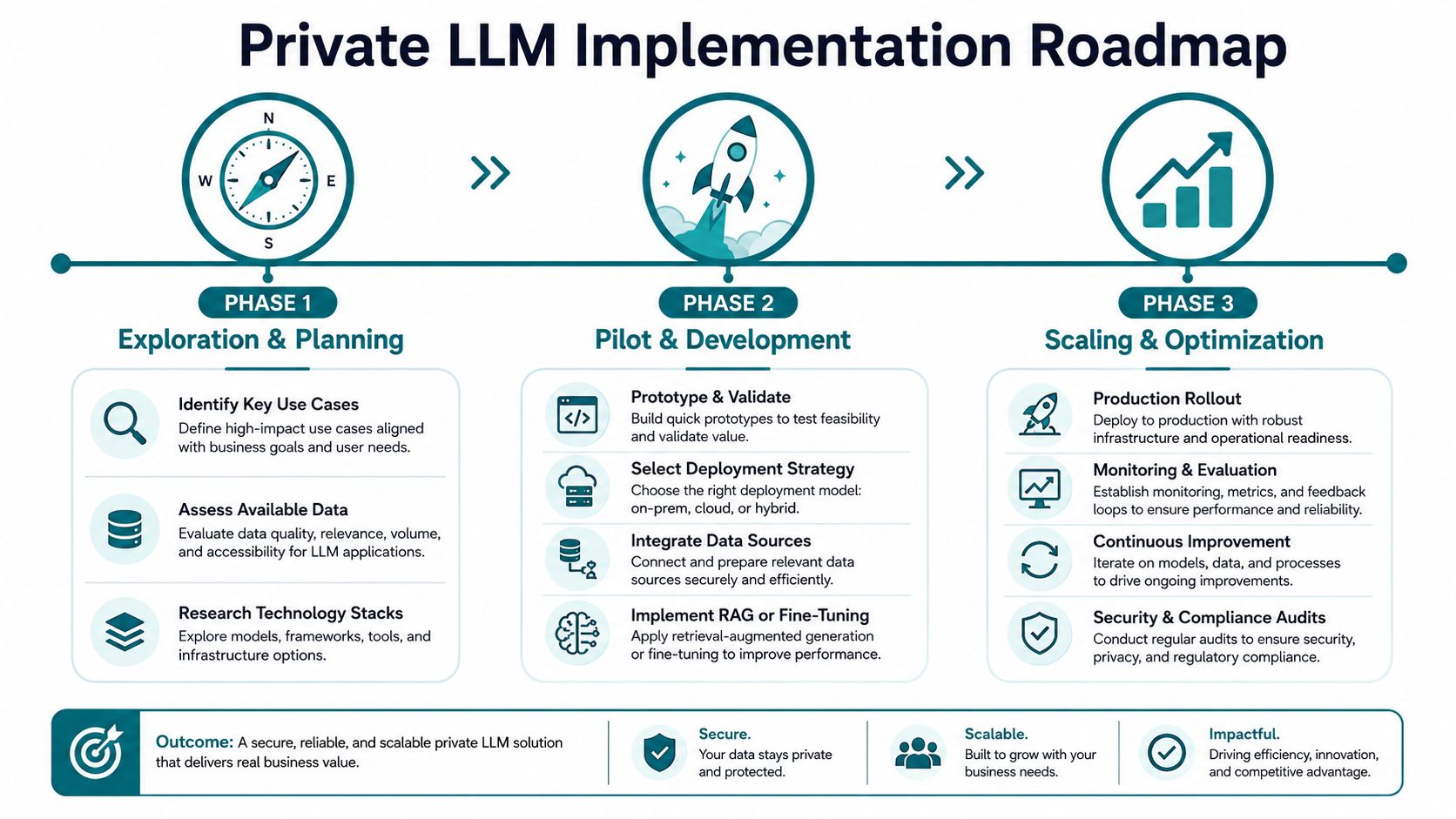
Phase one means audit before build
Start with data, process, and accountability.
Identify which internal sources are usable, which contain regulated or sensitive material, and which are too inconsistent to trust without cleanup. Then identify one workflow with enough repetition and enough business pain to justify intervention. In practice, an internal knowledge assistant, policy search tool, or controlled document review flow usually beats an ambitious multi-step agent.
Answer these questions before any serious build starts:
- Which team loses measurable time searching, summarizing, or validating internal information?
- Which use case has a named owner, a budget, and a success metric the business will accept?
- Which data sources can be connected safely without creating access conflicts or audit gaps?
- What level of error is tolerable, and where does a human need to stay in the loop?
Keep architecture choices narrow at this stage. The goal is not to pick a permanent stack. The goal is to reach a credible pilot fast enough to learn where the actual constraints are.
Phase two is pilot and evaluation
Build one system for one job.
That often means a private deployment boundary, retrieval over a selected document set, role-based access controls, logging, and human review for sensitive outputs. For many founders, this is also where the RAG versus fine-tuning debate gets distorted. Early on, the better question is usually simpler: do you need the model to know your information, or do you need the system to fetch the right information at the right time? In a first pilot, retrieval is often the safer choice because it is easier to inspect, update, and govern.
Evaluation needs to be operational, not theatrical. Measure answer quality, escalation rate, workflow completion, time saved, cost per query, and repeat usage. If users like the demo but still verify everything manually, the system has not created business value yet.
AmasaTech offers custom LLM applications, RAG pipelines, and phased AI deployment tied to business KPIs. That kind of delivery model can help when an internal team lacks the time or senior expertise to set up the pilot with proper controls.
Phase three is scale with discipline
Once one use case is stable, expand in layers.
That can include more repositories, better retrieval for narrative or fragmented content, selective fine-tuning for narrow tasks, or routing some workloads between private and public models based on sensitivity and cost. It also means tightening governance because scale increases failure modes. More users create more permission issues. More data creates more exposure. More automation increases the cost of wrong answers.
At this stage, focus on:
| Priority | What it means in practice |
|---|---|
| Reliability | Monitoring, fallback paths, response testing |
| Security | Tighter segmentation, audit logs, prompt controls |
| Economics | Ongoing review of infrastructure and inference cost |
| Scope control | Expanding only where the system proves value |
One practical rule helps here. Do not treat every new use case as a reason to retrain the model. Some problems need retrieval changes, some need workflow design, and some need no AI at all. Founders save money when they force that distinction early.
The founder's operating principle
Build the smallest private LLM system that solves a costly, defensible problem and can pass security review with clear ownership.
That is how private AI becomes durable inside a company. It starts as a controlled capability with measurable value, known limits, and a governance model that can hold up under pressure.
If you're planning your first serious private LLM investment, AmasaTech can help structure the work from audit to pilot to production. The practical goal is choosing the right architecture, protecting sensitive data, and tying the system to outcomes your team can measure.