
You're looking at a growing cloud bill, but your security team still won't approve sending sensitive prompts to a third-party model. Engineering wants the speed of a hosted API. Compliance wants data to remain inside a controlled boundary. Finance wants a business case that survives more than a spreadsheet built around optimistic GPU utilization.
That's the on premise LLM decision. It isn't a choice between privacy and convenience. It's a question of payback economics, data residency, and operational maturity. Private inference can be strategically valuable, but only when the workload generates enough volume, carries restrictions that cloud services can't satisfy, or justifies the team required to run the system reliably.
What an On Premise LLM Actually Means for Your Business
An on premise LLM runs inside infrastructure your organization controls. The model weights, inference servers, GPUs, networking, storage, access controls, logs, and supporting data services operate in your data center or another environment governed by your organization, rather than through a shared third-party API.
That distinction changes accountability. With a hosted API, the provider operates the serving layer and usually owns much of the responsibility for capacity, upgrades, and availability. With on premise deployment, your team decides who can access prompts, where retrieval data is stored, how long logs remain available, and how model changes reach production.
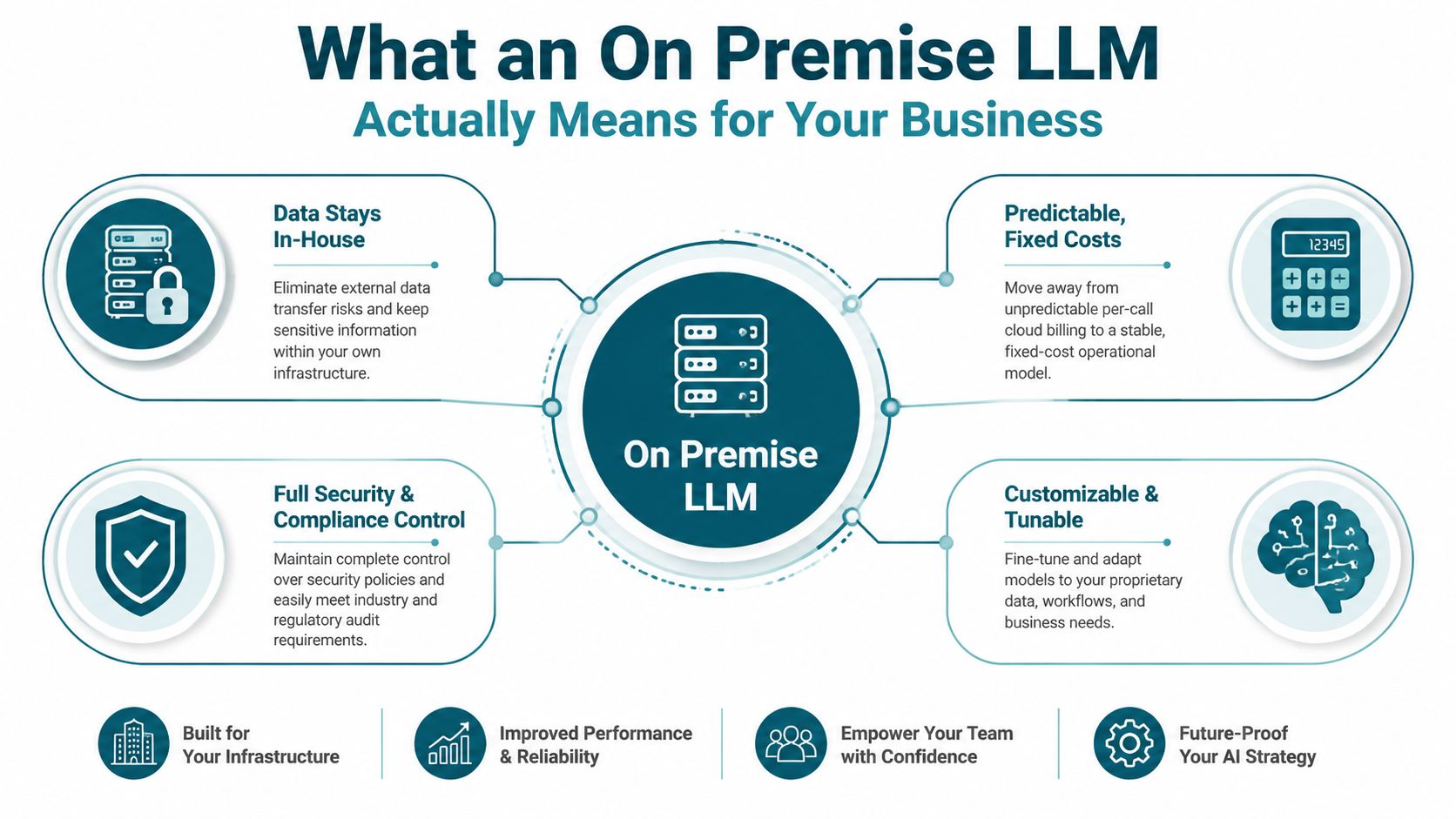
The three forces behind the decision
Data control is the first force. A private model can keep regulated records, proprietary documents, and sensitive prompts within a defined network boundary. That matters when contracts, internal policy, or sector requirements restrict third-party processing.
Predictable unit economics is the second. Cloud APIs make experimentation easy, but usage-based billing can become difficult to forecast when a product generates sustained inference traffic. On premise shifts the cost structure toward infrastructure, support, electricity, maintenance, and staff.
Operational maturity is the third. A downloaded model isn't a production service. You'll need serving software, authentication, monitoring, evaluation, model refresh procedures, incident runbooks, and someone accountable when latency rises or quality falls.
The category has moved beyond a niche infrastructure pattern. One market report estimates on-premise LLM serving at $3.08 billion in 2025, rising to $3.81 billion in 2026, an implied 23.8% year-over-year growth rate (market analysis of on-premise LLM serving). That doesn't mean on premise is right for every workload. It means private inference has become a recognized enterprise planning category.
Practical rule: Choose on premise because a specific workload needs control or can support the operating model, not because “local” sounds safer.
A private LLM also isn't automatically a custom-trained model. You can run an open-weight model without fine-tuning, connect it to internal documents through retrieval, or adapt it with lightweight techniques. The architecture should follow the business requirement. Teams evaluating the distinction between private deployment models can use this private LLM overview as a starting point.
On Premise vs Cloud vs Hybrid at a Glance
No deployment pattern wins every category. Cloud APIs are usually the fastest route to a working prototype. On premise provides the strongest direct control over infrastructure and data flows. Hybrid lets you reserve private capacity for restricted workloads while keeping less sensitive or more variable workloads in the cloud.
The right comparison focuses on the workload, not the label attached to the architecture.
| Dimension | On Premise | Cloud API | Hybrid |
|---|---|---|---|
| Data residency | Data can remain inside infrastructure controlled by the organization | Data crosses into a provider environment under contractual and technical controls | Sensitive workloads stay private while other traffic uses cloud services |
| Latency | Can provide consistent internal network performance once capacity is available | Depends on network path, provider load, and API behavior | Local routing for latency-sensitive requests, cloud capacity for bursts |
| Cost at scale | Higher initial commitment, with potentially predictable marginal cost at sustained volume | Low initial commitment, but usage charges grow with consumption | Cost is allocated by workload, volume, and sensitivity |
| Time to first token | Slower because hardware, serving, security, and operations must be prepared | Fastest path to experimentation | Moderate, depending on the private boundary |
| Vendor lock-in | More control over model and serving choices, though hardware and software dependencies remain | Stronger dependency on provider APIs, pricing, and model availability | Reduced dependency through routing and workload separation |
| Operational burden | Highest. Your team owns capacity, upgrades, monitoring, and incidents | Lowest infrastructure burden | Shared burden, with complexity at the routing and policy boundary |
| Best fit | Stable, sensitive, high-volume workloads | Prototypes, bursty demand, and workloads that benefit from frontier access | Regulated organizations with mixed data classes and uneven demand |
A startup validating a feature usually shouldn't buy infrastructure before it understands usage and quality requirements. A regulated enterprise with sustained internal traffic may find that sending every request to a public API creates unnecessary exposure and an unpredictable cost base.
Hybrid deserves more attention than it gets. You can route restricted documents to private inference while sending general-purpose requests to a cloud provider. That approach requires reliable classification, explicit routing policy, and audit evidence. It also avoids sizing private infrastructure for traffic that doesn't need it.
Before committing, test whether cloud economics and operational convenience still work for your workload. This cloud testing guide can help frame that evaluation before you make a permanent infrastructure decision.
The Real Economics of On Premise LLMs
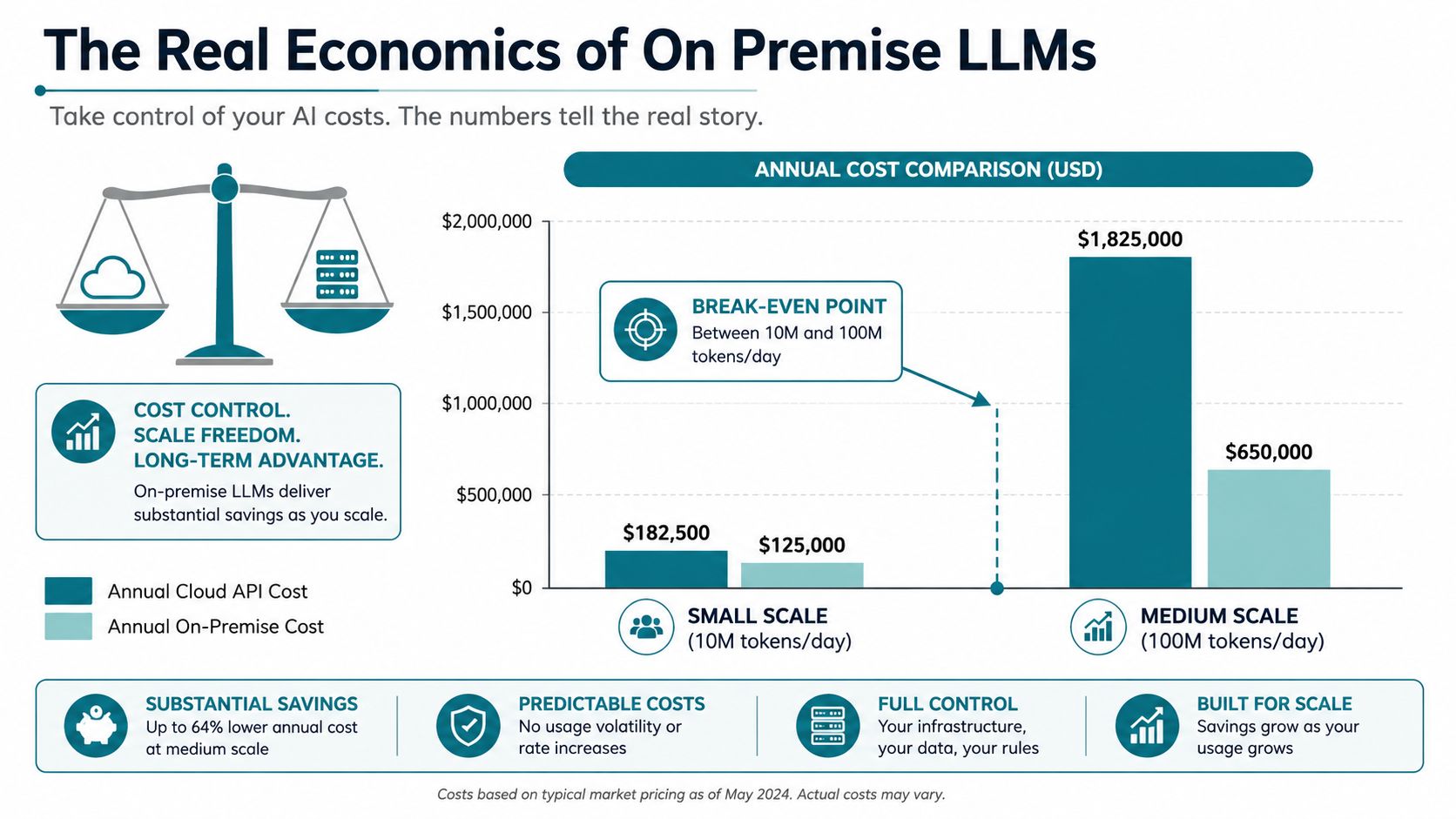
The payback question starts with token volume, not model enthusiasm. Count the input and output tokens generated by the workload you're considering, then separate steady demand from occasional spikes. A private cluster sized for peak demand can sit underused for long periods, while a cluster sized for average demand can create queues when adoption rises.
The available cost-benefit evidence points to a clear pattern. Break-even is typically within a few months for small models, about two years for medium models, and about five years for larger models. The analysis identifies workloads above roughly 50 million tokens per month or those subject to strict data residency requirements as the strongest candidates (academic cost-benefit analysis of on-premise LLM deployment).
Read the payback by workload
For a small company, low volume usually makes cloud the better financial choice. You avoid hardware commitments and let a provider absorb much of the serving complexity. On premise may still be justified, but then the business case is primarily about residency, contractual restrictions, or a product requirement that cannot tolerate external processing.
For a larger organization, aggregation changes the equation. Multiple teams may generate enough recurring inference traffic to keep infrastructure useful across applications. Internal knowledge search, document processing, support automation, and compliance workflows can share a model-serving platform if their security and quality requirements are compatible.
The model itself matters just as much as traffic. A small model can reach payback quickly because the infrastructure commitment is lower. Larger models require stronger utilization and a clearer reason to operate them privately. If the model's capability advantage matters more than control, a hosted frontier model may remain the better option.
Include the costs that spreadsheets hide
Your estimate should include:
- GPU capacity: Purchase, lease, or reserved capacity, including headroom for maintenance and demand changes.
- Power and facilities: Electricity, cooling, rack space, networking, and physical access controls.
- People: Platform engineering, security review, model evaluation, data pipeline maintenance, and incident response.
- Serving software: Runtime support, orchestration, model registry, deployment automation, and integration work.
- Quality operations: Evaluation datasets, regression testing, drift detection, retrieval monitoring, and release gates.
- Idle capacity: GPUs that remain available for reliability or bursts still carry a cost when they aren't generating tokens.
Use a simple comparison model that separates fixed infrastructure from variable usage. Then run it against conservative, expected, and high-volume scenarios. Don't claim savings until your assumptions include the people and systems required to keep the model dependable.
A financial model can help organize this work. Use an AI ROI calculator to structure the inputs, then validate those inputs against actual request logs rather than forecasts alone.
The best on-prem business case is usually a high-volume workload with a strict boundary requirement. One of those conditions can justify the investment. Both make the decision considerably stronger.
Inside the Stack That Makes an On Premise LLM Work
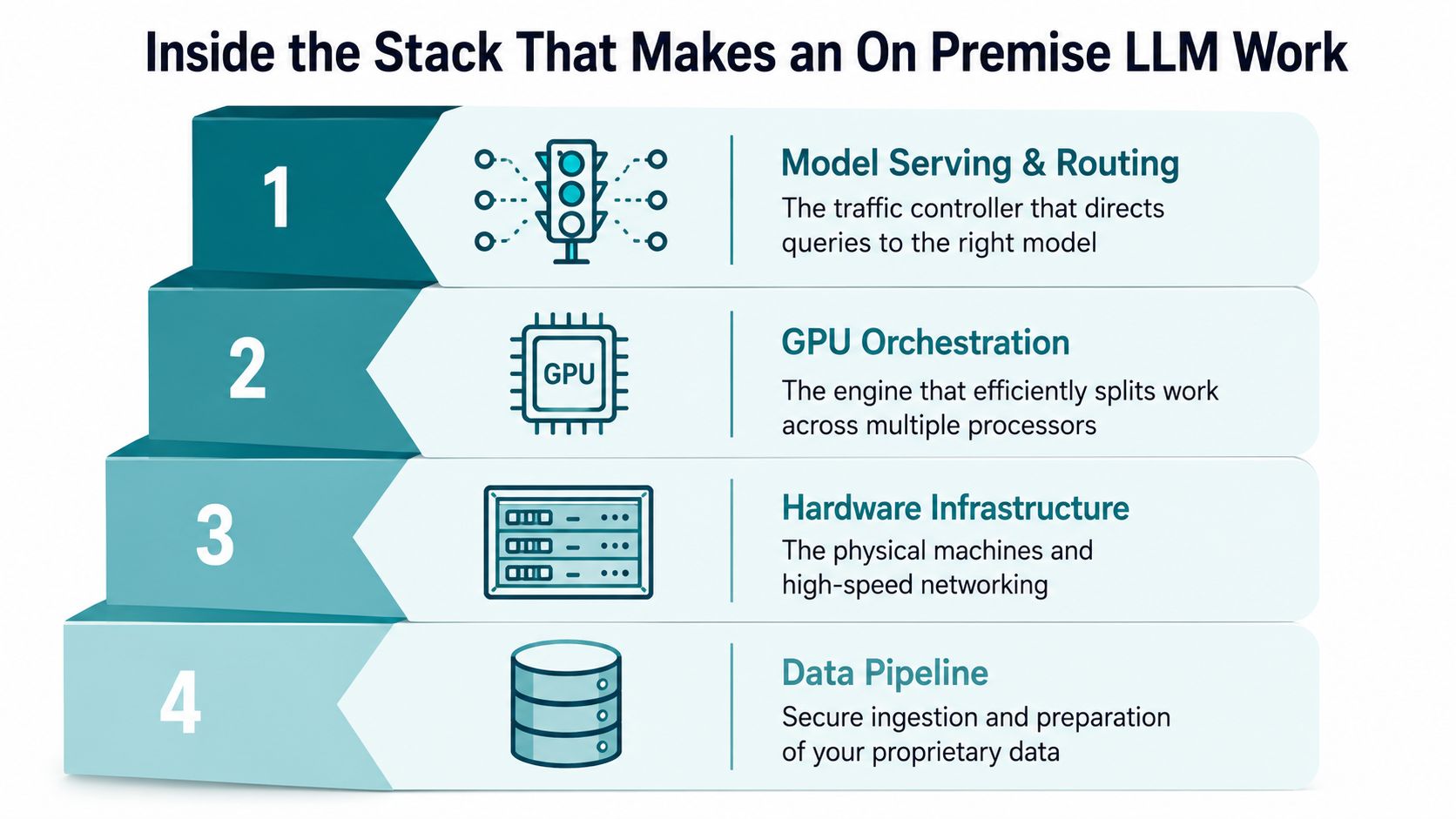
A production private model has several layers, and each layer creates a responsibility that someone must own. The business leader doesn't need to configure GPU kernels, but they do need to understand what the team is agreeing to operate.
Model serving and routing
The serving layer loads model weights and exposes an internal inference endpoint. Tools such as vLLM, SGLang, Triton, and Text Generation Inference can serve different deployment needs, but the choice should follow operational requirements rather than community popularity.
A gateway should sit in front of the runtime. It can authenticate users, enforce quotas, apply prompt and output limits, record audit events, and route requests to different models. Routing also supports hybrid architectures, where policy determines whether a request stays inside the private environment or goes to an approved external service.
GPU infrastructure and capacity planning
GPUs provide the main inference capacity, but hardware selection is only one part of the design. Teams must plan for concurrency, context length, memory requirements, model loading time, networking, storage, maintenance windows, and failure recovery.
Capacity planning should begin with the workload's response-time target and traffic shape. A model that performs well for interactive requests may behave differently under document batches or long retrieval contexts. Benchmark representative prompts, not just synthetic tests.
Retrieval and proprietary data
If the application uses internal documents, the data pipeline becomes part of the LLM platform. It may include parsing, cleaning, chunking, embeddings, a vector database, metadata filters, reranking, permissions, and refresh workflows.
Keep those components inside the same control boundary when the data requirement demands it. The RAG pipeline architecture guide provides useful context for connecting retrieval to a private model without treating the model endpoint as the entire system.
Evaluation and observability
Monitoring only GPU utilization won't tell you whether answers remain useful. Track latency, queue behavior, throughput, retrieval quality, refusal behavior, factuality against approved references, and changes in user feedback.
Llama 3.1 marked an important shift in model viability. An industry whitepaper described it as reaching performance parity with leading commercial models on many benchmark tests, including MMLU, which helped make self-hosted models more credible for enterprise use (on-premise LLM deployment statistics and model-quality analysis).
That quality milestone removes one historical objection, but it doesn't remove operational ownership. Your team still needs release gates, rollback procedures, access control, and an on-call path.
Compliance, Security, and the Limits of On Premise Safety
On premise reduces certain data-transfer risks. It doesn't secure an LLM by itself.
A private deployment can help when regulations, contracts, or internal policy require sensitive data to remain within a defined environment. It's especially relevant for workloads involving regulated personal information, privileged material, proprietary research, or air-gapped systems. In those cases, the physical and logical boundary may be part of the compliance requirement.
But the model can still expose data through weak access controls, excessive logs, insecure retrieval, compromised dependencies, or poorly governed administrators. A server room doesn't prevent prompt injection, unauthorized model access, unsafe tool calls, or incorrect answers.
Define what “private” must mean
Ask your compliance team to specify the required boundary:
- Prompt privacy: Can prompts and outputs leave the organization's environment?
- Operational privacy: Can a provider see usage patterns, identities, timing, or logs?
- Retrieval privacy: Do embeddings, vector records, source documents, and retrieval logs stay inside the boundary?
- Administrative control: Who can update weights, change prompts, inspect logs, or access the serving cluster?
These requirements lead to different architectures. A workload may need private data ingress without requiring a fully isolated model operation layer. Another may require control over both the model and the retrieval store.
Build the evidence, not just the perimeter
Compliance reviewers will want more than a network diagram. Prepare model documentation, approved-use boundaries, access logs, encryption controls, retention rules, incident procedures, vendor records for model components, and evaluation evidence.
Security boundary: On premise is a control choice. Security comes from the controls you implement around that choice.
Encrypt data at rest and in transit. Use enterprise identity rather than shared credentials. Restrict administrative access. Monitor retrieval and tool activity. Test upgrades in a controlled environment before promotion. The AI security best-practices guide can support a broader review of these controls.
The right question isn't “Is on premise safer?” Ask, “Which risk does private deployment reduce, and which risks remain our responsibility?”
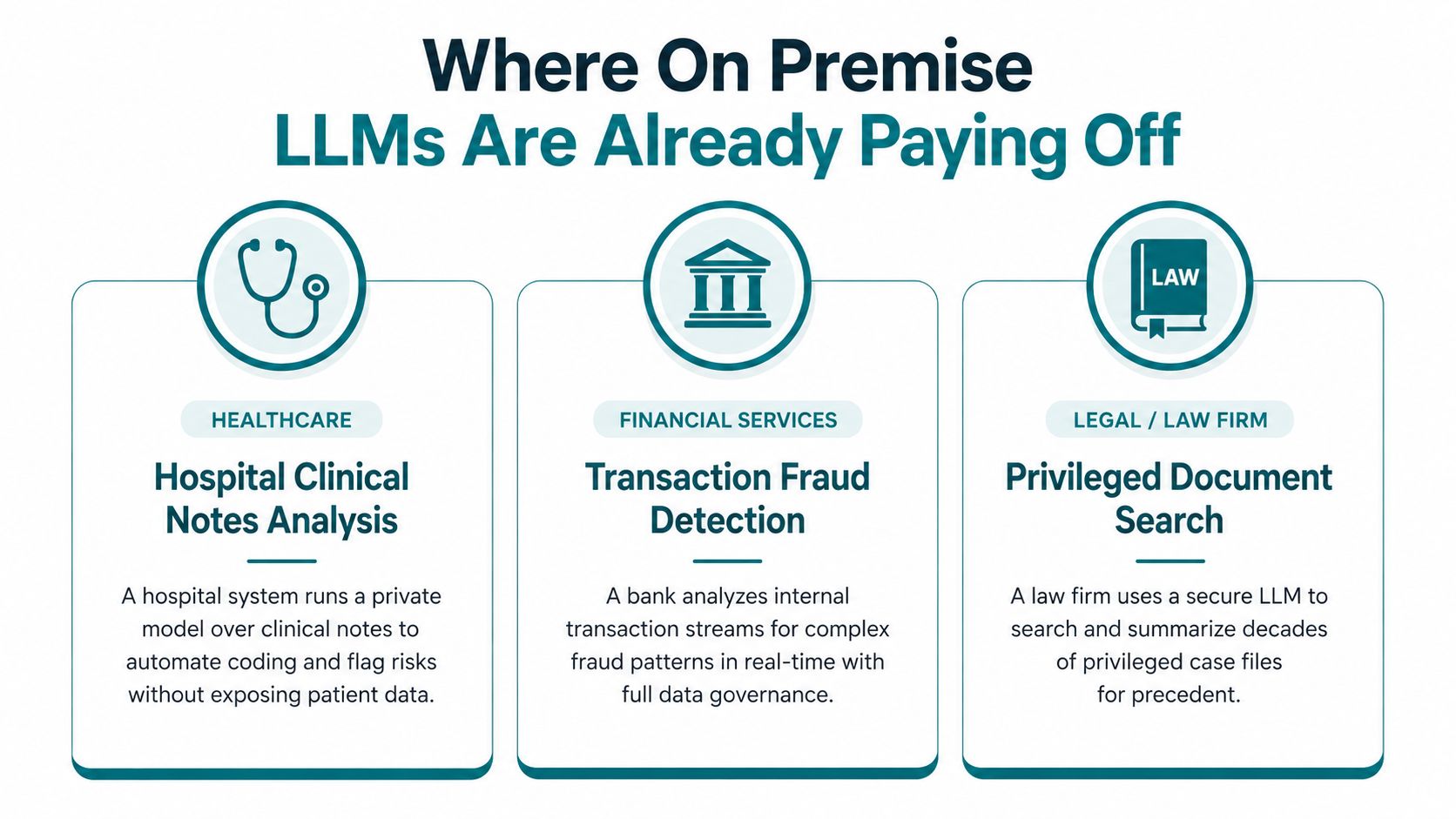
Where On Premise LLMs Are Already Paying Off
The strongest applications share a common pattern: the data is sensitive, the workflow is repetitive, and the organization can measure the value of faster or more controlled processing.
Healthcare
A hospital system may run a private model over clinical notes to support coding, summarization, or risk review without sending patient information to an external model endpoint. The justification isn't a vague desire for privacy. It's the need to keep protected information within a governed environment while improving a defined clinical or administrative workflow.
The deployment still needs role-based access, source attribution, evaluation by task, and careful separation between assistance and clinical decision-making. Retrieval permissions matter because a user authorized to search one department's records shouldn't automatically access another department's corpus.
Financial services and insurance
A bank or insurer can use a private model to process claims, know-your-business documents, policy manuals, or internal transaction context. Retrieval connects the model to approved procedures and documentation, while local serving keeps sensitive records and operational patterns under organizational control.
The economic case strengthens when the workflow runs continuously and across multiple teams. It weakens when demand is sporadic or when the workload needs the newest hosted model capabilities more than it needs a private boundary.
Legal
Law firms handle privileged contracts, case files, correspondence, and research. A private LLM can help search and summarize that material without placing the text in a third-party processing environment. The model should cite source passages, preserve document permissions, and make uncertainty visible.
Manufacturing and retail
Manufacturers can apply private models to maintenance records, quality documentation, work instructions, and internal support. Retail operators can use them for store operations, inventory guidance, and internal knowledge search. These use cases often benefit from local retrieval because the value comes from connecting the model to proprietary documents, not from generic conversation alone.
A good deployment starts with one workflow and one measurable outcome, such as review time, processing throughput, search usefulness, or policy adherence. Don't deploy a general assistant before proving that a bounded workflow creates value.
A Phased Roadmap From Pilot to Production
Reliable private AI comes from sequencing decisions. Teams get into trouble when they buy hardware before defining the workload, or launch a chatbot before creating evaluation and monitoring practices.
Assess the workload before buying capacity
Start with an inventory of data classes, users, request patterns, model tasks, and retention requirements. Estimate token volume from real application logs where possible. Identify whether the primary driver is cost, residency, latency, intellectual property, or operational control.
Then write a deployment boundary in plain language. Specify which prompts, documents, embeddings, logs, and outputs may leave the environment. If the answer is unclear, the architecture isn't ready for procurement.
Pilot one valuable workflow
Choose a use case with a clear owner and a measurable success criterion. A document review workflow, internal policy search tool, or structured extraction process is easier to evaluate than an open-ended enterprise chatbot.
Keep the pilot narrow. Use a limited model and a small infrastructure footprint, then compare quality, latency, operating effort, and user adoption against the existing process. A pilot should produce a decision, not become a permanent ungoverned system.
Harden before broad access
Production readiness requires more than a successful demo. Add:
- Evaluation gates: Test representative queries whenever weights, prompts, retrieval logic, or source data changes.
- Observability: Monitor token throughput, latency, queue depth, GPU health, retrieval behavior, and error patterns.
- Security controls: Integrate identity, quotas, audit logs, encryption, and network restrictions.
- Drift detection: Watch for changes in document formats, user behavior, retrieval results, and answer quality.
- Runbooks: Define who responds to capacity failures, bad releases, data-access issues, and model regressions.
A production analysis cited 67% of enterprises as having deployed LLMs in some capacity, while fewer than 30% had systems that reliably performed in production (analysis of the production gap for local LLMs). The gap is operational. Experimentation proves that a model can respond. Production proves that it remains useful, secure, observable, and supportable.
Scale by workload, not enthusiasm
Once the pilot is stable, add use cases through routing and shared controls. Plan capacity around concurrency and failure tolerance. Decide whether to purchase, lease, or contract GPU capacity based on utilization and refresh requirements.
Don't scale user access faster than the evaluation and incident process can support. Adoption without operational discipline creates a support queue disguised as AI progress.
Your On Premise LLM Decision Checklist and Next Steps
Use this checklist before approving an on premise LLM program:
- Token volume: Do you have sustained usage that could support private infrastructure?
- Data residency: Does a specific workload require prompts, retrieval data, or model operation to remain inside your boundary?
- Model fit: Does an available open-weight model meet the quality and context requirements?
- Operational maturity: Can your team own serving, monitoring, evaluation, upgrades, and incidents?
- Business outcome: Can you measure cost, throughput, accuracy, risk reduction, or revenue impact?
- Fallback plan: Can you route less sensitive or bursty workloads to a cloud service?
Founders exploring the option should begin with a token-volume audit across current workflows. Early-stage SaaS teams should pair that audit with a security and residency review before deciding whether private infrastructure belongs in the product roadmap. Growth-stage operations leaders evaluating AI repatriation should select one workload, document its cloud cost and risk profile, and run a scoped pilot with a measurable KPI.
The decision is ultimately about money and maturity. If volume is low and restrictions are light, cloud usually wins. If data residency is mandatory or usage is sustained, on premise may pay back. If your team can't operate the platform, hybrid may deliver the required control with less organizational drag.
AmasaTech helps organizations assess AI readiness, design private LLM applications, build RAG pipelines and AI agents, and connect deployment decisions to measurable KPIs such as accuracy, throughput, cost, or revenue impact. Visit AmasaTech to discuss your workload, data boundary, token-volume audit, and path from pilot to reliable production.