
You're probably here because a clinical leader, product manager, or compliance officer just asked the same question in a meeting, and the answer can't be “the vendor said it's fine.” That's how healthcare teams end up wiring a chatbot into patient notes, claims, or call-center transcripts and discovering too late that HIPAA compliant AI is not a product sticker, it's an operating state you have to prove.
What HIPAA Compliant AI Actually Means in 2026
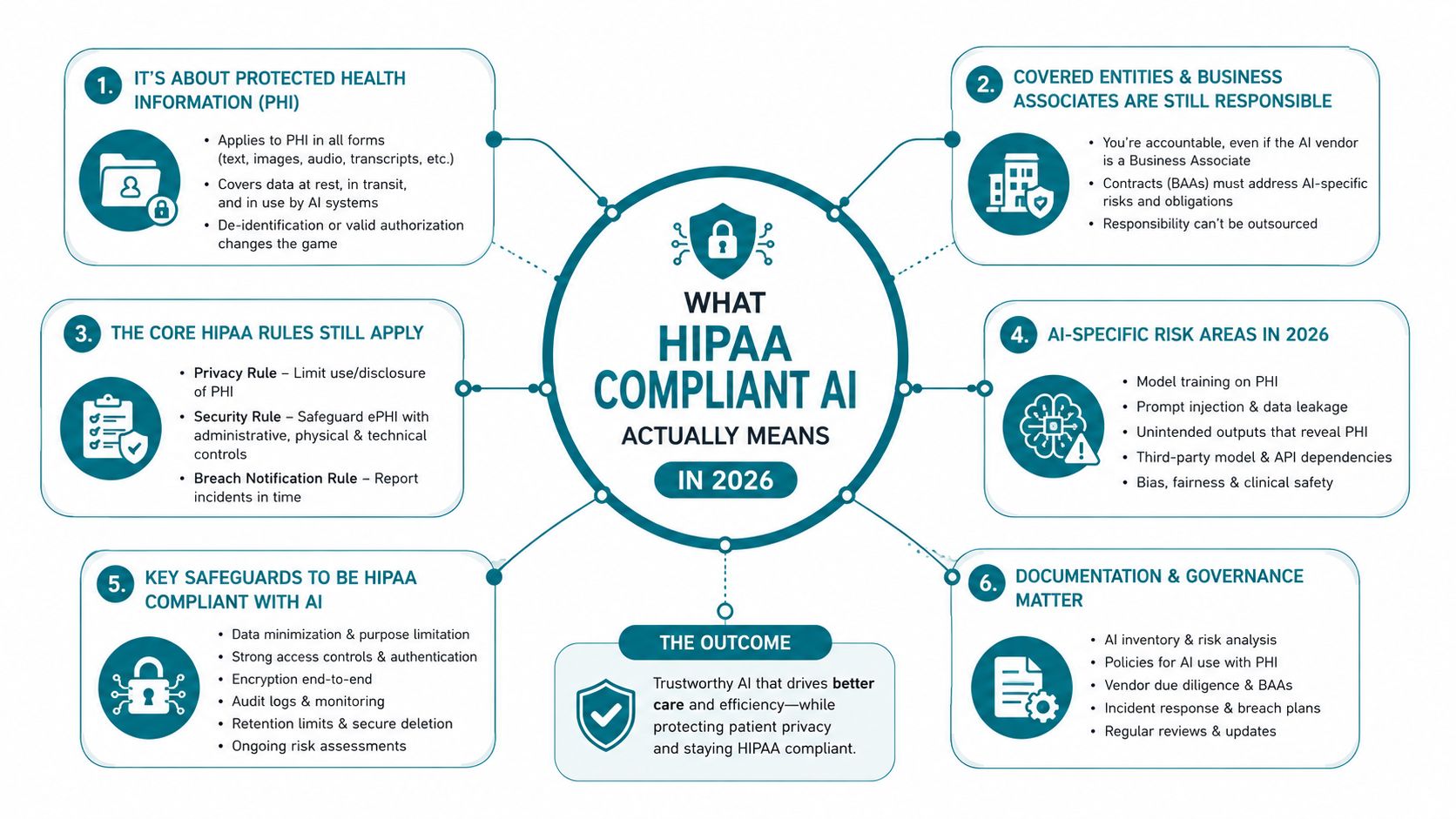
A vendor can say its model is “HIPAA ready,” “HIPAA safe,” or even “HIPAA certified,” but that language doesn't change the law. There is no formal HIPAA certification for AI software, and HHS does not recognize one, so the only question that matters is whether your deployment satisfies the administrative, technical, and physical safeguards required when protected health information is involved. That's why consumer AI tools can be useful in healthcare workflows and still be the wrong choice the moment PHI enters the prompt, log, embedding store, or fine-tuning set.
The clean way to think about it is simple. A covered entity, like a provider or health plan, and a business associate, like a vendor handling PHI on its behalf, each carry obligations that can't be outsourced to marketing copy. If the AI system touches PHI, you need a valid BAA, but you also need governance at the workflow level, because the model alone doesn't make the environment compliant. For a useful operating lens on that governance layer, see AI governance best practices.
| Role | Example | Core HIPAA Obligation |
|---|---|---|
| Covered Entity | Hospital, physician group, insurer | Protect PHI, enforce safeguards, oversee vendors |
| Business Associate | AI vendor processing PHI on behalf of the entity | Sign a BAA, secure PHI, follow contract terms |
| Subcontractor | Downstream service provider used by the AI vendor | Accept the same protections through the chain |
Practical rule: if you can't trace where PHI enters, where it's stored, who can access it, and where it leaves, you don't have a compliant AI workflow yet.
The five things founders need most are straightforward. First, the control stack. Second, the architecture patterns that keep PHI contained. Third, how BAAs work. Fourth, how to score vendors without getting fooled by compliance theater. Fifth, how to move from audit to pilot to production without guessing.
The Regulatory Scope and the Myth of HIPAA Certification
HIPAA compliance isn't one rule, it's a stack. The Privacy Rule governs use and disclosure, the Security Rule governs safeguards for ePHI, the Breach Notification Rule governs what happens when something goes wrong, and enforcement sits with HHS OCR, with state attorneys general also able to matter when privacy failures spill into their lane. If your AI workflow crosses these boundaries, the legal exposure doesn't come from the model's capability, it comes from how the system handles regulated data.
The biggest mistake I see is teams treating compliance like a badge. They ask whether the AI tool is certified, and the answer should be bluntly, there is no HIPAA certification for AI software. A vendor can be technically advanced and still be unsuitable for PHI if it won't sign a BAA, retains prompts for training, or pushes logs into systems your organization can't govern.
What matters operationally is where the regulated data lives. If a general-purpose assistant is used to draft a scheduling email, that's one thing. If the same assistant reads a patient record, a claim, or a support transcript with PHI, the use case changes immediately, and so do the controls. That's why governance belongs in the workflow, not in the product brochure.
A mature program treats this as an accountability problem, not a procurement slogan. The covered entity or business associate has to maintain the safeguards, choose vendors that will contractually support the use case, and prove the controls hold in practice. The vendor's label doesn't do that work for you. For a clinical-adjacent example of how AI programs get scoped in regulated environments, see AI in clinical trials.
A compliant contract with an ungoverned workflow is still a bad deployment.
Mapping the 18 HIPAA Identifiers to AI Pipelines
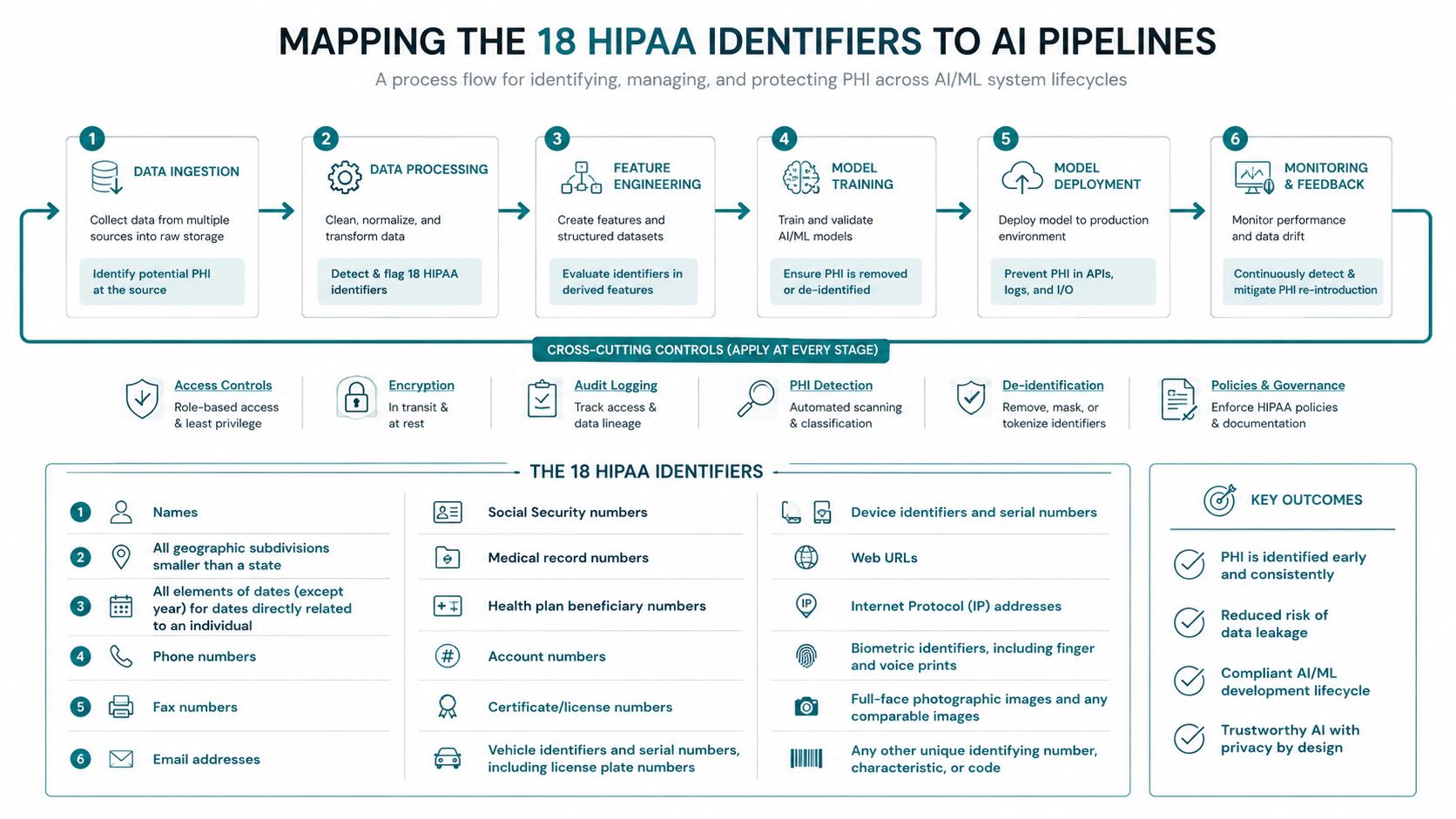
PHI doesn't disappear because a model is “secure.” It can enter through source records, prompts, vector stores, model outputs, embeddings, and even retention logs. The 18 HIPAA identifiers define the boundary, and if any dataset contains them, you have to treat it as PHI from ingestion through inference, not only at the application layer. That means de-identification has to happen before training, not after the model has already seen the data.
Where the identifiers actually leak
Names and dates are obvious, but they're not the whole story. Smaller geographic units, phone numbers, email addresses, biometric identifiers, and the rest of the 18-identifier set can show up in prompts and retrieval context long after an intake system has cleaned the original record. If your team fine-tunes on raw support tickets or drops chart text into a retrieval system without redaction, you've just moved the PHI problem, not solved it.
The engineering mistake is thinking the app layer is the only layer that matters. It isn't. Controls have to span the data lake, training cluster, embedding store, inference endpoint, and logs, because every one of those places can become a disclosure point if identifiers are left in place.
The pipeline rule founders should enforce
Start with a hard rule, then build around it. If data contains PHI, it does not enter model training until it has been de-identified to the degree your use case allows. If the use case needs runtime access to PHI, that access needs to be narrowly scoped, logged, and isolated. If the use case doesn't need PHI, strip it before the model ever sees it.
The practical payoff is clear. Teams that map identifiers early can choose safer patterns like redacted RAG, synthetic training data, or narrowly scoped inference, instead of discovering during audit that the model has been trained on regulated text. For a retrieval-focused implementation view, RAG pipeline design is the right place to align the architecture with the data boundary.
| Pipeline Stage | PHI Risk | Control to Apply |
|---|---|---|
| Data ingestion | Raw identifiers enter the system | De-identify before storage or training |
| Prompt construction | Users paste PHI into queries | Redaction, access scoping, input filtering |
| Embedding generation | Identifiers get encoded into vectors | Minimize source text, isolate storage |
| Inference logging | PHI lands in traces and audit trails | Immutable logs with restricted access |
| Fine-tuning | PHI becomes part of training corpora | Remove identifiers before training begins |
Technical Controls That Hold Under Audit
Auditors don't care that your model is clever. They care whether your environment protects ePHI under the Security Rule. The baseline controls are consistent across the serious implementations: AES-256 at rest, TLS 1.2 or 1.3 in transit, HSM- or KMS-backed key management, RBAC, MFA, and immutable audit logs. If model servers, vector databases, or inference logs store PHI without those safeguards, you've got a material disclosure problem, not a theoretical one.
Encryption and access are the floor
Encryption isn't optional decoration. Data at rest has to be protected, data in motion has to be protected, and the keys have to be managed in a way that doesn't collapse the whole design. That's why KMS or HSM-backed controls matter so much, because the lock is only useful if the key isn't sitting beside it.
Access controls need the same discipline. RBAC and MFA aren't admin preferences, they're the minimum way to make sure a scheduling workflow, a nurse workflow, and a model-admin workflow don't share the same level of access. If everyone can query everything, your “AI assistant” is just a faster way to expose PHI.
The evidence an auditor will ask for
The right control is only half the job. You also need evidence. That means logs that show who accessed what, when, and from where, plus proof the logs are tamper-resistant and reviewable. It also means the AI system is explicitly included in the risk analysis, not hidden inside a generic cloud assessment.
Recent compliance guidance also expects the system to be tested, not just documented. That includes biannual vulnerability scans and annual penetration tests, plus ongoing vulnerability management. If your AI layer sits outside those testing cycles, the auditor will notice.
| Control | AI Risk Mitigated | Audit Evidence |
|---|---|---|
| AES-256 at rest | Data theft from storage layers | Storage config, encryption policy, key records |
| TLS 1.2 or 1.3 in transit | Interception between components | Network policy, endpoint verification |
| KMS or HSM key management | Key compromise | Key ownership, rotation, access logs |
| RBAC | Overbroad model or user access | Role matrix, access reviews |
| MFA | Credential abuse | Identity policy, auth logs |
| Immutable audit logs | Hidden PHI access | SIEM exports, retention policy |
| Risk analysis inclusion | Unreviewed AI exposure | Signed risk assessment, remediation plan |
AI security best practices is the right companion view if your team is turning this into a build checklist.
Architecture Patterns for AI That Touches PHI
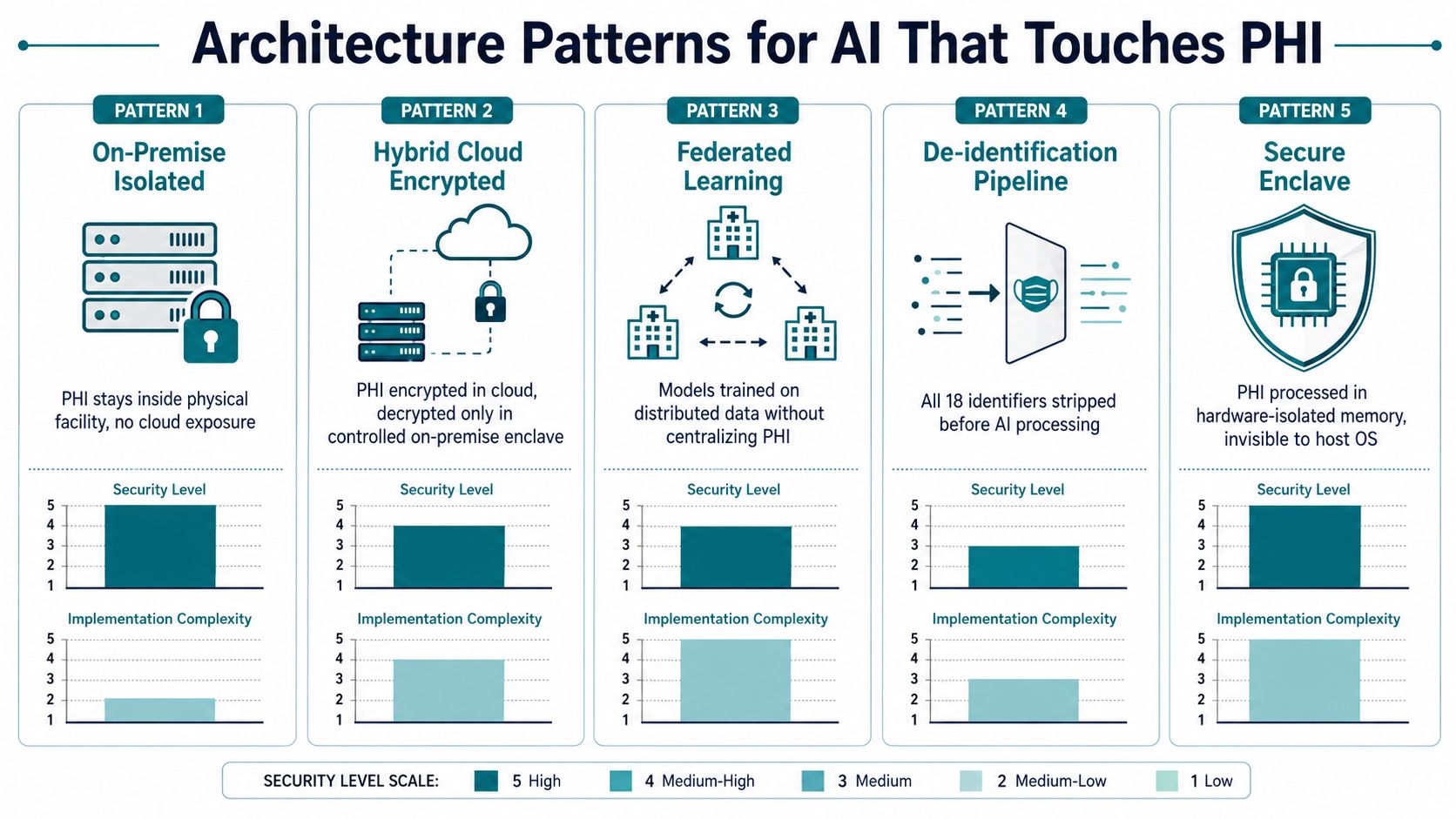
The architecture matters because controls behave differently depending on where PHI lives. I've seen teams overbuild the model and underbuild the perimeter, which is backwards. For HIPAA compliant AI, the safest pattern is the one that keeps PHI closest to the smallest possible trust boundary, then uses redaction and isolation to narrow exposure further.
Isolated deployment beats shared convenience
An isolated VPC with private endpoints is the first serious option because it reduces the blast radius. It's not the cheapest path, and it does add networking work, but it keeps PHI traffic away from the public edge. If you're dealing with live patient data, that trade-off is usually worth it.
RAG with PHI redaction at ingest and query time is the next practical pattern. It lets you keep source data useful while stripping identifiers before the model sees them, which lowers compliance risk without forcing a full retrain every time the corpus changes. The cost is operational complexity, because the redaction layer has to be reliable at both ends.
Per-tenant vector store isolation is a good fit for multi-client products. It's cleaner than shared retrieval, but it can raise storage and maintenance overhead, and it only works if tenant boundaries are enforced everywhere, not just in the UI. If one tenant can see another tenant's retrieval traces, the design failed.
When to use private models or synthetic data
Model deployment behind customer-managed keys is the better fit when you need strong control over cryptographic boundaries and retention. It won't magically make a weak workflow compliant, but it does provide the security team an advantage when they're validating who can decrypt what. Synthetic data pipelines are useful for training and fine-tuning because they reduce direct PHI exposure, but they're only as good as the fidelity of the synthetic set.
For teams deciding whether to run a private or managed stack, private LLM deployment patterns is the right reference point. AmasaTech is one option in that market for healthcare AI workflows that need EHR integration and HIPAA-aware implementation, but the core decision should still be architectural, not brand-driven.
| Pattern | Main Advantage | Main Trade-off |
|---|---|---|
| Isolated VPC with private endpoints | Stronger network containment | More infrastructure overhead |
| RAG with PHI redaction | Good balance of utility and control | Redaction must be reliable |
| Per-tenant vector stores | Cleaner tenant separation | More storage and ops work |
| Customer-managed keys | Better control over decryption | Higher key-management burden |
| Synthetic data for training | Lowers direct PHI exposure | May reduce realism |
The BAA Is a Starting Point Not the Finish Line
A Business Associate Agreement is necessary, but it's not enough. It creates the contractual obligation for the vendor to safeguard PHI, yet auditors still look at the actual system, including where PHI enters, how inference is isolated, where logs go, and whether downstream subcontractors are covered. A signed BAA without architectural discipline is a paper shield.
What the contract covers, and what it doesn't
The BAA should name the services you're using, define breach responsibilities, and bind the vendor's subcontractors to the same obligations. It should also address whether PHI can be used for model training, because that is one of the fastest ways to create avoidable risk. If the vendor won't sign a BAA for the service you want, stop there.
What the BAA does not do is repair a bad deployment. If PHI can leak into general logs, if inference isn't isolated, or if subcontractors aren't in scope, the contract doesn't save you. Compliance is still determined by the architecture and the operating controls around it.
The evidence trail auditors actually review
The cleanest programs maintain a simple chain of proof. They can show the PHI entry points, the inference boundary, the SIEM integration, the retention rules for logs, and the names of any subprocessors that touch the workflow. That evidence trail matters because “we had a BAA” is not a complete answer during review.
If the vendor contract says one thing and the workflow does another, the workflow wins.
For founders, the operational checklist is short. Confirm the specific AI service is named in the BAA, confirm subcontractors are covered, confirm PHI doesn't flow into uncontrolled logging, and confirm security has visibility into the events your compliance team will ask about later.
Vendor Evaluation Criteria Tuned for Founders and Ops Leaders
Vendors should be scored on what they will support in production, not on how polished the demo feels. The first question is whether they will sign a BAA for the exact service you plan to use. If they won't, the rest of the conversation is academic.
What to ask in the sales call
Ask how they handle de-identification, whether audit logs can be exported, and whether model boundaries are isolated from general training. Ask which subprocessors touch PHI, how incident notification works, and what happens to your data at termination. Those questions force the vendor to talk about operations instead of slogans.
A second filter is technical transparency. You want to know where encryption is enforced, how key ownership works, and whether logs can land in your SIEM. You also want a straight answer on data retention, because AI products often become compliance problems long after the pilot if old prompts and outputs keep piling up.
For a founder, the red flags are easy to spot. “We're HIPAA compliant by design” is weak. “We're compliant because we signed a BAA” is weaker. If the vendor can't explain the workflow controls, they're selling assurance, not infrastructure.
| Evaluation Area | What Good Looks Like | Red Flag |
|---|---|---|
| BAA willingness | Signs for the exact service | Only signs vague enterprise terms |
| De-identification | Built-in redaction and minimization | Leaves redaction to the customer |
| Encryption posture | Clear at-rest and in-transit controls | Hand-wavy security claims |
| Audit logs | Exportable, immutable, SIEM-ready | Limited or inaccessible logs |
| Model isolation | PHI excluded from general training | Training use left ambiguous |
| Subprocessors | Transparent list and flow-down terms | Downstream vendors are hidden |
| Contract terms | Incident, return, and termination terms defined | Short, generic paperwork |
A Phased Roadmap from AI Audit to Production
Start with a data and AI maturity audit. Inventory every PHI source, every place the data moves, and every workflow where staff already use AI informally. If you don't know where PHI sits today, you can't defend where it goes tomorrow.
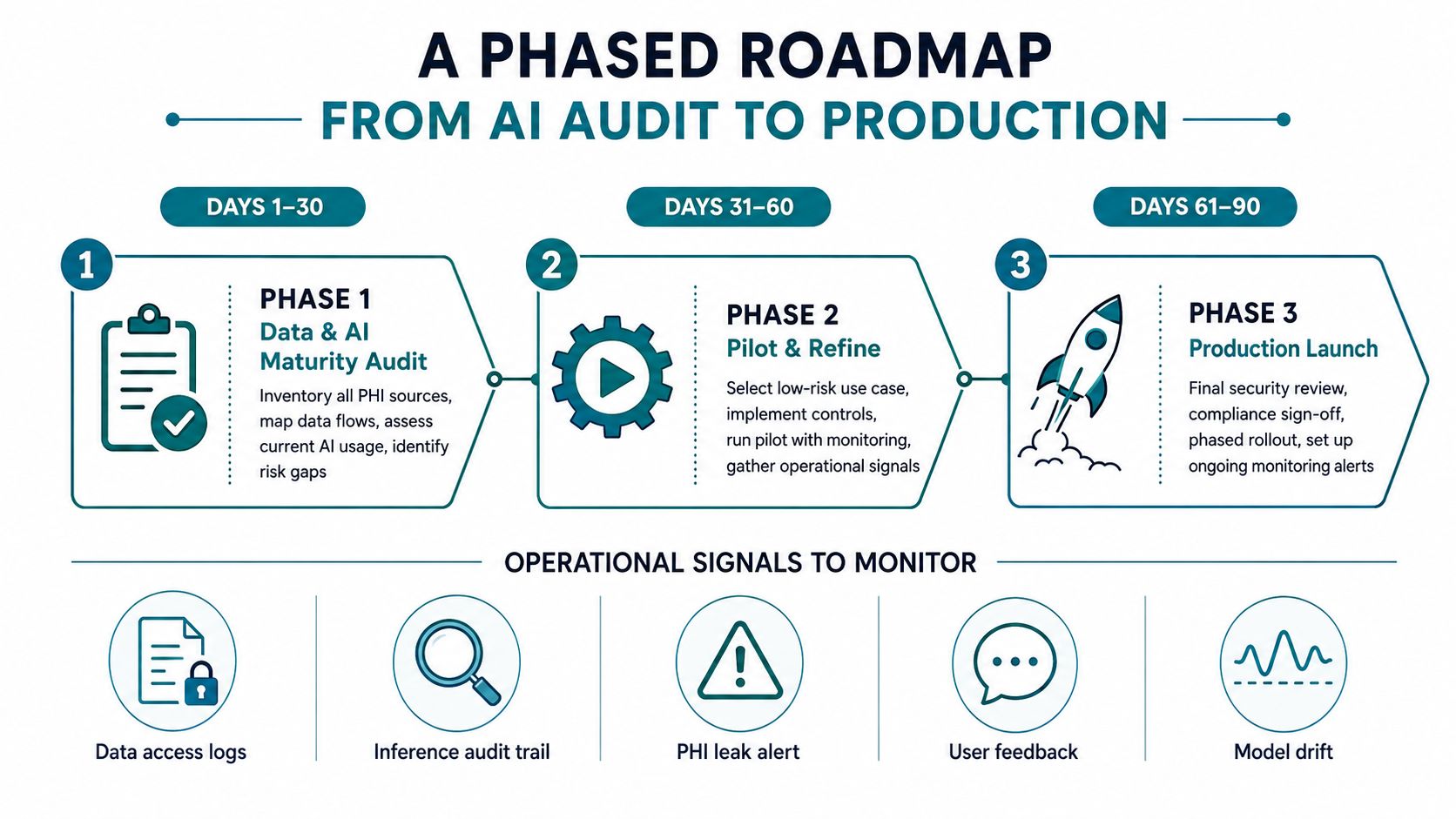
Then pick one low-risk workflow and run it behind the strongest controls you have, usually a redacted internal assistant or RAG system with a signed BAA. Keep the launch narrow, instrumented, and reviewable. The goal isn't to prove you can ship fast, it's to prove you can ship safely.
By day 61 to 90, you should be moving into production discipline. That means drift detection, alerting, incident response runbooks, and a paper trail that shows security and compliance signed off on the environment before users depend on it. The operational signals that matter most are data access logs, inference audit trails, PHI leak alerts, user feedback, and model drift.
| Phase | Focus | Exit Criteria |
|---|---|---|
| Days 1 to 30 | Data and AI maturity audit | PHI inventory complete, risk gaps documented |
| Days 31 to 60 | Pilot and refine | One controlled use case running with monitoring |
| Days 61 to 90 | Production launch | Security review done, alerts and runbooks active |
If you want a partner that starts with an AI audit, builds phased rollouts, and implements healthcare workflows with HIPAA-aware controls, visit AmasaTech and ask for a deployment review tied to your specific PHI workflow.