
You're probably living one of two versions of the same problem right now. Either your team has already built a chatbot and watched it answer a policy question with confidence and no clue, or you're still deciding whether it's worth connecting your private documents to an LLM at all.
That gap is exactly where a RAG pipeline earns its keep. Retrieval-Augmented Generation lets a model fetch relevant internal evidence first, then answer from that evidence instead of relying only on what it memorized during training, which is why it's become the default pattern for knowledge-heavy assistants, internal copilots, and compliance workflows. AmasaTech's overview of AI transparency is a good companion read if you're trying to make these systems easier to explain to stakeholders while still keeping them useful in production: AI transparency practices.
Why Your LLM Keeps Making Things Up
A founder asks for the return policy. The chatbot sounds polished, cites nothing, and gives a policy that never existed. The issue isn't that the model is “bad” in some abstract sense. It's answering from general patterns, not from your actual company documents.
That's the core reason RAG exists. A rag pipeline gives the model a way to read your own source material at answer time, so the response is grounded in retrieved evidence instead of a guess from pretraining. In practice, that makes the difference between a demo that sounds smart and a system that can support real customer support, internal policy lookups, and regulated knowledge work.
What changes when the model can read your documents
The benefit is simple to explain and hard to overstate. When a user asks about a refund window, a benefits rule, or an internal process, the system pulls the relevant policy or document excerpt first, then asks the LLM to answer using that context. The model still generates the final wording, but it's no longer improvising from memory alone.
Practical rule: if the answer has to match a specific document version, don't let the model answer without retrieving that document first.
That matters most in knowledge-heavy Q&A, internal copilots, compliance lookups, and customer support where accuracy depends on private data. It also helps when the source of truth changes often, because you can update the underlying document set without retraining the model. A well-designed RAG system becomes a controlled interface to your own knowledge base, not a second brain making things up behind the scenes.
The main mindset shift is this. A raw LLM tries to be helpful from general language patterns. A RAG pipeline tries to be helpful by looking up the right evidence before speaking. That's why teams use it when hallucination risk is expensive, embarrassing, or legally dangerous.
How a RAG Pipeline Actually Works
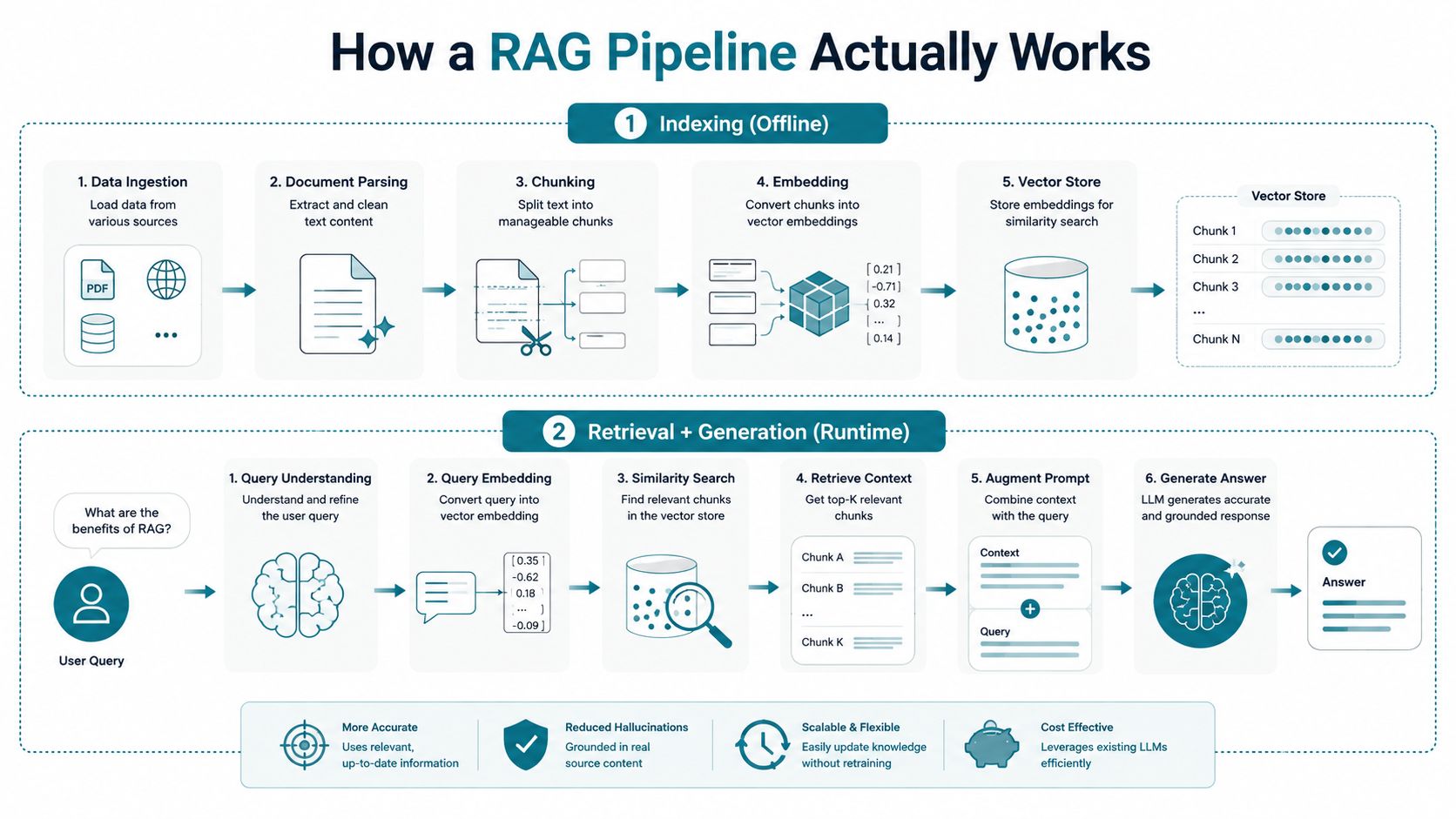
A production rag pipeline usually behaves like two separate systems that happen to meet at answer time. The first is offline indexing, where documents are cleaned, split, embedded, and stored. The second is online inference, where a live question is embedded, relevant chunks are retrieved, and the LLM generates the final answer from that context.
The simplest way to think about it is a library with a front desk. The library staff catalog books in the back room. The front desk then finds the right books quickly when a visitor walks in. Indexing is the back room, query-time retrieval is the front desk.
The offline path
Offline indexing is where your documents become searchable. A document processor cleans the text, a chunker breaks it into manageable pieces, an embedder turns each piece into vectors, and a vector store keeps those vectors ready for search. Because this part is batchable, you can recompute it when content changes, when your chunking strategy improves, or when you switch embedding models.
The online path
At query time, the system must stay fast and predictable. The user question gets embedded, the retriever pulls top candidates, a reranker may reorder them, and the selected context is injected into the prompt for generation. That separation matters because retrieval quality and latency are now part of the product experience, not just the infrastructure layer. AmasaTech's write-up on generative AI workflows is useful if you want to see how this retrieval step fits into broader production automation: generative AI workflows.
Three operational truths follow from this split. Indexing can be recomputed, query-time retrieval can't be sloppy, and the final answer is only as good as the evidence that made it through retrieval. If the wrong document gets selected, the generator usually won't save you.
The Core Components and the Trade-Offs Between Them
Every rag pipeline is a chain of design decisions. Each component solves a specific problem, and each one creates a trade-off that shows up later in answer quality, latency, or maintenance effort. The fast way to get confused is to treat “RAG” like a single feature. It isn't. It's a set of interlocking choices.
Start with the chunker
Chunking decides how your source material is sliced before embedding. Production guidance usually converges on semantic or section-aware chunking, with common windows around 512 to 1024 tokens and roughly 10 to 20% overlap for context carryover. Smaller chunks improve retrieval granularity, but they can lose surrounding meaning. Larger chunks preserve context, but they raise embedding cost and can dilute precision.
| Chunking Strategy Trade-Offs at a Glance | |||
|---|---|---|---|
| Strategy | Best For | Typical Chunk Size | Main Trade-Off |
| Fixed-size | Fast baselines, simple docs | Around 512 to 1024 tokens | Easy to implement, but may cut ideas in awkward places |
| Semantic | Dense prose, policy text, technical docs | Varies by topic boundaries | Better coherence, more processing effort |
| Section-aware | Manuals, handbooks, structured content | Often aligned to headings | Strong structure, but depends on clean document formatting |
| Large chunks with overlap | Broad context, fewer boundary losses | Toward the upper end of the range | More context, but more embedding cost and noisier retrieval |
A good first move is to tune chunk size and overlap before touching anything else. If retrieval is missing the right evidence, chunking is often the reason.
Then choose the embedding model and retrieval path
The embedder turns text into vectors that can be compared quickly. Your choice here should reflect domain fit and cost, not just generic benchmark popularity. A vector database stores those embeddings and supports approximate nearest-neighbor search, metadata filtering, and, in some setups, hybrid search that combines lexical and semantic signals.
The retriever is the part that decides what evidence gets shown to the model. Dense retrieval helps with meaning-based matching. Sparse retrieval helps when exact terms matter. Hybrid retrieval is often the practical compromise for enterprise text because users don't always phrase things the way the source documents do.
Add reranking only when it pays for itself
Reranking is a precision layer. A cross-encoder compares the query and each candidate more carefully than a plain embedding search does, but it costs more latency. LLM-based reranking can be useful when the task needs reasoning over candidates, though it adds even more overhead. That means reranking is worth it when your shortlist is noisy and answer quality justifies the extra step.
The prompt template and generator sit at the end of the chain. The prompt has to budget context carefully, tell the model how to cite sources, and avoid stuffing in too much irrelevant text. If the prompt is bloated, even a good retriever can't rescue the result. The generator only works well when the upstream pieces have already done their jobs.
Design principle: fix retrieval before you chase generation tricks. Most “bad answers” start as “bad evidence selection.”
Choosing Your Vector Store, Orchestrator, and Reranker
The tool question is less about a winner and more about fit. Some teams need maximal control. Others want managed infrastructure because the first production use case matters more than the architecture purity. The wrong choice is usually the one that forces your engineers to spend weeks on plumbing before they've proven that the use case works.
Vector stores and orchestration frameworks
For vector databases, open-source options like FAISS, Milvus, Weaviate, and Qdrant appeal to teams that want control over deployment and indexing behavior. Managed services like Pinecone, Vertex AI Vector Search, and Azure AI Search reduce operational burden. Chroma often shows up in prototypes because it's lightweight and easy to move quickly with.
Orchestration sits in a different category. LangChain, LlamaIndex, and Haystack give you different levels of opinionated structure, while a from-scratch pipeline gives you the most control and the most maintenance responsibility. If your organization already has strict platform standards or data boundaries, that control can be valuable. If your goal is to validate a customer-facing use case, the fastest path is often the one with the least framework overhead.
Rerankers and when to use them
Cross-encoder rerankers are worth the extra latency when you need better judgment over a small shortlist. They can help when users ask ambiguous questions or when the retriever tends to surface “close, but wrong” evidence. LLM-based reranking can make sense when the decision requires more nuanced comparison, but it should be used deliberately because it can be slower and more expensive.
A practical founder's question is not “which tool is best?” It's “which tool lets us ship a controlled first version without painting ourselves into a corner?” For some teams, that means a managed vector store plus a framework. For others, it means self-hosted retrieval with a simpler orchestration layer and stricter control over data boundaries.
AmasaTech is one option in that tooling conversation because it works across document intelligence, custom LLM apps, and GPU-accelerated inference on secure infrastructure, which can matter when you're packaging RAG into a broader enterprise workflow. For a broader view of search and retrieval patterns, their enterprise search overview is a useful reference point: enterprise search solutions.
| Tool Categories and Where They Fit | |||
|---|---|---|---|
| Category | Representative Tools | Best Deployment Pattern | Watch Out For |
| Open-source vector database | FAISS, Milvus, Weaviate, Qdrant | Self-hosted or tightly controlled environments | Operational overhead and tuning responsibility |
| Managed vector search | Pinecone, Vertex AI Vector Search, Azure AI Search | Teams that want faster rollout and simpler ops | Less low-level control |
| Prototype-friendly storage | Chroma | Early demos and internal experiments | May not match production-scale requirements |
| Orchestration framework | LangChain, LlamaIndex, Haystack | Teams that want reusable pipeline patterns | Framework sprawl if the use case is narrow |
| From-scratch orchestration | Custom Python or service code | Highly regulated or highly custom systems | More engineering effort |
| Cross-encoder reranker | Specialised reranking model | High-value shortlists where precision matters | Added latency |
| LLM-based reranker | General-purpose or task-tuned LLM | Complex ranking decisions | Cost and slower response time |
The Hard Problem Nobody Talks About, Freshness and Governance
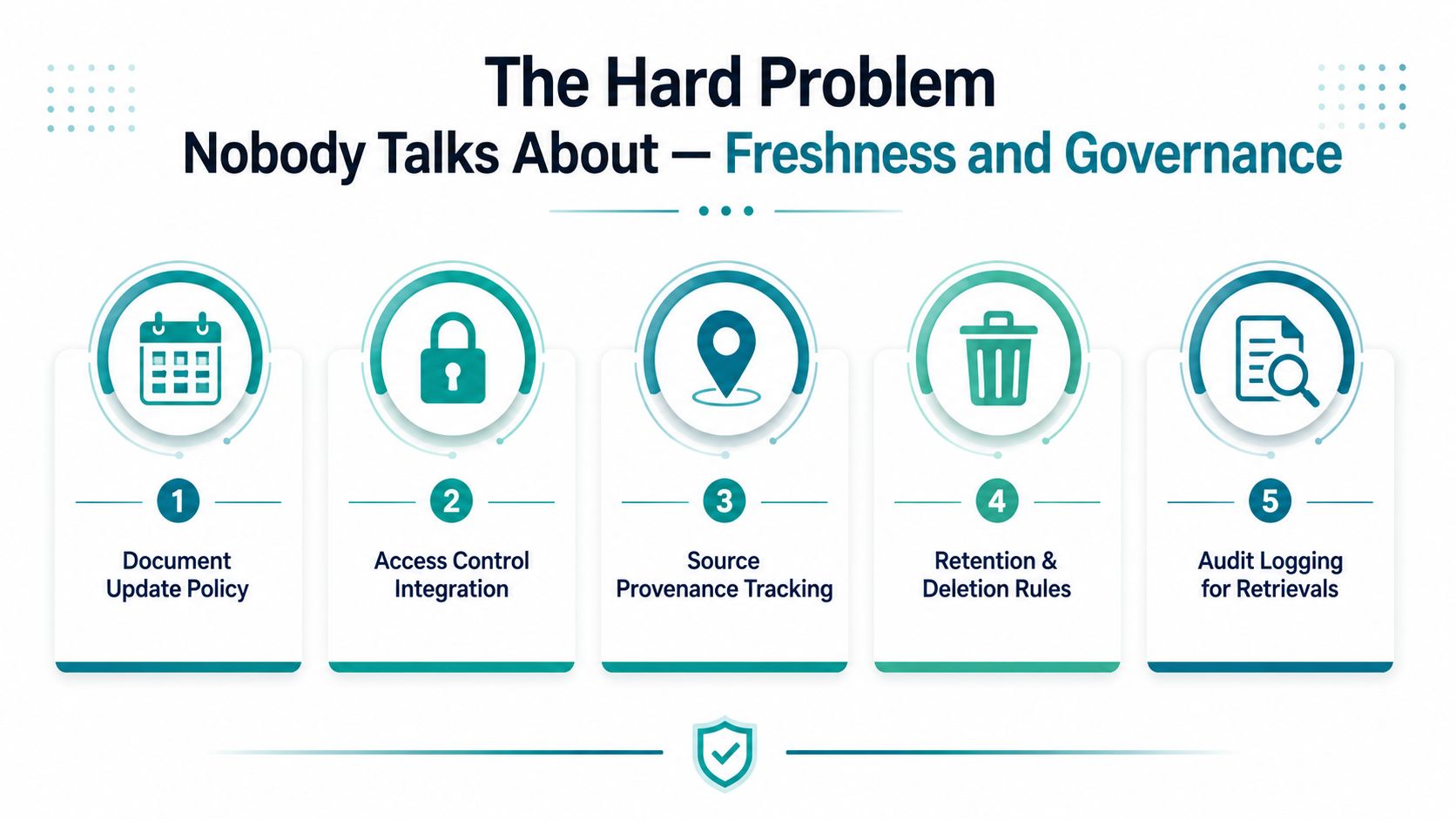
A lot of RAG advice stops at “chunk well and embed better.” That's not the hardest enterprise problem. The harder one is making sure the system answers with the latest approved source, not just the most semantically similar source. In regulated or fast-changing environments, stale retrieval is not a minor quality issue. It's a governance issue.
When the knowledge base changes faster than the index, old chunks keep surfacing. Deleted documents can still appear in search results. Policy updates can be ignored because the retriever found an older version that looked closer to the query. That's why indexing can't be treated as a one-time setup. It has to behave like an ongoing operational pipeline.
What good freshness control looks like
Teams usually need a mix of delta indexing, freshness timestamps, per-document TTLs, and source-of-truth tagging. Access-control-aware retrieval matters too, because a user shouldn't retrieve material they're not allowed to see just because it's a strong semantic match. The goal is to narrow retrieval to approved content, current content, and content that the requester can use.
The most dangerous answer is often the one that sounds right and comes from the wrong version.
Legal, healthcare, fintech, insurance, and similar domains get serious quickly. In those environments, the question is not only whether the answer is accurate. It's whether you can prove it came from the correct version of the correct document under the correct permission model. AmasaTech's guidance on AI governance best practices fits naturally here because retrieval-time controls are part of governance, not an afterthought: AI governance best practices.
What to ask before you go live
A useful vendor question is, “How do you handle document deletion, policy updates, and version precedence in retrieval?” Another is, “Can we audit which source version was used for each answer?” Those questions are better than asking only about retriever accuracy, because they reveal whether the system can survive real business change.
The deeper insight is that freshness and governance become more important as the pipeline gets more agentic. Once retrieval can happen in multiple steps, outdated evidence can get amplified instead of corrected. That's why the retrieval layer needs operational discipline, not just clever similarity search.
KPIs, Evaluation, and Monitoring in Production
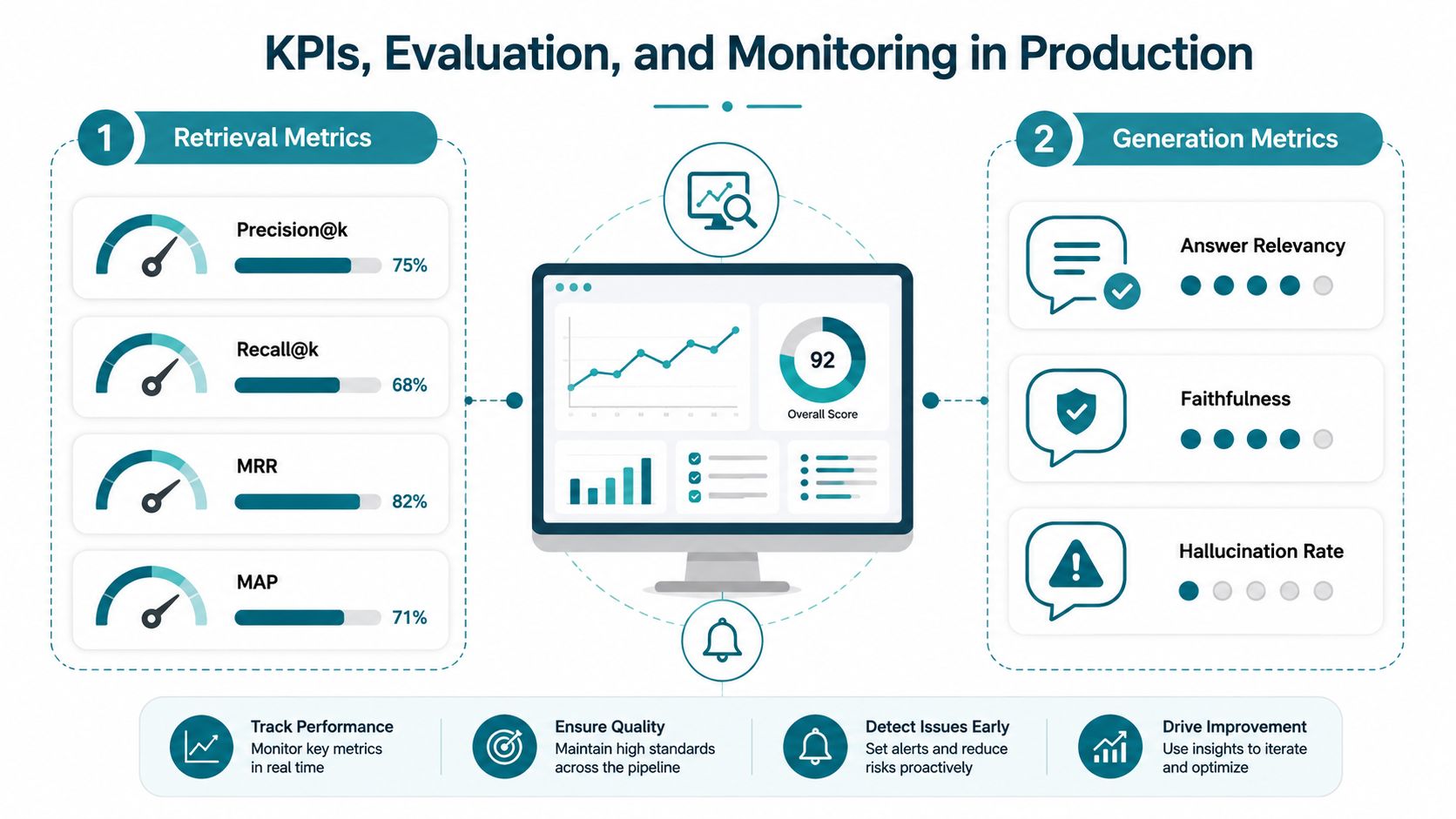
Evaluation can't be a one-time notebook exercise. A production rag pipeline needs separate checks for retrieval and generation, because those two layers fail in different ways. If retrieval is weak, the model may never see the right evidence. If generation is weak, the model may still see the right evidence and answer badly.
Retrieval is commonly measured with Precision@k, Recall@k, MRR, and MAP. Generation-side checks usually include answer relevancy, faithfulness, contextual relevancy, contextual recall, and contextual precision. Those metrics help teams connect system behavior to business outcomes like accuracy, grounding, and lower hallucination risk.
A useful benchmark anchor exists here. A recent NVIDIA evaluation of synthetic-data-based RAG assessment reported 94% precision and 90% recall for an LLM-as-judge workflow, which shows that quantitative benchmarking is now central to production pipelines, not optional. The point isn't that every team should chase that exact number. The point is that serious RAG programs now measure retrieval quality with the same discipline they apply to application uptime or inference latency.
What to monitor in practice
Start with an offline eval set that reflects real questions, not just synthetic ones. Add an LLM-as-judge workflow for faster iteration, then validate the results with human review where stakes are high. After launch, wire in user feedback, drift detection, and latency and cost dashboards so you can see whether the system is degrading.
The production view should be boring in the best way. Retrieval metrics tell you whether the right evidence is showing up. Generation metrics tell you whether the answer is grounded. Operational metrics tell you whether the system can keep doing that at a price and speed your business can tolerate.
Operational habit: if a metric changes and nobody knows which layer changed, your monitoring is too shallow.
A Phased Roadmap for Enterprise RAG Adoption
A practical rollout starts with an audit, not a model choice. First, map data maturity, source systems, and access controls so you know which use case is safe to launch. That's the right point to decide whether your first RAG project should be an internal policy assistant, a support copilot, or a search layer over curated knowledge.
For a founder or ops leader, a good 30 to 60 day win is usually a constrained Q&A system over a small document set. The goal is to prove citation quality, grounding, and user trust before you expand to more sources. AmasaTech's AI adoption roadmap is relevant here because it frames the shift from first audit to phased deployment in business terms: AI adoption roadmap.
What the phases usually look like
Phase 1 is the audit and use-case selection stage.
Phase 2 is the contained pilot with a curated corpus.
Phase 3 expands into role-aware, multi-source RAG for support, sales enablement, and compliance.
Phase 4 adds agentic patterns, multi-step retrieval, and continuous evaluation.
Each phase should have its own success criteria. Early on, that may be answer accuracy and citation quality. Later, throughput, cost, and business impact matter more. AmasaTech's broader delivery model covers document intelligence, custom LLM apps, GPU-accelerated inference on SOC 2-certified cloud infrastructure, and 24/7 monitoring with drift detection, which are the kinds of capabilities enterprises usually need once a pilot has to become a system.
The best RAG programs don't start broad. They start controlled, prove trustworthiness, then widen the blast radius only when the evidence is solid.
If you're planning a RAG initiative, AmasaTech can help you audit your data, design the retrieval flow, and operationalize the system with governance and monitoring built in. Visit AmasaTech to discuss a grounded pilot, a phased rollout, or a production-ready RAG architecture that fits your team's risk and speed requirements.