
Production AI agents typically cost $3,200 to $13,000 per month to operate, while build costs range from $5,000 for a focused MVP to $400,000+ for enterprise multi-agent systems. Over the long term, 90% to 95% of total spend sits in orchestration, infrastructure, integration, governance, and maintenance, not tokens.
That's the counterintuitive part of AI agent cost. Leaders often fixate on the model invoice because it's visible and easy to compare. The expensive work happens underneath: connecting business systems, controlling context, handling failures, reviewing outputs, monitoring drift, and keeping the workflow secure after launch.
An agent that works in a demo can be cheap. An agent that operates reliably inside a CRM, ERP, claims platform, helpdesk, or codebase is a software product with a recurring operating burden. Treating it like a clever prompt is how budgets get blown.
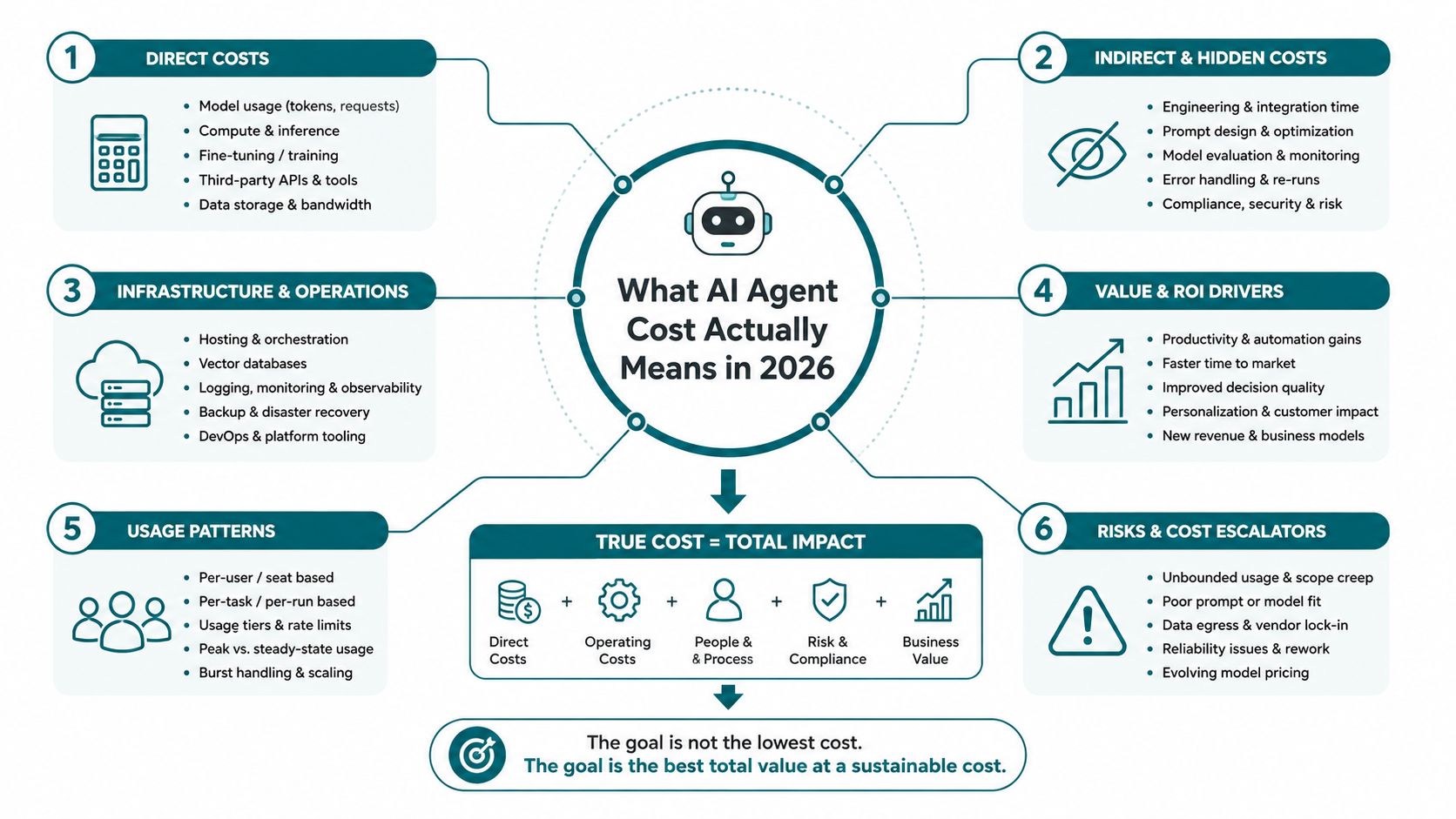
What AI Agent Cost Actually Means in 2026
The useful definition of AI agent cost is a three-part equation:
- Build, the one-time work required to design, develop, integrate, test, and launch the system.
- Run, the recurring cost of models, compute, storage, tool calls, monitoring, and workflow execution.
- Maintain, the ongoing expense of improving prompts, refreshing models, fixing integrations, managing security, and reviewing quality.
Production operating costs are commonly estimated at $3,200 to $13,000 per month, with spend driven by model tokens, vector database hosting, monitoring, prompt tuning, and security upkeep, according to this 2026 AI agent cost benchmark. The same benchmark places assisted agents at roughly $150 to $600 per month, semi-autonomous agents at $1,200 to $5,500, and fully autonomous multi-agent systems at $7,000 to $15,000+, showing why autonomy and orchestration complexity matter more than a simple API price.
Build pricing sits on a much wider curve. Independent 2026 pricing summaries place a focused MVP around $5,000 to $15,000, while enterprise multi-agent systems can reach $75,000 to $400,000+, with ongoing monthly costs adding $500 to $50,000+ depending on complexity and compliance requirements, as detailed in this AI agent implementation cost guide.
The waterline most buyers miss
Cognizant's analysis estimates that roughly 90% to 95% of total agentic AI cost sits below the waterline, covering context engineering, data pipelines, infrastructure, human-in-the-loop operations, governance, compliance, and monitoring. Token costs account for only about 5% to 10%, according to the agentic AI cost analysis.
That changes the buying question. Don't ask only, “What does the model cost?” Ask, “How many steps does this workflow execute, how often does it retry, who reviews exceptions, and what must remain operational for three years?”
Teams evaluating private deployment should also understand the trade-offs described in this guide to on-premise LLM deployment. Hosting models yourself can change the balance between licensing, infrastructure, security, and operational labor. It doesn't make the system free.
The rest of the financial model follows this structure: estimate build, forecast monthly run cost, reserve maintenance capacity, then multiply the full operating picture across the intended life of the system.
The Six Components That Drive AI Agent Cost
A production agent's bill has six major buckets. The percentages below are lifecycle-weight estimates from the planning framework in this brief, while the central cost lesson is consistent with the agentic AI cost benchmark analysis: infrastructure and orchestration usually outweigh raw inference.
| Cost Component | Share of Lifecycle Spend | What's Inside |
|---|---|---|
| Development and design | 15% to 25% | Prompt engineering, orchestration code, evaluation harnesses, workflow design, and user interface |
| LLM licensing and token usage | 5% to 10% | Model calls, embeddings, reranking, caching, and provider fees |
| Compute and infrastructure | 25% to 35% | Vector databases, GPU endpoints, serverless runtimes, queues, storage, and networking |
| Integration and connectors | 10% to 20% | CRM, ERP, ticketing, identity, business APIs, permissions, and data synchronization |
| Monitoring, evaluation, and observability | 5% to 10% | Trace storage, quality evaluation, drift alerts, logging, and incident analysis |
| Maintenance and retraining | 20% to 30% | Prompt updates, model swaps, security patches, workflow changes, and regression testing |
Development and design
The first bucket pays for the thinking that makes the agent dependable. Developers define state transitions, tool permissions, fallback behavior, evaluation cases, and escalation paths. A prompt-only prototype avoids much of this work, but production systems can't.
Inference is visible, not necessarily dominant
LLM licensing gets the most attention because providers publish clear per-token prices. Yet context overhead, retries, tool-call chatter, and review loops can make a low token rate irrelevant. Use a RAG pipeline only when retrieval improves the workflow, because every added retrieval, reranking, and context step becomes part of the operating surface.
Infrastructure and integration
Vector stores, runtimes, queues, and observability services keep the agent moving. Integrations create another cost layer because each connector must respect authentication, permissions, rate limits, schema changes, and audit requirements.
Maintenance is where many business cases fail. A CRM field changes, a model's behavior shifts, or a policy document becomes outdated. Someone must detect the change, update the workflow, test it, and deploy the fix. Budgeting only for the initial build leaves no owner for that work.
Practical rule: Treat maintenance as a standing product function, not a support ticket you'll handle later.
Realistic Cost Ranges by Autonomy and Use Case
Autonomy is the strongest early predictor of AI agent cost. A single-task assistant retrieves information and responds. A multi-step agent selects tools, maintains state, and handles branches. A multi-agent system coordinates specialized workers, which creates more calls, more failure modes, and more monitoring requirements.
The ranges below combine the tiered planning model in this brief with the broader production operating benchmarks cited earlier.
| Autonomy Level / Use Case | One-Time Build | Monthly Run Cost | Per-Unit Economics |
|---|---|---|---|
| Level 1, single-task assistant | $5,000 to $25,000 | $3,200 to $6,000 | Depends on task volume and review rate |
| Level 2, multi-step agent with tools | $40,000 to $120,000 | $6,000 to $13,000 | Higher cost from tool calls, state, and retries |
| Level 3, autonomous multi-agent system | $150,000 to $400,000+ | $18,000 to $45,000+ | Enterprise workload, governance, and orchestration dominate |
| Customer support triage | Qualitative design and integration scope | Depends on deployment | $0.40 to $1.20 per resolved ticket |
| Sales research | Qualitative data and workflow scope | Depends on deployment | $2 to $8 per qualified lead |
| Internal IT helpdesk | Qualitative identity and system scope | Depends on deployment | $150 to $400 per user per month |
| Claims processing | Qualitative document and policy scope | Depends on deployment | $0.80 to $3.50 per claim |
| Code generation assistant | Qualitative developer-tool scope | Depends on deployment | $80 to $200 per active developer per month |
A benchmark for production agents places monthly operation at $3,200 to $13,000, while its autonomy breakdown shows assisted agents near $150 to $600, semi-autonomous agents at $1,200 to $5,500, and fully autonomous multi-agent systems at $7,000 to $15,000+. These figures come from the AI agent statistics benchmark, and they're more useful for budgeting than inflated vendor stickers that hide integration and maintenance.
Per-unit economics matter because monthly totals can mislead. A support agent may look expensive until you divide its cost across resolved tickets. A research agent may look cheap until retries and human review are included. Define the unit before approving the project.
A Working 3-Year Total Cost of Ownership Model
A credible TCO model starts with editable assumptions, not a single vendor quote. Set monthly task volume, average tokens per task, autonomy level, compliance burden, expected retry rate, review requirements, and the number of systems the agent must connect.
For a mid-market deployment, use a 50,000-task monthly case as the conservative operating assumption and a 500,000-task monthly case as the high-volume stress test. Keep the workflow at Level 1 for retrieval and routing, then model a Level 3 autonomous multi-step version separately. SOC 2 and HIPAA requirements should be treated as different operating burdens, not decorative checkboxes.
The planning assumptions supplied for this model are $25,000 to $90,000 in year-one build cost, incremental year-two engineering at 15% of build, and year-three maintenance plus model refresh at 20%. The table is a template, not a claim about a universal invoice.
| Cost Line | Conservative (Y1/Y2/Y3) | Expected (Y1/Y2/Y3) | Aggressive (Y1/Y2/Y3) |
|---|---|---|---|
| Build and launch | $25,000 / $0 / $0 | $60,000 / $0 / $0 | $90,000 / $0 / $0 |
| Incremental engineering | $0 / $3,750 / $0 | $0 / $9,000 / $0 | $0 / $13,500 / $0 |
| Maintenance and refresh | Included in run reserve / $5,000 / $5,000 | Included in run reserve / $12,000 / $12,000 | Included in run reserve / $18,000 / $18,000 |
| Operating services | $4,200 monthly / $4,200 monthly / $4,200 monthly | $13,000 monthly / $13,000 monthly / $13,000 monthly | $28,000 monthly / $28,000 monthly / $28,000 monthly |
| Compliance and review | Light / Moderate / Moderate | Moderate / Moderate / High | High / High / High |
The operating line can include LLM tokens, vector database hosting, orchestrator runtime, observability, and integration upkeep. Under a higher-autonomy and compliance-heavy design, the baseline can climb from $4,200 per month past $28,000 per month in the supplied scenario framework. That's why calculating cloud TCO is a useful adjacent discipline, but an agent model must also account for quality review and workflow failure.
Build a spreadsheet with one row per cost line and separate columns for volume, unit rate, retries, and compliance multiplier. An AI ROI calculator can help structure the benefit side, but don't let projected labor savings conceal an unpriced maintenance obligation.
The assumption that swings the model most is simple: average tokens per task multiplied by annual task volume. Add autonomous planning, tool calls, retries, and long context, and that product grows quickly.
Why Model Routing Beats Picking the Cheapest LLM
Choosing one cheap model for every request is as shortsighted as choosing one expensive model for every request. The right question is whether the model is capable of completing a specific task at an acceptable quality and risk level.
A 2026 coding-agent benchmark measured the same 225-exercise workload across models and found task costs from about $0.028 with Gemini 2.5 Pro to $0.129 with GPT-5 high-reasoning. Cost per solved task ranged from roughly $0.039 to $0.147, depending on model choice and pass rate, as documented in this coding-agent cost benchmark.
That result matters more than a provider's headline token price. A high-reasoning model may solve harder work more reliably, but it can consume more tokens and cost more per attempt. A small model may handle classification, routing, extraction, or formatting without needing frontier reasoning.
Build a router around risk
Use a tiered policy:
- Low-risk classification: Send intent detection, field extraction, and simple routing to a lower-cost model.
- Moderate-complexity synthesis: Use a mid-tier model for summarization, policy comparison, and structured drafting.
- High-risk escalation: Reserve a stronger model for ambiguous cases, complex planning, or decisions requiring deeper reasoning.
- Human review: Escalate uncertainty instead of forcing the most expensive model to solve every edge case.
The benchmark's conclusion is direct: routing simple steps to cheaper models is the main lever for reducing total cost without abandoning quality. Measure pass rate, retry rate, latency, and cost per successful task together. Never optimize cost per call while ignoring failed outcomes.
For practical model-price comparisons and budgeting ideas, cut your AI bill by comparing complete task economics rather than isolated input and output rates. An AI orchestration platform can centralize routing, permissions, traces, and provider switching, but the architecture still needs a clear routing policy.
Routing rule: Send work to the cheapest model that can meet the task's quality and risk threshold, then escalate only when evidence requires it.
Procurement Checklist and Cost Control Metrics
Procurement should force the vendor to expose the operating model before anyone signs a build statement of work. Ask binary questions, require written answers, and make unanswered items a commercial risk.
The 18-item buyer checklist
Build
- Data readiness: Has the vendor documented source quality, ownership, and access?
- Evaluation harness: Can you test representative tasks before launch?
- Prompt versioning: Can the team compare and roll back prompt changes?
- Workflow ownership: Is every tool, branch, and escalation path assigned?
- Acceptance criteria: Are accuracy and completion conditions explicit?
- Security design: Are permissions and sensitive-data boundaries documented?
Run
- Token budgets: Can you set limits by workflow, team, or model route?
- Rate limits: What prevents runaway loops and excessive retries?
- Vendor lock-in: Can you change models without rebuilding the application?
- Egress fees: Does moving data or logs create additional charges?
- Regional pricing: Do location and data-residency requirements alter cost?
- SLA penalties: Does the contract provide a remedy for missed service levels?
Maintain
- Refresh cadence: Who decides when the model or prompt needs updating?
- Drift monitoring: How will quality degradation be detected?
- Retraining budget: Is improvement work included or billed separately?
- Security review: Is recurring vulnerability and access review funded?
- Incident response: Who owns failures outside business hours?
- Exit plan: Can you export prompts, traces, evaluations, and configurations?
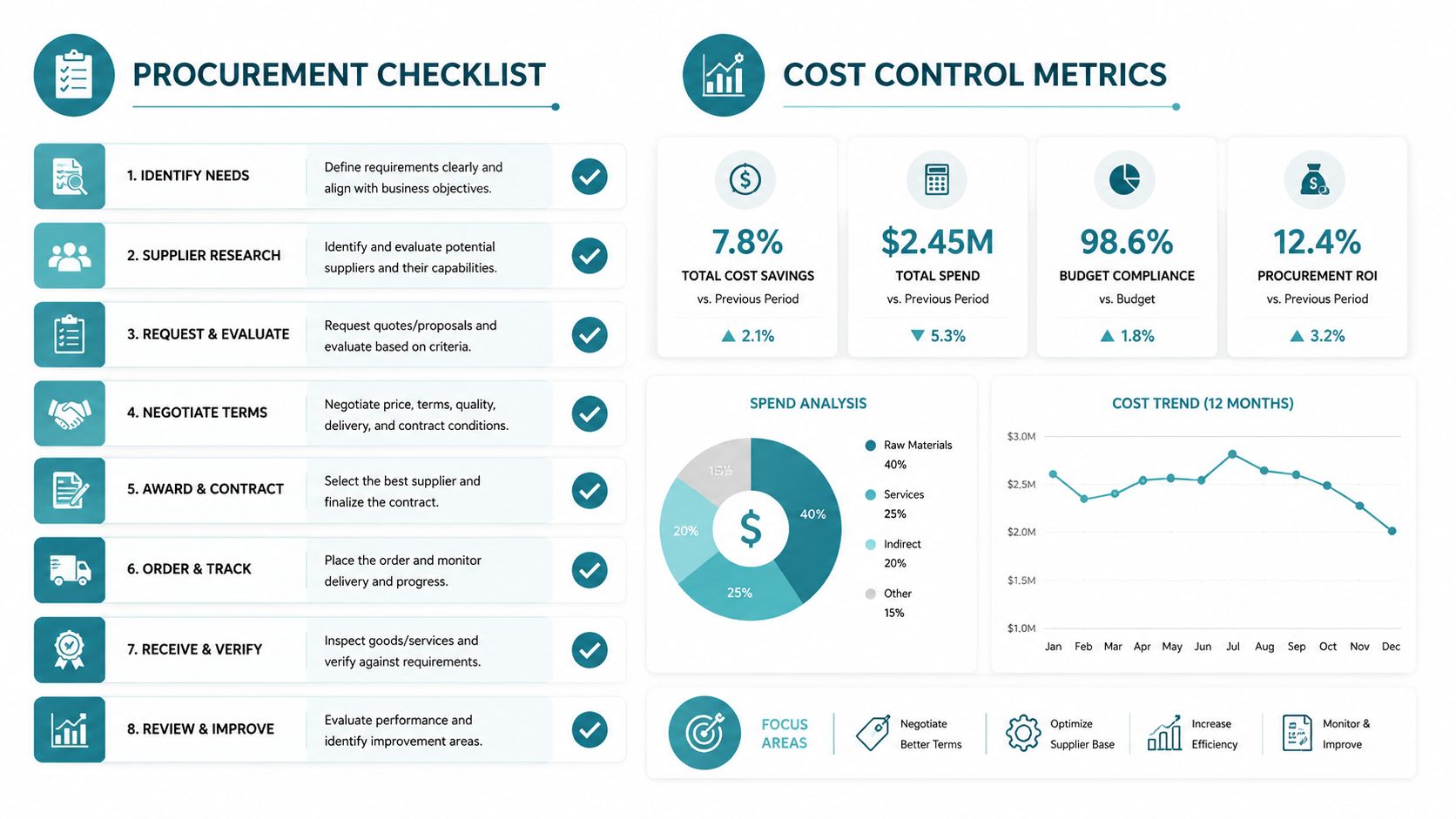
Put seven metrics on the weekly review
Track cost per resolved task, with a target that stays below the approved unit economics and a kill switch when it exceeds the business case. Track cost per successful escalation, because expensive handoffs can erase automation savings.
Also review:
- Token spend by route: Flag any route whose share grows without a matching quality benefit.
- Orchestrator minutes per 1,000 tasks: Pause workflows that add steps without improving completion.
- Vector database growth rate: Investigate uncontrolled context ingestion and retention.
- Integration uptime: Escalate unstable connectors before they create retry storms.
- Cost-to-revenue ratio: Stop expansion when agent-driven outcomes consume more value than they create.
A structured generative AI procurement transformation process can help finance, security, and operations evaluate the same evidence. The essential requirement is ownership. A dashboard without an accountable operator is just an expensive display.
How to Maximize ROI on AI Agent Investments
Technical sophistication doesn't create ROI by itself. Pricing structure and outcome measurement determine whether the buyer captures the value.
Fixed-bid builds transfer operational risk to the customer. The vendor delivers a system, collects payment, and may have little incentive to reduce retries, simplify orchestration, or improve the cost per successful outcome. An outcome-as-a-service model aligns both parties around measurable results, such as resolved tickets, qualified leads, processed claims, or completed compliant reviews.
Tie invoices to finance-approved outcomes
Use the metrics finance already understands:
- Cost per resolved ticket: Measures whether automation beats the current service cost.
- Deflection rate: Shows how much eligible work avoids human handling.
- Hours of human labor reclaimed: Converts workflow completion into capacity that managers can validate.
- Accuracy floor: Prevents a vendor from reducing cost by lowering decision quality.
- Uptime: Protects the operating value of the agent, not just its availability in a demo.
The supplied pricing example makes the point. A team paying $0.40 per resolved ticket has a very different business case from one paying $8.00 per interaction, even if the underlying models and infrastructure are identical. The unit must describe a successful business outcome, not an arbitrary conversation or prompt.
Write accountability into the contract
Require minimum uptime, accuracy floors, transparent usage reporting, and shared-savings clauses tied to volume scaling. Give the vendor a reason to reduce unnecessary tool calls and improve routing rather than passing higher infrastructure costs through to you.
AmasaTech is one option for teams that want an outcome-focused engagement. Its stated approach begins with an AI audit and phased strategy, then ties delivery to KPIs such as accuracy, throughput, cost, or revenue impact.
Ignore vanity metrics such as conversation count, prompt volume, or the number of agents deployed. The only honest ROI signal is verified business outcome per dollar spent.
If a vendor can't map an invoice line to a business KPI, walk away.
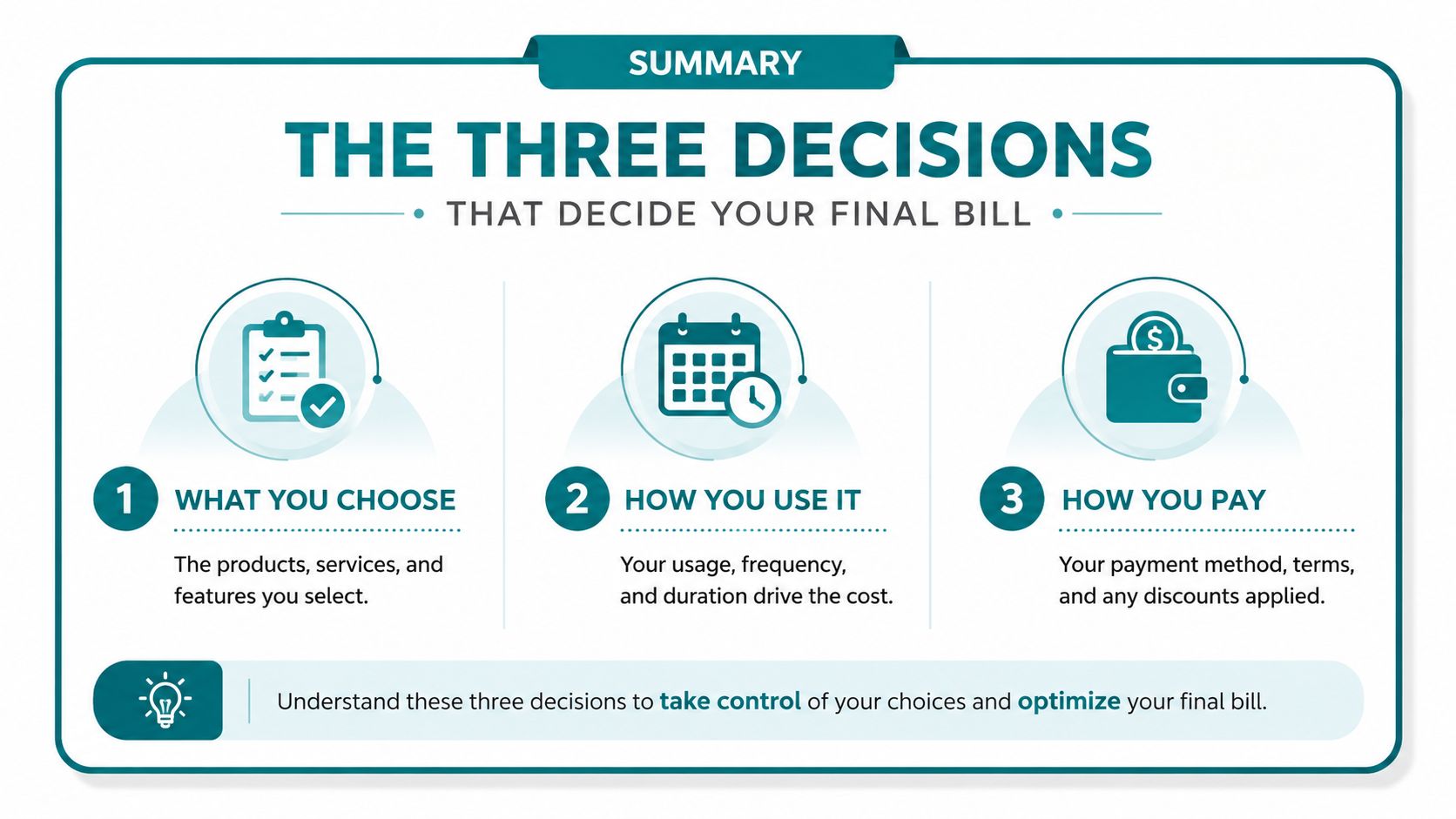
The Three Decisions That Decide Your Final Bill
Three choices determine most of the final bill. Everything else is downstream optimization.
Choose the autonomy tier
Buy the least autonomy that completes the business outcome safely. A retrieval assistant may be enough where a fully autonomous workflow would add planning steps, tool calls, retries, approvals, and monitoring. Most buyers overestimate how much independent action they need.
Choose the routing architecture
Use a layered router across small, mid-tier, and frontier models. The benchmark evidence above shows why task complexity and pass rate should shape the route, not a single default model. Keep the router observable so you can change the mix as traffic and task difficulty shift.
Choose the commercial model
Prefer outcome-tied pricing when the vendor can measure successful completion. A fixed bid can be appropriate for a tightly bounded prototype, but it's a poor default for a system that needs continuous optimization. Require shared accountability for uptime, quality, cost per outcome, and scaling behavior.
Prompt tuning, vector database selection, and dashboard design still matter. They won't rescue a poor decision about autonomy, routing, or commercial accountability. Make those three choices deliberately, then optimize the implementation underneath them.
If you want to replace a sticker-price estimate with a defensible build, run, and maintain model, visit AmasaTech. Its team can audit your data and workflows, define KPI-linked agent opportunities, and design an outcome-focused deployment with ongoing monitoring and optimization.