

Most enterprise leaders no longer need convincing that AI matters. They need a reliable way to make it work.
The hardest truth is that enterprise AI pilots face a 95% failure rate in delivering measurable ROI, according to MIT reporting summarized by Chronus in 2025, and the causes are mostly organizational rather than model-related: poor data quality, fragmented infrastructure, weak change management, and limited executive commitment beyond the pilot stage (Chronus on why enterprise AI adoption fails). That single fact reframes the entire enterprise ai adoption conversation.
The practical question isn't which model is newest. It's whether your company can connect an AI capability to a workflow, wrap it with governance, integrate it into systems people already use, and measure the result in operational terms.
I've seen the same pattern repeatedly in enterprise programs. Teams buy tools before they define ownership. They approve pilots before they clean the data path. They celebrate a promising demo before they budget for production engineering. Then they call the pilot a success even though nobody can prove business value.
That approach doesn't survive scrutiny. A better one does.
Enterprise AI Adoption: Why Most Pilots Fail
The 95% pilot failure rate for measurable ROI has already been established earlier in this article. That number matters because it points to a planning problem, not a model problem.
Most enterprise AI initiatives stall for a simple reason. Companies treat AI as a software purchase when it behaves more like an operating model change. A strong model can still fail inside a weak process, poor data flow, or an organization with no clear owner for outcomes.
I see the same breakdown in early-stage enterprise programs. A business unit buys a tool. An innovation team builds a promising demo. Security, legal, IT, and operations review it late. Nobody has defined the production workflow, the exception path, or the metric that proves value. At that point, the pilot was never designed to survive real operating conditions.
What usually goes wrong
Failure tends to follow a familiar sequence:
- Tool-first buying: Teams start with Microsoft Copilot, ChatGPT Enterprise, Claude, Vertex AI, Bedrock, or a vertical AI product before defining the business problem.
- Disconnected data: The information needed to make AI useful sits across ERP, CRM, email, shared drives, ticketing systems, PDFs, and spreadsheets without a reliable retrieval or integration layer.
- Poor workflow fit: The output may look impressive, but it does not match approval steps, service-level targets, handoffs, or edge cases in the live process.
- Pilot theater: A small team can run the experiment, but the functions that would need to support it in production are not staffed, aligned, or accountable.
- Weak value measurement: Leaders track usage or demo quality instead of time saved, errors reduced, cycle time improved, margin protected, or revenue captured.
Practical rule: If a pilot has no business owner, no workflow target, and no agreed success metric, it is a test environment, not an investment case.
That distinction matters. Teams that expect production-level value need to design for production-level constraints from the start. That includes role-based access, audit trails, fallback paths, model monitoring, escalation logic, and a human review step where the cost of error is high.
This is also where many pilot budgets fail. The demo budget covers prompt work, a few integrations, and vendor licenses. Production requires more. Identity controls, observability, testing, support processes, and change management all add cost. If those items are missing from the original plan, the business often discovers too late that the pilot was cheap only because the hard parts were deferred.
The shift leaders need to make
The companies that get ROI usually narrow the scope before they expand it. They start with a process that has clear friction, enough transaction volume to matter, and an owner who will change how the team works if the results are real.
Good questions sound like this:
- Which workflow loses time every day because staff must search, summarize, validate, or route information?
- Where does delay create downstream cost, compliance risk, or customer dissatisfaction?
- Which decisions are repetitive enough to support AI assistance, but important enough to justify governance?
- What result would justify deployment in financial or operational terms?
That is a better starting point than asking how to use AI everywhere.
For teams that need outside support, our enterprise AI strategy and implementation services are built around business-case design, delivery planning, and production rollout. AmasaTech also shares related perspective on its AI and product strategy blog.
First Step Assess Your True AI Readiness
Most firms overestimate readiness because they confuse interest with capability. Enthusiasm from a strategy offsite doesn't mean the organization can support enterprise ai adoption in production.
Leadership matters more than many teams admit. Forrester surveys show successful AI adoption is often led by the CEO in 25% of cases, with those leaders prioritizing customer experience and investing early in governance and infrastructure. Lagging firms are often described as "paralyzed by a lack of understanding" (ITPro coverage of Forrester's finding).
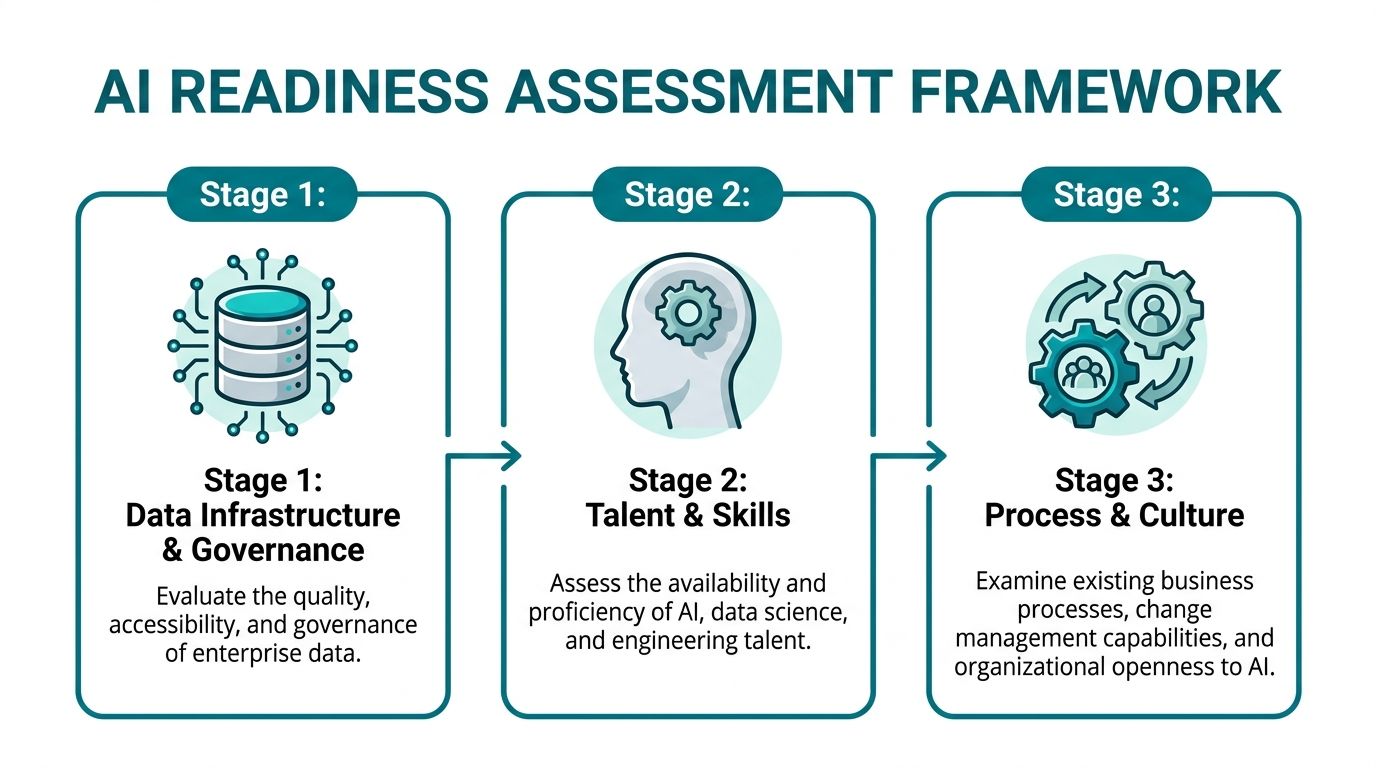
Readiness starts with three checks
A useful assessment is simple enough to run and detailed enough to expose risk.
Data infrastructure and governance
Start with the data path, not the model.
Ask these questions:
- Can teams find the right data: If policy documents, contracts, claims, tickets, or customer records are spread across SharePoint, Google Drive, Salesforce, ServiceNow, SAP, or local folders, retrieval will be inconsistent.
- Is the data usable: Duplicates, stale records, scanned PDFs, and inconsistent field names will contaminate outputs.
- Who can access what: Role-based access controls need to be decided before retrieval-augmented workflows go live.
- Can outputs be audited: In regulated work, users need traceability back to approved source material.
If leadership says "we have lots of data," that's not enough. The question is whether that data is available, trusted, permissioned, and connected to a workflow.
Talent and skills
You don't need a research lab. You do need the right mix of operators.
Look for these gaps:
- Product ownership: Someone must own the business outcome, not just the implementation.
- Data engineering: Pipelines, transformations, and observability often matter more than prompt quality.
- Application engineering: Most value comes from embedding AI into systems and user flows, not from a standalone chat interface.
- Process expertise: Operations leaders know where exceptions happen and where automation breaks.
Teams often look for "AI talent" when they need stronger product management, cleaner data engineering, and clearer operational ownership.
Process and culture
Many programs stall here.
Readiness depends on whether teams can absorb workflow change. A company may have access to OpenAI, Anthropic, Azure OpenAI, AWS Bedrock, Databricks, Snowflake, or internal ML tooling and still fail because managers don't redesign approvals, retrain staff, or define escalation paths.
Check for signals such as:
- Executive sponsorship with decisions attached
- Managers willing to change KPIs and team routines
- Security and legal teams involved early
- Users trained on when to trust, verify, or override AI output
A practical readiness scorecard
Use a plain internal rating across these areas:
| Readiness Area | What good looks like | Common failure sign |
|---|---|---|
| Data access | Core workflow data is available and permissioned | Data sits in silos or unofficial exports |
| Governance | Clear rules for privacy, approval, and audit | Governance starts after the pilot |
| Ownership | A business leader owns outcome and rollout | IT owns delivery alone |
| Engineering | APIs, integrations, and monitoring are planned | Pilot runs as a standalone sandbox |
| Workforce adoption | Managers know how roles will change | Users hear about AI after launch |
If your scorecard shows weak ownership, fragmented data, or unresolved governance questions, pause. Fix those first.
For companies that need outside help structuring that assessment, one option is reviewing AmasaTech's AI and software services to see how readiness, product engineering, and implementation can be scoped together.
Identify and Prioritize High-Impact AI Use Cases
The biggest early mistake in enterprise ai adoption is starting with a use case list that is too broad. "Customer service," "sales productivity," "knowledge management," and "automation" aren't use cases. They're buckets.
What works is narrowing the field to workflows with measurable friction, enough data to support intervention, and a realistic path to production.
A 2025 analysis of more than 1,200 enterprise initiatives found that the top explored AI use cases are content creation (79%), code generation (68%), and data analysis (61%), yet only 31% have scaled into full production (ISG's 2025 enterprise AI adoption report). That gap matters. Popularity isn't the same as operational value.

Use an impact versus feasibility filter
A practical way to choose is to score each candidate use case on two axes:
-
Business impact
Does it reduce manual effort, improve decision speed, cut error rates, strengthen compliance, or support revenue workflows? -
Technical feasibility
Is the data accessible? Can the task tolerate probabilistic output? Will the system integrate with current tools? Is human review easy to keep in the loop?
Multiply the scores. Then challenge the result with operational judgment.
AI Use Case Prioritization Matrix
| Use Case Example | Business Impact (1-5) | Technical Feasibility (1-5) | Priority Score (Impact x Feasibility) |
|---|---|---|---|
| Claims document triage | 5 | 4 | 20 |
| Internal policy assistant | 3 | 5 | 15 |
| Sales proposal drafting | 4 | 4 | 16 |
| Legacy code modernization support | 4 | 3 | 12 |
| Contract clause extraction | 5 | 4 | 20 |
| Executive dashboard summarization | 2 | 5 | 10 |
The exact numbers are internal scoring, not benchmarks. What matters is the discussion they force.
What high-value early use cases usually share
The best first projects usually have four traits.
- They live inside an existing workflow. Example: extracting fields from invoices, onboarding files, claims packets, or KYB documents directly into an operations queue.
- They already consume staff time. If humans spend hours reviewing, classifying, summarizing, or validating content, AI can assist.
- They allow supervised output. Human review remains possible while confidence and process design improve.
- They touch a business metric the owner already cares about. Queue time, exception rate, resolution speed, or compliance readiness are easier to defend than vague productivity claims.
Industry examples that are worth considering
Different sectors should prioritize differently.
Manufacturing and supply chain
Look at maintenance logs, quality reports, supplier communications, and production incident summaries. AI can help classify, summarize, and route information, but only if shop-floor and ERP data are connected well enough to support action.
Insurance and financial services
Good targets include claims intake, policy comparison, underwriting support, KYB, KYC review, and contract analysis. These use cases often produce value because they combine high document volume with repetitive review steps.
A concrete example of this category is AmasaTech’s work on automating KYB for a fintech workflow, where the business problem is operational review, not generic “AI transformation.”
Healthcare and regulated operations
Start with administrative workflows. Referral processing, prior authorization support, document extraction, coding assistance, and internal knowledge retrieval are more manageable than direct clinical decisioning.
Don’t choose the use case that sounds smartest in a board meeting. Choose the one with enough friction, enough data, and enough operational ownership to survive production.
What to avoid early
Avoid use cases that depend on unresolved data access, unclear accountability, or highly subjective output.
That includes broad enterprise chatbots with no defined business process, autonomous decision systems without human review, and “personal productivity” rollouts with no agreed measurement model. Those projects generate activity. They rarely create evidence.
Build Your Data and Technology Foundation
The fastest way to kill a good AI concept is to run it on a brittle foundation. In enterprise ai adoption, the difficult work isn’t glamorous. It’s pipeline reliability, document normalization, permissions, audit trails, and integration discipline.
Start with the minimum production architecture
Most enterprise AI systems need a stack that includes these layers:
- Data ingestion: Pull from systems such as Salesforce, SAP, ServiceNow, SharePoint, Google Drive, email, file stores, and internal databases.
- Preparation and transformation: Clean fields, remove duplicates, normalize structure, parse documents, enrich metadata.
- Storage and retrieval: Keep source records, indexed content, embeddings if needed, and version history.
- Application logic: Handle prompts, business rules, retrieval orchestration, validation logic, and fallback paths.
- Delivery layer: Put outputs inside the tools users already work in. That might be a CRM screen, agent desktop, claims queue, internal portal, or document workflow.
- Monitoring: Track failures, latency, quality drift, feedback, and security events.
If any one of those is missing, the system may still demo well. It won’t operate well.
Build versus buy is a trade-off, not an ideology
Leaders often ask whether to build an internal AI platform or use managed services. The answer depends on control needs, engineering maturity, and how differentiated the use case is.
| Decision Area | Build In-House | Use Managed Services |
|---|---|---|
| Control | Extensive oversight on architecture and data | Accelerated deployment following vendor |
| Speed | Initially slower | Rapid initial implementation |
| Internal Effort | Requires significant engineering and management | Reduces platform management requirements |
| Flexibility | Best for unique processes and custom integrations | Appropriate for standard practices |
| Long-term Fit | Advantageous if AI integration becomes vital | Adequate if use cases are limited |
A hybrid model is common. Use Azure OpenAI, AWS Bedrock, Google Vertex AI, or enterprise APIs for model access. Build your own workflow layer, evaluation logic, and system integrations on top.
Data quality is a systems problem
Poor output rarely comes from “bad AI” alone. It usually comes from weak upstream controls.
Common technical issues include:
- Document inconsistency: Scanned forms, handwritten notes, old templates, and image-heavy PDFs.
- Schema mismatch: The CRM uses one customer identifier, billing uses another, and support tools use neither.
- Missing governance: No one has defined retention, access rights, or approved knowledge sources.
- No exception design: The system produces an output, but nobody defined how uncertain cases get routed.
A strong AI workflow has two outputs, the primary result and a safe path for exceptions.
Evaluate partners by production criteria
When choosing vendors or development partners, ask blunt questions.
- Can they integrate with your current systems without forcing a full platform rewrite?
- Can they support role-based access and auditability?
- Can they help define evaluation criteria, not just implement prompts?
- Can they support document-heavy workflows, structured data workflows, or both?
- Can they maintain the system after launch?
If your roadmap includes unstructured documents, extraction pipelines, and human review steps, a focused workflow layer matters more than a general chatbot interface. That’s why many teams assess tools such as OCR engines, vector search platforms, orchestration frameworks, and document processing solutions together. For document-heavy operations, AmasaTech’s document intelligence solution reflects the kind of capability stack enterprises often need to operationalize extraction, classification, and review.
From Pilot to Production The Smart Way
A good pilot answers one question. A production system answers many more.
Can it run reliably? Can it recover from bad input? Can it handle permissions? Can operations trust it? Can managers measure it? Can engineering support it six months later?
Those are the questions that separate successful enterprise ai adoption from pilot theater.

Design the pilot as a production prototype
Too many pilots are built as isolated sandboxes. That creates a false positive. The model works on selected examples, but the workflow fails under real-world conditions.
A smarter pilot includes production realities from the start:
- Real source data, not handpicked samples
- Real users, not only the innovation team
- Real exception cases
- Real integration points
- Real approval paths
That doesn’t mean the first version must be fully hardened. It means the architecture and operating assumptions should be honest.
Define success before the pilot starts
If the business owner can’t explain what improvement should happen, stop.
Useful pilot success measures usually fall into categories such as:
- Workflow efficiency: reduced handling time, faster turnaround, fewer manual touches
- Quality: fewer extraction errors, fewer missed fields, better consistency
- Adoption: whether the target team uses the capability inside daily work
- Operational reliability: whether the system handles edge cases and degraded states safely
What you should not do is rely on vanity signals. Prompt counts, login volume, and number of generated outputs are weak indicators unless tied to a process outcome.
“Production doesn’t begin when the pilot ends. It begins when you design the pilot.”
Build the handoff model early
A pilot often succeeds because a small, motivated group is babysitting it. Production fails when that support disappears.
Plan these ownership questions before launch:
Who owns business performance
A line leader should own the operational result. If nobody in operations owns the outcome, adoption will drift.
Who owns technical reliability
Engineering, platform, or IT must own uptime, integrations, model routing, access controls, and incident response.
Who owns quality review
Someone must evaluate outputs, review edge cases, and decide when prompt logic, retrieval sources, thresholds, or workflows need revision.
Put MLOps discipline around the system
Even if you’re using foundation model APIs rather than training custom models, the operating discipline still looks like MLOps.
That includes:
- Versioning: prompts, retrieval settings, source corpora, business rules, and application code
- Evaluation: fixed test sets, red-team scenarios, and workflow-level acceptance checks
- Monitoring: response quality, failure classes, latency, user overrides, and feedback
- Release controls: staged rollout, rollback paths, and change approval
If the system touches core workflows, treat prompt changes with the same seriousness as code changes.
A practical walkthrough of production-oriented AI implementation helps here:
Budget for the phase after the demo
Many teams budget for exploration and forget the cost of integration, controls, monitoring, and workflow redesign.
The expensive part of production isn’t always the model. It’s the surrounding engineering:
- connectors to internal systems
- review interfaces
- logging and observability
- role-based access
- evaluation pipelines
- human escalation logic
- support processes
That is why post-pilot planning matters so much. If you’re moving from experimentation to a production deployment, service scope should include architecture, integrations, evaluation, and operating support, not only prototyping. AmasaTech’s generative AI development services are one example of the kind of implementation support enterprises typically need at this stage.
Roll out in controlled layers
A clean production rollout often follows this pattern:
- Limited team deployment with close feedback.
- Workflow-level expansion after exceptions are understood.
- Cross-team standardization once governance and support are stable.
- Platform reuse when patterns are mature enough to replicate.
That sequence isn’t slow. It’s disciplined. It protects credibility. In enterprise environments, credibility is what earns the next deployment.
Embed Governance and Drive Change Management
Most leaders treat governance and change management as separate workstreams. In practice, they reinforce each other.
Governance creates trust boundaries. Change management creates human confidence inside those boundaries. Without both, enterprise ai adoption either stalls in review or spreads in ways the company can’t control.
The workforce side is changing in a useful direction. The 2025 Wharton AI Adoption Report found that 89% of enterprise users agree Gen AI enhances employee skills rather than replacing them (Wharton’s 2025 AI Adoption Report). That doesn’t remove fear, but it does show why leaders should frame AI as augmentation and upskilling, not just efficiency.
Governance should answer practical questions
Good governance isn’t a slide deck full of abstract principles. It should help teams decide what they can deploy, how they can deploy it, and what controls are mandatory.
A workable governance checklist covers:
- Data privacy: Which data can be used in prompts, retrieval, fine-tuning, or logs?
- Security controls: Which teams can access which models, tools, and outputs?
- Human oversight: Which decisions require review before action?
- Auditability: Can users trace outputs back to source material or business rules?
- Bias and fairness checks: Where could the system create harmful or inconsistent outcomes?
- Vendor boundaries: What happens to submitted data, stored context, and telemetry?
If governance starts after teams have already deployed tools informally, cleanup becomes painful. It’s far easier to define approved patterns early.
Change management has to be role-specific
Generic AI training doesn’t stick. People adopt AI when they see how it changes their job.
For operations teams, that may mean faster document review with defined exception handling. For customer support, it may mean draft responses with approval rules. For legal or compliance, it may mean clause extraction with source traceability.
Use a role-based approach:
- Managers need operating guidance. What should they expect to change in throughput, review patterns, and quality control?
- Individual contributors need task-level training. When should they accept, edit, reject, or escalate AI output?
- Control functions need visibility. Security, legal, and compliance teams need clear documentation and access to logs or audits.
People resist AI less when leaders explain the workflow change clearly and give them authority to challenge weak outputs.
Train for judgment, not blind trust
One of the worst adoption patterns is forcing employees to use AI while implying they remain fully accountable for any mistake, without giving them clear review standards. That creates silent resistance.
Training should include:
- examples of good and bad outputs
- rules for verification
- escalation paths for uncertainty
- feedback loops that reach product and engineering teams
This matters most in document-heavy and regulated environments, where a plausible answer can still be the wrong answer.
Make the message credible
Leaders lose trust when they say AI is about productivity but employees experience ambiguity, extra review work, or poorly designed tools.
A better message is narrower and more honest. Explain which tasks are changing, where human judgment still matters, what controls exist, and how the company will support skill development. That is how governance becomes an enabler instead of a brake.
Measure Scale and Evolve Your AI Strategy
Only a small share of enterprise AI programs produce clear profit or revenue gains. Many companies still cannot see what their AI systems cost, where they fail, or which workflows they improve, as summarized by The Bakery in its review of common corporate AI adoption mistakes (The Bakery on common mistakes in corporate AI adoption). That gap explains why so many pilots stall. Teams scale access before they can prove value.
A mature AI strategy needs a measurement loop tied to business decisions. If leadership cannot tell which use cases reduce cost, improve throughput, or lower risk, the program turns into a growing software bill with no clear case for expansion.

Measure business outcomes, not activity
Usage data has a place. Operators should watch prompts, sessions, latency, token spend, and model performance. But executive decisions should rest on workflow and financial results.
Track measures such as:
- Cycle time reduction
- Manual effort removed from a specific process
- Error or rework reduction
- Case throughput
- Compliance handling quality
- Decision speed
- Adoption by the target team in the target workflow
At this point, many AI programs go off course. A team can show rising usage while the process itself stays slow, expensive, or hard to control. More interaction with a model does not equal ROI.
Build visibility at three levels
Workflow level
Start with the process. Measure whether claims are triaged faster, whether underwriting reviews need fewer touches, or whether support cases close with fewer handoffs. If the workflow did not improve, the model is not creating business value.
System level
Then look at operating health. Teams need visibility into failures, overrides, source retrieval gaps, latency spikes, and integration issues. Without that visibility, it is hard to know whether weak results come from the model, the data, or the surrounding application.
Portfolio level
Executives also need a portfolio view. Which AI systems are live? Who owns them? What data do they use? What controls apply? Which ones still justify budget?
That portfolio discipline separates the 5 percent of programs that scale from the far larger group that accumulates pilots.
Create a scaling model
Enterprises that get repeatable value usually standardize a few things early. They set one review path for architecture and risk. They reuse components that show up across use cases, such as retrieval pipelines, prompt patterns, document parsers, approval flows, and feedback capture. They also define how to shut down pilots that never earned a production role.
That last point matters more than many teams expect. In practice, portfolio quality improves when leaders stop funding interesting demos and keep investing in workflows with measurable gains.
A simple operating rule works well here: scale what improves a business process and can be monitored. Retire what cannot.
Revisit strategy with evidence
An AI roadmap should change as the company learns. Some workflows adopt quickly because the process is standardized, the data is usable, and the review burden is manageable. Others look promising in workshops but break down under production constraints.
Review the strategy on a fixed cadence and ask:
- Which use cases earned broader rollout?
- Where did human review remain necessary?
- Which integrations created bottlenecks?
- Which teams adopted quickly, and why?
- Which initiatives consumed budget without proving value?
Over time, strong enterprise programs stop treating AI as a stack of separate experiments. They invest in capabilities they can use across the business, such as document intelligence, decision support, knowledge retrieval, and workflow automation. That is how AI shifts from pilot activity to operating model.
If you’re evaluating enterprise ai adoption and want a partner that can help assess readiness, prioritize use cases, build the right technical foundation, and take AI systems from pilot to production, explore Amasa Tech. We work with startups and enterprises to build AI-driven products, workflow automation, and custom software systems designed for measurable business use.