
A domain specific LLM isn't automatically a better business tool because it has been fine-tuned on proprietary data. That advice is incomplete, and it sends founders toward expensive training work before they can answer a more important question: how will you prove the system is reliable on the tasks that matter?
The strongest implementations treat customization as an operating discipline. They define domain-native tests, connect outputs to verifiable evidence, monitor failures after launch, and assign clear fallback rules. Fine-tuning may be part of that system, but it isn't the system itself.
Why Most Domain Specific LLM Projects Fail Before They Start
Fine-tuning alone rarely delivers the reliability a domain-specific LLM needs. The gap usually sits in the work before training and the controls added after deployment. A model may learn company terminology, preferred formats, and recurring examples while still mishandling edge cases that create legal exposure, incorrect financial decisions, unsafe clinical guidance, or expensive operational rework.
The first failure often appears in the project brief. Teams define success as “better answers” or “higher accuracy” without naming the workflow, users, error types, and business consequences that matter. A support assistant, contract reviewer, and engineering copilot require different tests. A broad score cannot show whether the model cited the correct policy version, preserved a contractual exception, or followed an approval path.
Practical rule: If the team cannot describe a failure in operational terms, it cannot measure improvement reliably.
Recent benchmark work reinforces the point. EvoCodeBench evaluates 8 popular LLMs across 10 programming-domain taxonomies, treating specialized evaluation as a formal method rather than an informal comparison of outputs. Its design connects testing with real-world open-source community statistics, reflecting the shift toward measuring actual task distributions instead of general language ability alone. The benchmark abstract offers useful evidence for founders creating domain-specific test programs.

The proof-of-concept trap
A prototype succeeds under controlled conditions: clean inputs, technically capable users, and manual repair of weak outputs. Production removes those supports. Documents arrive in unexpected formats, policies change, retrieval returns incomplete context, and users submit requests the test team never covered.
Founders should make four decisions before approving training:
- Task definition: Name the exact workflow the model will support.
- Error tolerance: Classify mistakes as acceptable, reviewable, or prohibited.
- Evidence standard: Require citations, structured fields, calculations, or source passages where the task demands them.
- Escalation path: Specify the safe response when evidence or confidence is insufficient.
Build an evaluation harness that classifies failures automatically where possible. automated failure mode analysis can turn isolated bad outputs into recurring categories, including missing context, unsupported claims, formatting violations, and incorrect tool use. Those categories guide remediation more effectively than one aggregate score.
Tie the implementation plan to measurable outcomes such as throughput, review burden, response quality, or revenue protection. A practical AI implementation strategy for measurable ROI keeps technical spending connected to those outcomes. The operating model should treat a domain-specific LLM as a monitored production service with a model inside it.
Comparing the Main Approaches to Building Domain Specific LLMs
There isn't one correct way to specialize a model. The right choice depends on whether your problem is missing knowledge, weak reasoning behavior, inconsistent instructions, or a need to keep sensitive workloads under your control.
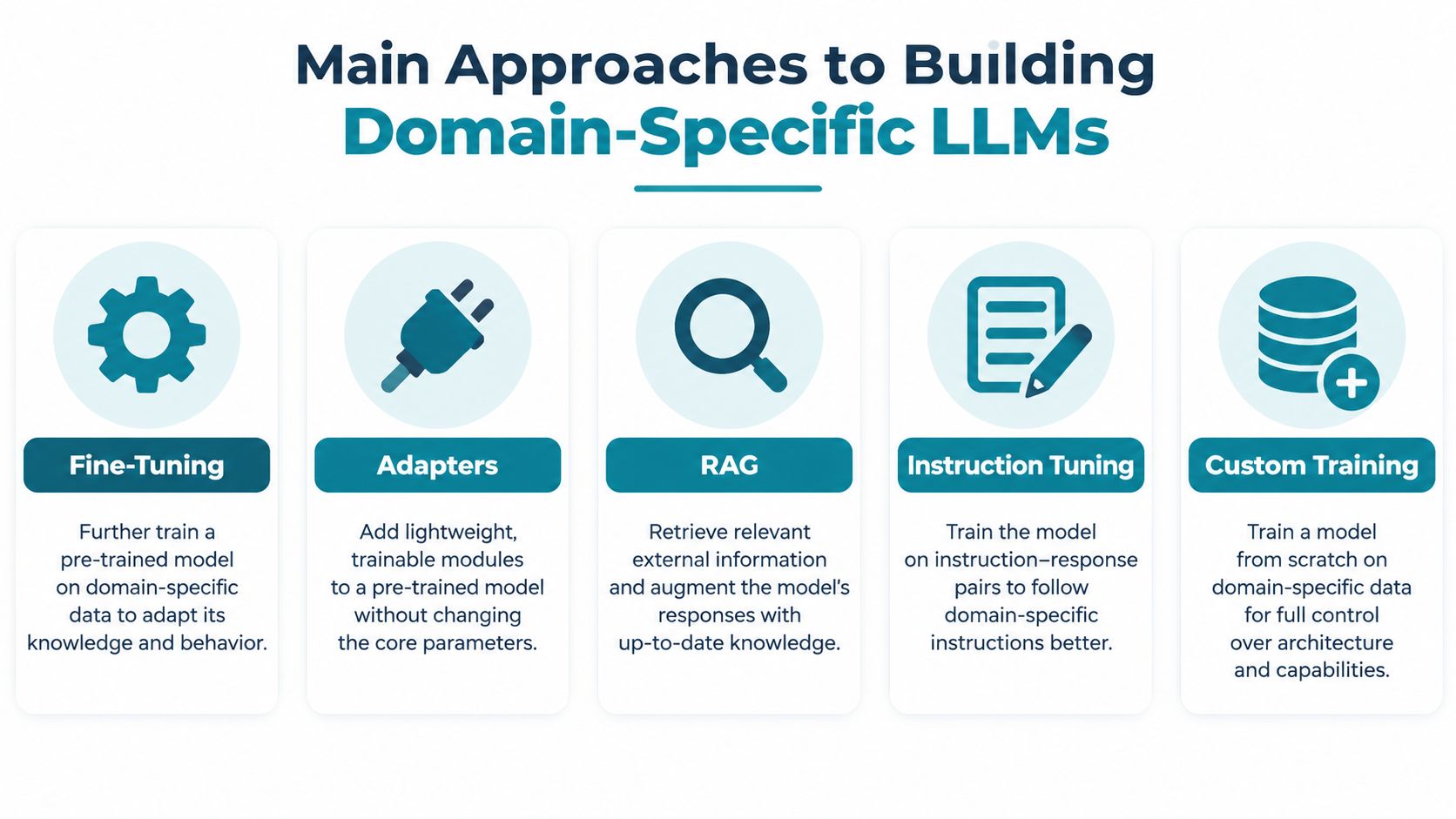
| Approach | Cost | Data Required | Latency | Best For |
|---|---|---|---|---|
| Fine-tuning | Training and evaluation expense | Curated domain examples | Can reduce runtime retrieval overhead | Stable behaviors and specialized reasoning |
| Adapters | Lower training footprint than changing the full model | Focused task examples | Usually adds little application complexity | Multiple domains sharing one foundation |
| RAG | Retrieval infrastructure plus inference | Trusted, searchable documents | Retrieval adds a processing step | Current knowledge and frequently changing content |
| Instruction tuning | Dataset preparation and training work | High-quality instruction-response pairs | Efficient after deployment | Consistent task execution and output format |
| Custom training | Highest engineering and infrastructure burden | Large, carefully prepared domain corpus | Depends on serving design | Strategic domains with unusual requirements |
Choose the method that matches the failure
Use RAG when the model already reasons adequately but lacks access to current policies, product documentation, internal records, or other changing information. Retrieval lets you update the knowledge source without retraining the model, but it won't automatically teach deep domain reasoning. Poor chunking, weak ranking, or missing metadata can still produce confident answers from incomplete context.
Choose fine-tuning when the task depends on recurring behavior that retrieval alone can't provide. Examples include converting complex inputs into a strict schema, applying a consistent classification policy, or following a specialized reasoning pattern. Fine-tuning can also encode style and workflow conventions, but it may make updates slower when the underlying facts change frequently.
Adapters are useful when teams need separate domain behaviors without maintaining entirely different foundation models. They can reduce the compute and storage burden of specialization, although the application still needs careful routing, version control, and evaluation for each adapter.
Instruction tuning is a behavior intervention. It teaches the model how to respond, not necessarily all the facts it needs. A hybrid architecture often combines instruction tuning or adapters with RAG, plus deterministic tools for calculations, validation, and policy checks.
Before committing to training, compare the options against data freshness, privacy, latency, and maintenance requirements. A detailed fine-tuning versus training comparison can help teams avoid treating full model training as the default answer. In most enterprise settings, hybrid systems are the practical destination, but the architecture should follow the failure mode rather than fashion.
Evaluation Design Is the Real Bottleneck
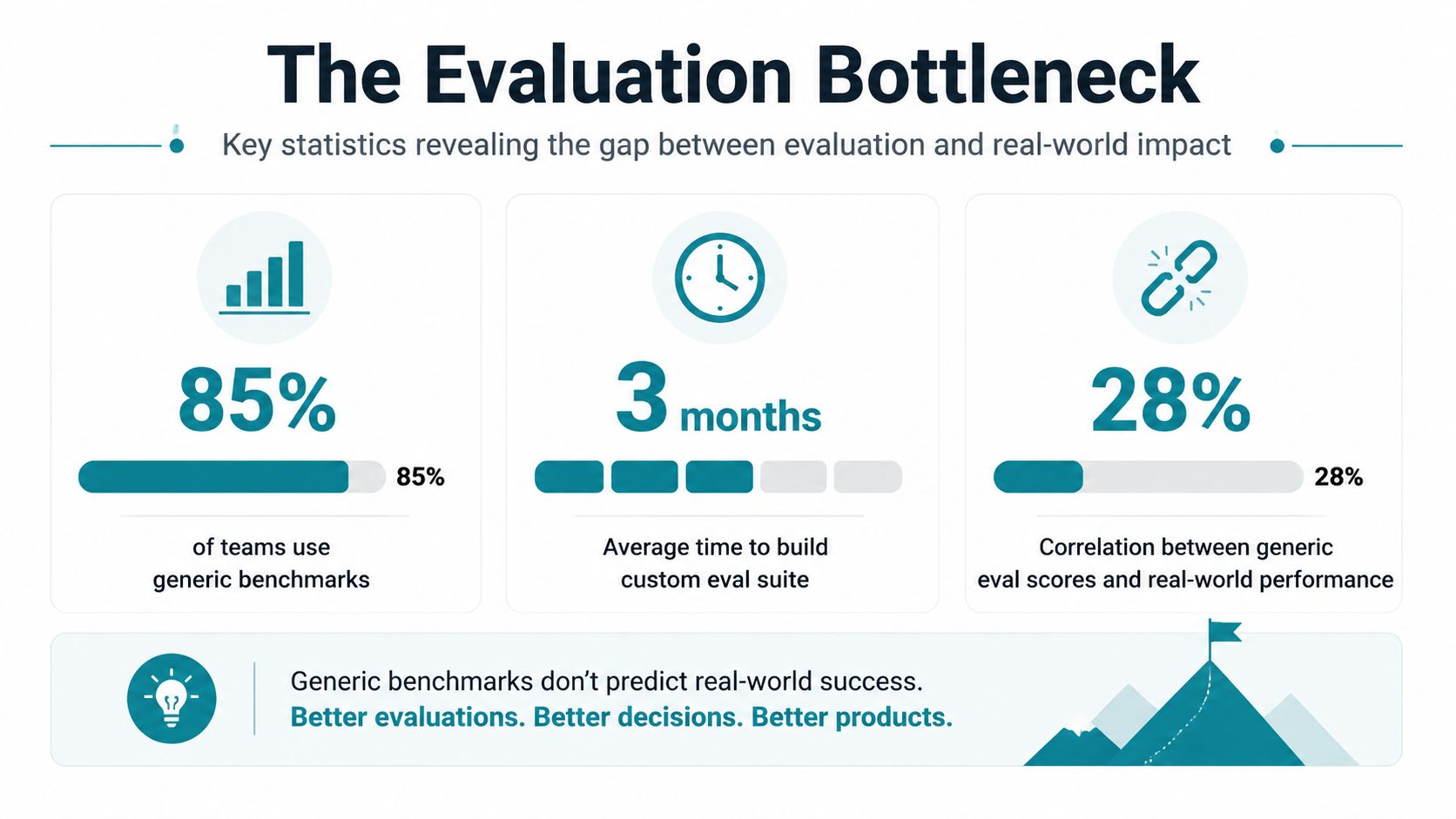
Generic benchmarks answer a broad question: can the model perform common language tasks? Founders need a narrower answer: can this system complete our workflow, with our documents, constraints, and consequences, without creating unacceptable risk?
A domain-native evaluation set should mirror production inputs. For a compliance assistant, that means testing policy interpretation, version conflicts, missing evidence, and escalation behavior. For a statistical assistant, it means testing multi-step reasoning, calculations, assumptions, and explanations, not just whether the final prose sounds plausible.
The StatQA benchmark demonstrates why general capability scores can mislead. It contains 11,623 examples, and GPT-4o reached only 64.83% best performance on those specialized statistical tasks. Fine-tuned models outperformed in-context learning approaches, showing that general-purpose models can struggle when the task demands domain-heavy reasoning. The study discussion also reports an LLM hidden-state classifier improving accuracy by 12.3% over domain fine-tuned models on domain representation tasks, which suggests that adaptation strategy matters as much as model selection.
Build tests from real failure modes
Start with production-like examples, not synthetic prompts designed to make the model look capable. Include ordinary cases, ambiguous requests, incomplete records, conflicting sources, adversarial phrasing, and stale information. Preserve the original context, expected answer, acceptable alternatives, and reason a reviewer would reject the output.
Your harness should measure more than answer similarity:
- Task correctness: Did the system complete the required business action?
- Evidence quality: Can a reviewer trace the answer to an approved source?
- Constraint compliance: Did it obey policy, schema, permissions, and formatting rules?
- Abstention behavior: Did it decline or escalate when evidence was insufficient?
- Consistency: Does the same input produce an acceptable result across repeated runs?
- Operational cost: Does the workflow meet its latency and review-effort requirements?
The benchmarking field is moving toward this broader view. BenchHub aggregates 303K questions across 38 benchmarks, reflecting the fragmentation of specialized testing and the need to compare systems with more than one narrow harness. The ACL paper on domain-specific benchmark design highlights why domain closeness, task format, and freshness can change the meaning of a model comparison.
Teams should document production-oriented metrics for production AI alongside model scores. A custom LLM evaluation program should produce a release decision, a failure taxonomy, and a regression suite. If the test set doesn't represent the work users perform, its score is decoration.
Deployment and Monitoring Best Practices for Production Reliability
A tuned model can still fail after launch. Domain language changes, source systems evolve, new products introduce unfamiliar terminology, and users discover inputs that the original test set never covered. Reliability therefore depends on the surrounding controls, not just the model checkpoint selected for deployment.
Put evidence between the model and the user
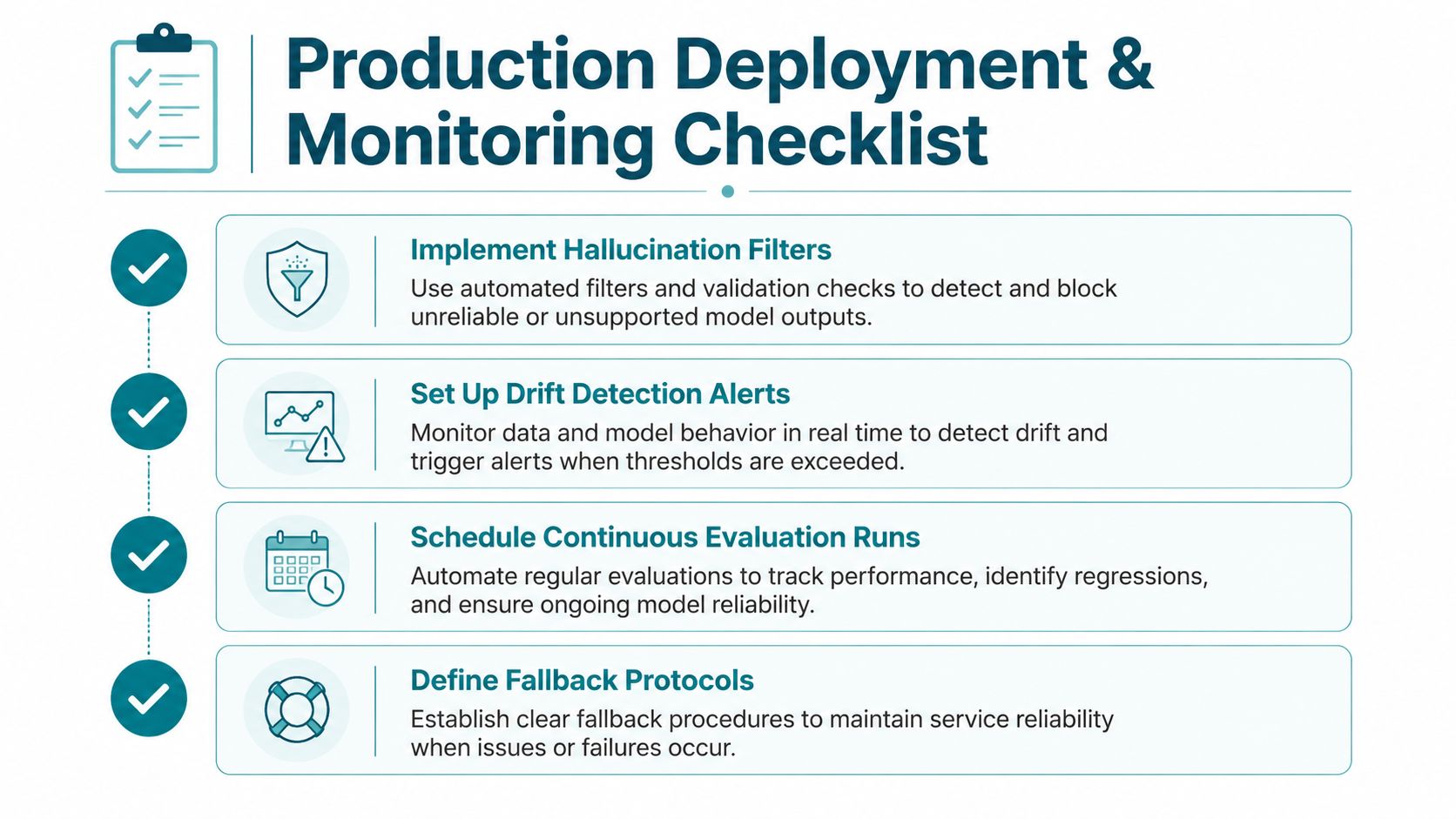
For knowledge-heavy workflows, require retrieval from approved sources and show the supporting passages to reviewers or users. Add deterministic validation where the output has a formal structure. A calculator should handle arithmetic, a rules engine should enforce hard constraints, and a schema validator should reject malformed records before downstream systems accept them.
Hallucination measurement also needs dedicated tests. HALoGEN includes 10,923 prompts across nine domains with automatic verifiers, reflecting a move toward evidence-backed measurement rather than broad accuracy claims. The HALoGEN research is relevant because it treats unsupported output as an operational failure that can be detected and categorized.
Monitor the system, not just the model
Log inputs, retrieved documents, tool calls, outputs, user corrections, escalation events, and latency. Redact sensitive fields before storing traces, and restrict access according to the same data governance rules used elsewhere in the business.
Set alerts around meaningful degradation:
- Drift signals: Watch for new terms, changed document distributions, unusual query types, and retrieval failures.
- Quality signals: Sample outputs for expert review and run regression tests whenever prompts, models, tools, or source indexes change.
- Safety signals: Track unsupported claims, policy violations, privacy incidents, and failures to escalate.
- Business signals: Measure completion rate, human review time, rework, and the outcome tied to the workflow.
A production model should earn continued access through monitored performance, not through the fact that it passed a launch review.
Define fallback behavior before deployment. The application may return source-backed excerpts, route the case to a human, use a simpler model, or refuse to answer. Retraining isn't the automatic response to every incident. First determine whether the problem came from retrieval, source freshness, prompt logic, tool execution, model behavior, or a changed workflow.
Teams with strict data residency or infrastructure requirements can also evaluate self-hosted AI models. Hosting choices don't remove monitoring obligations. They add responsibility for serving, patching, capacity, access control, and incident response.
Real-World Use Cases and ROI Across Industries
The business case for a domain specific llm becomes credible only when the workflow has a measurable bottleneck. “More intelligent conversations” isn't a KPI. Reduced review effort, faster document triage, fewer unresolved requests, and better first-pass quality are measurable outcomes.
In healthcare, a model can support clinical dialogue summarization, terminology normalization, or administrative document extraction. The safe design keeps clinicians responsible for judgment, grounds suggestions in approved records, and routes uncertain cases for review. The value comes from reducing documentation friction while preserving traceability, not from presenting the model as an autonomous clinician.
In fintech, domain adaptation can support regulatory filing analysis, transaction explanations, policy lookup, and compliance document classification. A RAG layer can keep answers aligned with changing internal policies, while deterministic checks handle thresholds, dates, and required fields. The evaluation set should include conflicting rules and incomplete evidence because those are the inputs most likely to expose operational risk.
Legal teams can use specialized systems for contract clause extraction, obligation mapping, due diligence, and research assistance. The strongest workflow separates retrieval, extraction, and drafting. It also records the source text behind each identified issue, allowing a lawyer to verify the result instead of trusting a fluent summary.
Retail and manufacturing present different opportunities. Retail teams can connect product catalogs, service policies, and order information to support agents. Manufacturing teams can apply document intelligence to inspection records, maintenance procedures, and quality-control workflows. A model may classify or summarize the record, while a rules layer decides whether the case requires escalation.
Measure the workflow, not the demo
Each industry needs its own baseline and outcome definition:
- Healthcare: Documentation time, escalation quality, and unsupported clinical statements.
- Fintech: Review throughput, evidence traceability, and policy adherence.
- Legal: Clause recall, citation accuracy, and lawyer correction effort.
- Retail: Resolution rate, transfer rate, and policy-consistent responses.
- Manufacturing: Inspection consistency, defect routing, and rework reduction.
Enterprise copilots also need attention to permissions, employee adoption, and source connectivity. A practical reference for Averta for enterprise copilots illustrates the broader category of systems that bring company knowledge into employee workflows.
Don't promise ROI before measuring the existing process. Run a controlled pilot with a defined user group, compare the model-assisted workflow with the current process, and record both gains and new review costs. A technically impressive answer that forces experts to verify every sentence may have negative business value.
Cost, Data Requirements, and Compliance Considerations
The cheapest architecture is the one that solves the actual problem with the least operational burden. Teams often overestimate the data needed for retrieval and underestimate the work required to clean, label, govern, and evaluate training examples.
Start with the data type. If the problem is access to current company knowledge, well-structured documents and reliable retrieval may be sufficient. If the problem is behavior, formatting, classification, or specialized reasoning, curated examples become more important. If the source material contains sensitive personal, financial, or health information, privacy review must happen before data enters a training pipeline or external API.
Calculate total cost, not training cost
A realistic budget includes:
- Preparation: Ingestion, deduplication, redaction, metadata, labeling, and versioning.
- Development: Experiments, evaluation harnesses, prompt and retrieval engineering, and integration.
- Infrastructure: Inference, storage, indexing, observability, backups, and access controls.
- Operations: Human review, incident response, model updates, regression testing, and vendor management.
- Compliance: Legal review, audit evidence, retention policies, and approval processes.
Fine-tuning may lower repeated retrieval work in some workflows, but it can also make knowledge updates more complicated. RAG may reduce training effort, but poor retrieval can create silent quality failures. Adapters can support domain separation, although each variant still needs its own governance and regression coverage.
A practical cost analysis of fine-tuning an LLM should be paired with a comparison of alternative architectures. Don't choose based on GPU expense alone. Include the cost of expert labeling, failed deployments, human correction, and delayed updates.
Apply a risk-based decision rule
Low-risk internal search can start with a general model, RAG, access controls, and strong citations. Regulated workflows need stricter evidence requirements, retention controls, human approval, and auditability. Sensitive workloads may justify private or self-hosted infrastructure, but that choice increases operational ownership.
Synthetic data can help expand rare scenarios, but it shouldn't replace authentic examples and expert review. Use it to test edge cases or format variation, then validate the results against real workflow requirements. The central decision is not “build or buy.” It is whether your organization can maintain the data, evaluation, governance, and monitoring required after launch.
Your Next Steps to Operationalize Domain Specific LLMs
Treat the next three months as a sequence of decisions, not a race to fine-tune.
Start by auditing the workflow, data sources, permissions, failure costs, and current human process. Choose one narrow use case, then define acceptance criteria before selecting a model.
Build a domain-native evaluation set in the second phase. Test a baseline with RAG or structured prompting, and compare it with the existing workflow, including review time and escalation quality. Fine-tune only when the baseline misses a behavior that training can realistically improve.
Pilot with controlled users. Log failures, add verifiers and fallbacks, and schedule recurring evaluations. Track business outcomes alongside quality and safety signals. If your team lacks evaluation design, data governance, or production monitoring experience, bring in outside expertise before deployment.
Prioritize the evaluation harness before expanding model scope. It should expose recurring failure modes, measure regression across versions, and flag issues before users find them. Teams that establish this feedback loop early can stop weak releases, target remediation, and connect model changes to operating results.
AmasaTech helps organizations audit AI readiness, curate specialized training data, build custom LLM applications, and deploy monitored workflows tied to measurable KPIs. Visit AmasaTech to discuss a domain-specific AI system that can move from evaluation to reliable production.