
Bots as a service has moved well past the demo stage. The market was already forecast to grow from USD 1.6 billion in 2022 to USD 6.7 billion by 2027 at a 33.2% CAGR, while a separate projection sees it reaching USD 19.82 billion by 2031 from USD 5.11 billion in 2026 at 31.20% CAGR (industry forecast, separate market report). That kind of growth says buyers aren't shopping for novelty, they're buying packaged automation for support, sales, HR, and channel messaging.
What matters in production is much less glamorous than the marketing pages suggest. Enterprises want systems that route cleanly, escalate properly, stay observable, and prove value without creating new operational messes. The companies that win with this category treat bots as a service as infrastructure tied to outcomes, not as a shiny chat widget.
What Bots as a Service Actually Delivers
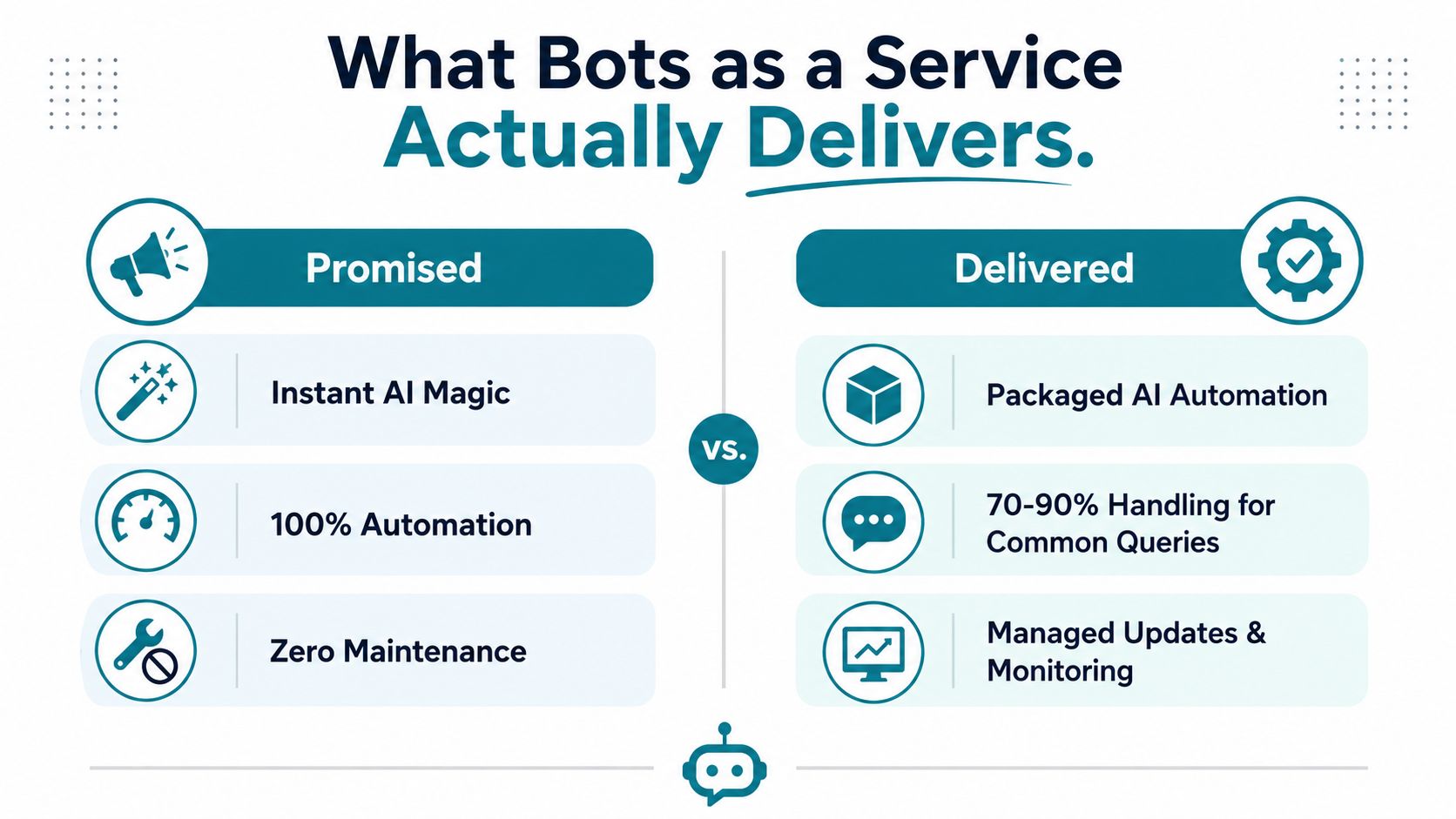
A bots as a service purchase rarely gives teams full autonomy. It gives them a packaged layer of AI automation, hosting, orchestration, monitoring, and integrations so they can deploy conversational and workflow bots without assembling every piece in-house. The category has moved into real enterprise use, with market coverage showing broad adoption across businesses of different sizes and particularly heavy use in large companies (market adoption coverage).
From rule-based scripts to packaged workflow automation
The old chatbot model was a decision tree with a few canned responses. The current model is broader. Vendors now combine language models, retrieval, workflow routing, and channel integrations so the bot can do more than answer a single FAQ loop. In practice, that means the system can respond to common questions, pull context from a CRM, create a ticket, or hand off to an agent without forcing the user to start over.
Practical rule: if a vendor cannot explain how it preserves context during escalation, the product is probably still a demo dressed up as automation.
That shift changes the buying decision. You are not buying a self-running employee. You are buying a managed automation layer that needs governance, content upkeep, and integration work to stay useful. Launch timelines rarely reduce to “turn it on and go,” especially once the bot touches customer records, internal knowledge, or payment-adjacent workflows.
For a useful example of the operating model behind that kind of service delivery, see AmasaTech's AgentOps services approach. The question is not whether the bot can speak fluently. It is whether it can complete a task inside your systems without breaking the journey.
What enterprises actually receive
The delivered value usually looks like this, not the hype:
- Packaged AI automation, not a custom model research project.
- Managed updates and monitoring, so prompts, knowledge sources, and routing logic do not rot immediately.
- Integration points with CRM, support, and messaging systems, which is where the value usually shows up.
- Production guardrails, including access controls, logging, and escalation paths.
That is why the buying conversation has changed. Leaders are no longer asking only “Can it answer questions?” They ask whether it can protect the customer journey, support the team, and produce measurable operational lift.
The Technical Architecture Behind Production Bots
Production bots live or die on latency. The SpeechSquad benchmark defines end-to-end conversational latency as the time from the last audio chunk sent to the server until the first response audio returns, and voice-AI guidance notes that sub-250 ms two-way delay is close to the practical limit for natural turn-taking, while current production systems often sit around 1.4 to 1.7 seconds median response time (benchmark and guidance). That gap is exactly why some bots feel smooth and others feel irritating before the first sentence finishes.
The stack that actually matters
A production setup usually has three layers. The infrastructure layer handles cloud compute, containers, databases, and queueing. The processing layer does streaming ASR for voice, language understanding, dialog control, retrieval, and model inference. The integration layer connects the bot to CRM records, knowledge bases, ticketing systems, and channel APIs.
The most common mistake is treating those layers like separate procurement decisions. They're not. Every extra network hop, slow model pass, or non-streaming text-to-speech step adds delay and makes the bot feel less natural. That's why vendors that rely on batch-style response generation often look fine in a scripted demo and fall apart once traffic is real.
If a vendor talks only about model quality and not about streaming, service health, and latency percentiles, they're describing a lab result, not a production system.
What to inspect in vendor claims
The relevant metrics are P95 and P99 latency, not just averages. Averages hide ugly tails, and ugly tails are what users feel when the system hesitates during a high-intent conversation. You also want to know whether the vendor supports early token emission, how they handle streaming ASR, and whether text-to-speech is optimized for short turn-taking instead of long monologues.
For teams comparing operating models, multi-agent architecture patterns are relevant because production bots often need more than one specialized service behind the scenes. One model can handle intent detection, another can retrieve knowledge, and a separate workflow layer can decide when to escalate. That split is more complex than a monolithic chatbot, but it's also more resilient when traffic grows.
The test is simple. If a bot can answer correctly but not quickly enough, users still abandon it. In production, speed is part of correctness.
Enterprise Use Cases That Drive Measurable ROI
Enterprise ROI usually shows up first in repetitive work with clear handoffs. Support, sales qualification, internal HR, and compliance can all produce value, but they differ in how much integration they need and how fast they pay back. The safest starting point is the process where people still copy data between systems and the escalation path is already defined.
| Enterprise Bot Use Cases by Business Function | Implementation Time | Payback Period | Primary KPIs |
|---|---|---|---|
| Customer support automation | Moderate | Fastest in the portfolio, commonly the shortest payback path | Resolved requests, escalation reduction, cost per resolution |
| Sales qualification | Moderate to heavy, depending on CRM depth | Longer than support, because handoffs and lead routing need tuning | Qualified leads, SDR workload, meeting booked rate |
| Internal HR operations | Moderate | Often steady rather than immediate, because policy and identity checks matter | Routine inquiry deflection, response time, employee satisfaction |
| KYB and compliance workflows | Heavy | Usually slower, because document handling and governance take longer | Throughput, accuracy, review time, exception rate |
Where the quick wins usually live
Support automation is usually the clearest first win. The bot handles repetitive questions, deflects tickets, and sends edge cases to the right queue. That works best when the answer set is stable and the human fallback is clean.
Sales qualification can also pay off, but only if CRM data is usable and routing rules match how the team works. HR bots reduce repetitive employee questions, yet they need tighter access controls and careful wording. Compliance workflows can be valuable too, though they are rarely the first deployment unless document handling is already slowing the business.
If you are mapping automation candidates, RPA use cases are a useful reference point because many bot wins follow the same pattern, repetitive work with predictable inputs. Conversational automation adds a user-facing layer on top of that workflow, which helps adoption but also raises the cost of bad handoffs.
The wrong first move is usually the flashy one. Teams pick a cross-functional workflow because it sounds strategic, then spend months cleaning up exceptions, access issues, and unclear ownership. Start with the process that already has data, a known business owner, and a clear escalation path.
Measuring ROI at the Workflow Level
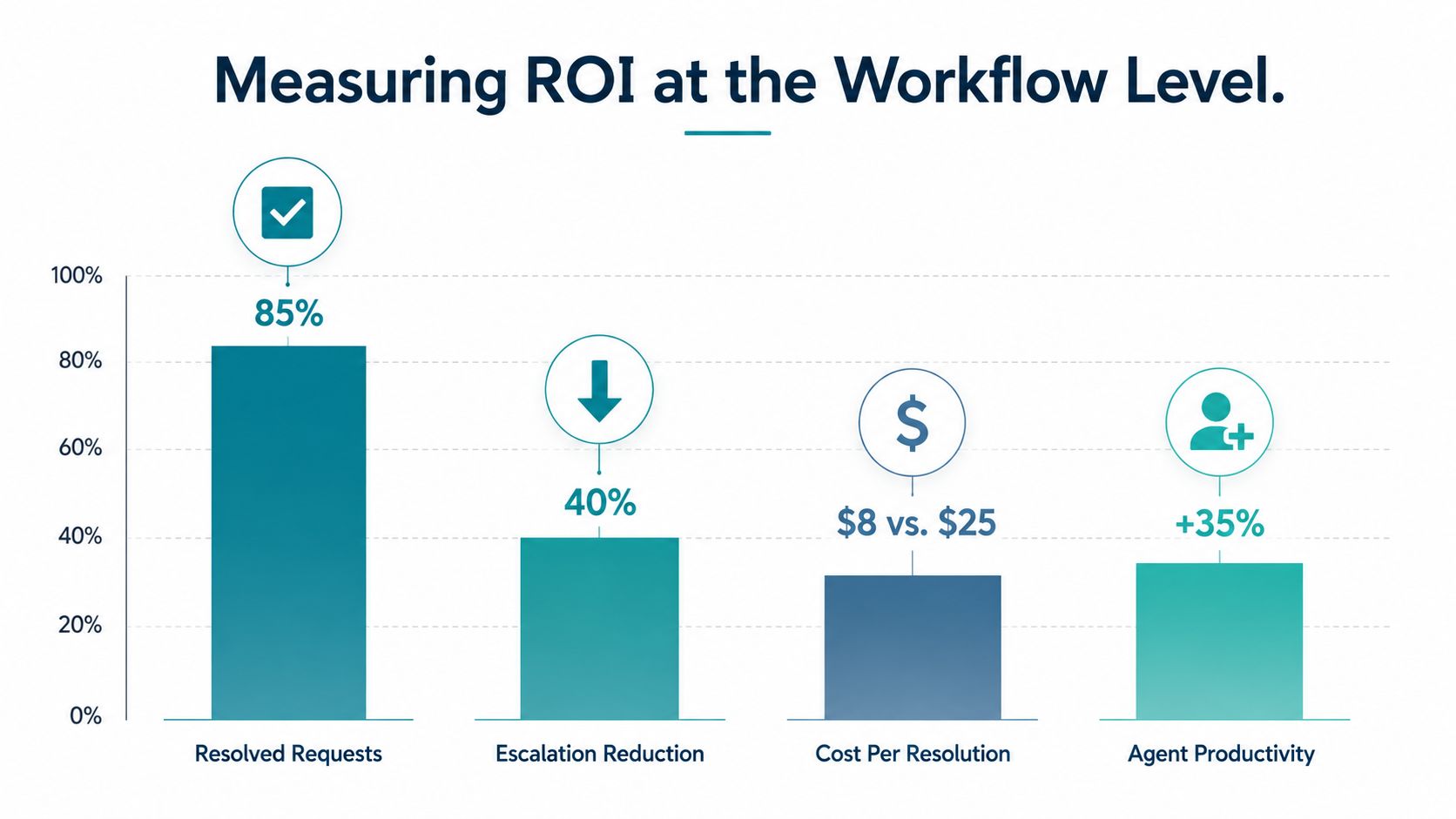
Conversation volume looks good on a dashboard, but it says little about business value. A bot that chats often and resolves little can still add cost, confusion, and rework. The metrics that hold up in budget reviews are resolved requests, escalation reduction, cost per resolution, and agent productivity, because they connect the bot to workflow outcomes and operating expense (ROI guidance).
What belongs in the numerator and denominator
The numerator is the impact you can defend in finance and operations. It usually includes fewer tickets, lower average handle time, faster resolution, and higher agent throughput. The denominator has to cover the full cost of making the workflow work, not only the software line item.
A practical cost model includes:
- Implementation, including setup and workflow design.
- Integration, especially CRM, knowledge, and ticketing connections.
- Training, for agents, admins, and reviewers.
- Maintenance, because prompts, content, and flows drift.
- Governance and monitoring, which many pilots undercount.
- Operating costs, including ongoing support and vendor fees.
This is the part that gets missed in board materials. A bot with strong adoption but weak handoff logic can raise cost if it creates duplicate work. A bot with modest adoption and clean resolution can be the better investment.
How to present the result
Start with a baseline before launch. Measure the same workflow for a meaningful period, then compare post-launch performance on the same steps. Keep the focus on what changed in the process, not on whether the bot felt useful.
Use the workflow, not the chat log, as the unit of truth.
For executive reporting, I've found it helps to show one primary KPI, two supporting metrics, and one failure metric. That keeps the story honest and makes it easier to see when the bot helps one path but hurts another. If you need to model the economics before rollout, this ROI calculator resource is a practical starting point for the cost side.
Operational Risks Vendors Downplay
The most common failure isn't that the bot can't answer anything. It's that it answers the wrong thing confidently, then routes the customer into a dead end. Enterprise buyers care about this because 81% of consumers expect bots to escalate to a human when needed, yet only 38% say that happens always or often, and 74% expect bots to remember past interactions while only 28% say that's their experience (customer expectation data).
The failure modes that hurt the business
Intent recognition failures send customers to the wrong queue or the wrong self-service path. Sentiment analysis gaps miss the point where a frustrated user should be escalated. Channel-specific limitations break omnichannel support, because a bot that works in web chat may not behave the same way in messaging or voice.
Those gaps matter more than feature lists. Buyers aren't just purchasing automation, they're purchasing risk reduction. Juniper's 2025 market note also highlights that enterprises need accurate intent and sentiment analysis to route conversations correctly, and it says RCS-based chatbot deployment will not expand much in 2025, which is a useful reminder that channel hype often runs ahead of operational reality (market note).
What to ask before signing
The vendor should be able to explain:
- How failed intents are detected, not just how successful ones are handled.
- How handoff preserves context, so the agent doesn't restart the conversation.
- How drift is monitored, because accuracy does not stay constant.
- Who owns escalation logic, especially in regulated workflows.
- What happens when a channel degrades, since outages and partial failures are inevitable.
A lot of teams underinvest in governance until something breaks. That's backwards. If the bot handles customer service, HR, or compliance, the operating model needs clear owners, review cycles, and auditability from day one. The bot is part of the process, which means the process inherits its mistakes.
The shortest version is this. Vendors often sell capability. Enterprises need reliability, recovery, and accountability.
Implementation Roadmap for Early and Growth Stage Teams
The safest rollout path is phased, not heroic. Teams do better by proving value in one controlled workflow, then expanding once they've earned internal trust and built enough data discipline to support the next layer. The goal is to create a repeatable operating model, not a one-off pilot that dies in committee.
Phase 1 quick wins
Start with support automation and a limited knowledge base. The decision gate here is simple, can the bot resolve common questions cleanly and escalate the rest without confusion. If the answer is yes, you've earned the right to expand. If it's no, the problem is usually content quality, routing design, or weak handoff logic, not the model itself.
Phase 2 process expansion
Move into internal workflows and CRM-linked use cases once the first bot is stable. At this stage, the team needs stronger ownership, better logging, and cleaner data definitions. The biggest mistake here is adding too many workflows at once, because each new path multiplies the number of edge cases the ops team has to monitor.
Phase 3 scaling and optimization
Only after the system is stable should you push into more advanced analytics or broader workflow automation. Model selection, routing strategy, and exception handling become a real operating discipline. The success criteria should include not just adoption, but whether the bot stays accurate, recoverable, and supportable as usage grows.
If your team needs help deciding what belongs in each phase, AI chatbot production services are one option among several for getting from strategy to deployment without overbuilding the first release. I've seen the best results when early-stage teams treat the bot as a process product with an owner, a backlog, and a review cadence.
The right roadmap prevents a familiar failure. Teams don't usually lose because the bot is useless. They lose because they start with the hardest workflow, skip the operating model, and run out of patience before the system proves itself.
Vendor Selection Criteria That Matter
Vendor selection should start with operational risk, not feature checklists. A demo matters less than the provider's answer to a simple question, what happens when a bot fails in production, and how fast can the customer journey recover? The right partner is the one that can keep escalation paths, logging, and governance intact after launch.
The questions that separate serious vendors from generic platforms
Ask about SOC 2, data residency, access control, and how customer data is isolated. Ask whether the provider supports RAG pipelines, custom LLM applications, fine-tuning where it fits the use case, and integration depth across CRM, ERP, and document systems. Then ask how they monitor drift, what they do when confidence drops, whether they provide 24/7 support, and how they define service levels.
Pricing needs the same scrutiny. Some vendors sell software licenses, others bundle delivery and ongoing operations, and that changes behavior after go-live. If a vendor is paid for activation only, you may get launch support without accountability for broken handoffs, low containment, or weak recovery when users hit an edge case.
What to compare side by side
- Infrastructure security: Get clear answers on compliance, data handling, and cloud architecture.
- Model customization: Confirm whether the system can fit your workflow, not just sit on a generic prompt layer.
- Integration depth: A bot that cannot reach your systems will not create durable value.
- Operational support: Monitoring, drift detection, and optimization should be part of the deal, not a hidden add-on.
- Exit strategy: Data ownership and portability matter if the vendor underperforms.
A serious vendor can explain failure handling without getting defensive.
That is the test. If the seller keeps steering the conversation back to flashy features, they may not have the operating maturity you need. If they talk about metrics, escalation, governance, and support before you ask, you are probably in a better conversation.
For teams that want an implementation partner rather than just software, AmasaTech builds outcome-tied AI automation, including chatbots, workflow systems, and monitored deployments on secure infrastructure. If you need help scoping a phased rollout, AI chatbot production services are one path to move from strategy to deployment without overbuilding the first release. The right vendor should reduce risk while proving ROI. That is the standard to hold them to.