
Most advice about multi agent architecture starts in the wrong place. It treats more agents as an automatic upgrade, when the central question is whether your workflow can survive the coordination overhead without turning small mistakes into expensive ones. In production, the divide is simple: parallelizable work benefits, sequential work often suffers, and the architecture only earns its keep when specialization, isolation, and orchestration are doing real work.
The research backs that up. Google's controlled testing across 180 agent configurations showed a predictive model could identify the optimal architecture for 87% of unseen tasks, and coordination improved performance on parallelizable work by as much as 81% in Finance-Agent tasks, while sequential tasks dropped by 39% to 70% in cases like PlanCraft. Independent multi-agent systems also amplified errors by up to 17.2x in the survey summary. That's why the right conversation isn't “Should we use multiple agents?” It's “Where does decomposition reduce risk, and where does it just add another failure surface?”
When Multi Agent Architecture Actually Helps
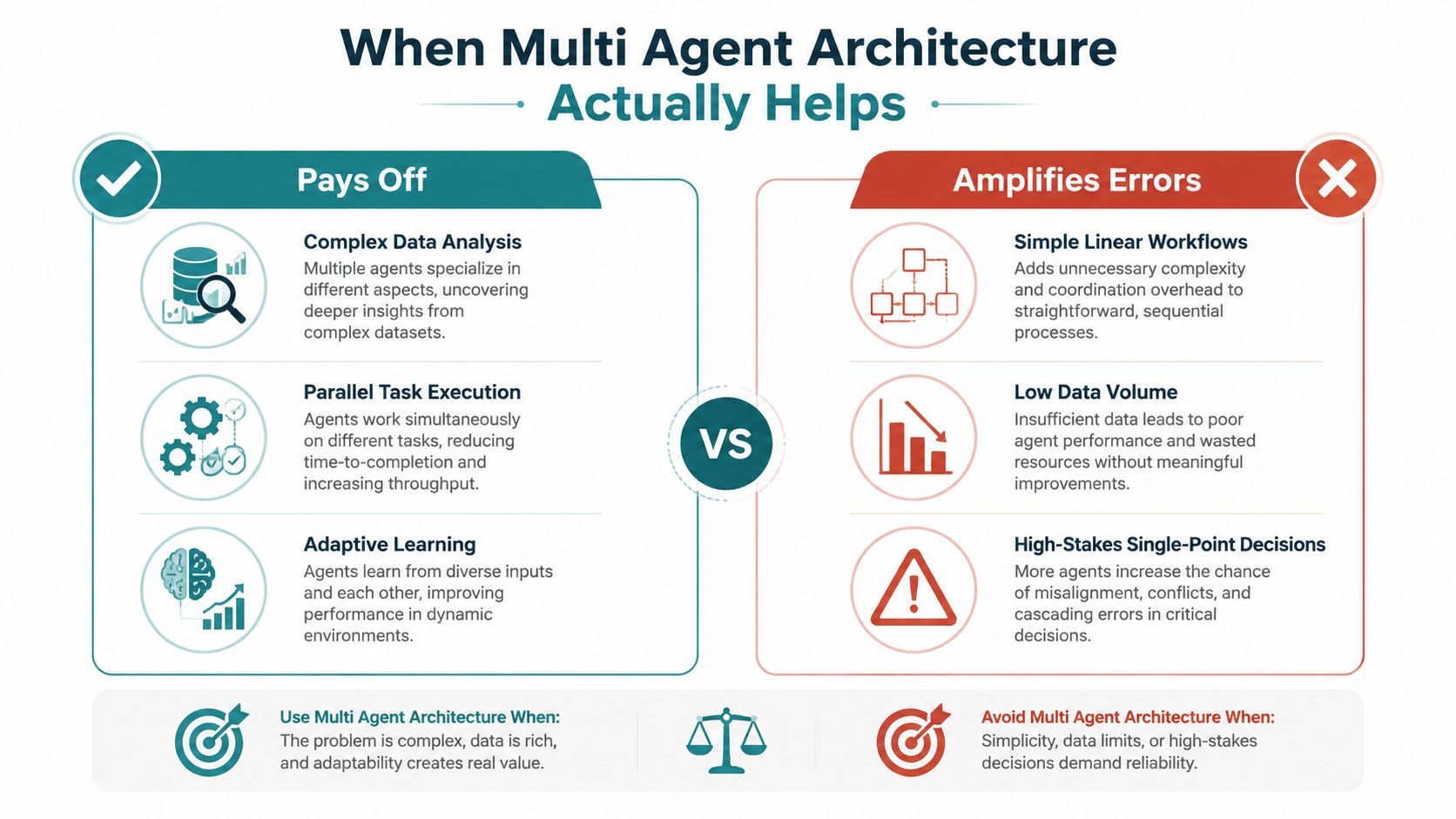
The strongest case for multi agent architecture is decomposability. If the work can be broken into bounded pieces with clear inputs and outputs, multiple agents can reduce bottlenecks and keep one messy task from polluting the whole flow. That is why it shows up in document triage, research synthesis, validation pipelines, and enterprise routing where different request types can move at the same time.
The throughput argument matters too. A single agent can become the choke point when one request depends on a long context window, or when several users push different tasks through the same workflow. Split the work across specialist agents, and you often get better isolation, cleaner handoffs, and less context collision under load.
The catch is coordination cost. Every added agent creates another place for ambiguity, overlap, and drift, so the architecture only helps when the orchestration layer can keep the boundaries tight. In A comparison chart showing when to use or avoid multi-agent architecture for software development projects., that trade-off is the core filter, not raw agent count.
The workload has to be decomposable
If a task can be split into research, extraction, validation, and response generation, multiple agents are worth considering. If it is a single linear decision with a narrow input set, extra agents usually add hops without adding control. In those cases, one agent with the right tools is often easier to reason about and easier to debug.
Practical rule: define the boundaries first, then decide how many agents deserve those boundaries.
That boundary check is where many teams skip ahead. They often deploy agents for perceived intelligence gains rather than genuine workflow necessity, then spend weeks untangling handoff failures, duplicate work, and unclear ownership.
The same principle shows up across practical deployments, especially in the agentic AI use cases overview. The useful question is simple: does decomposition reduce risk or improve throughput in a way a single agent cannot, or does it just distribute the same uncertainty across more components?
Understanding Agent Roles and Responsibilities
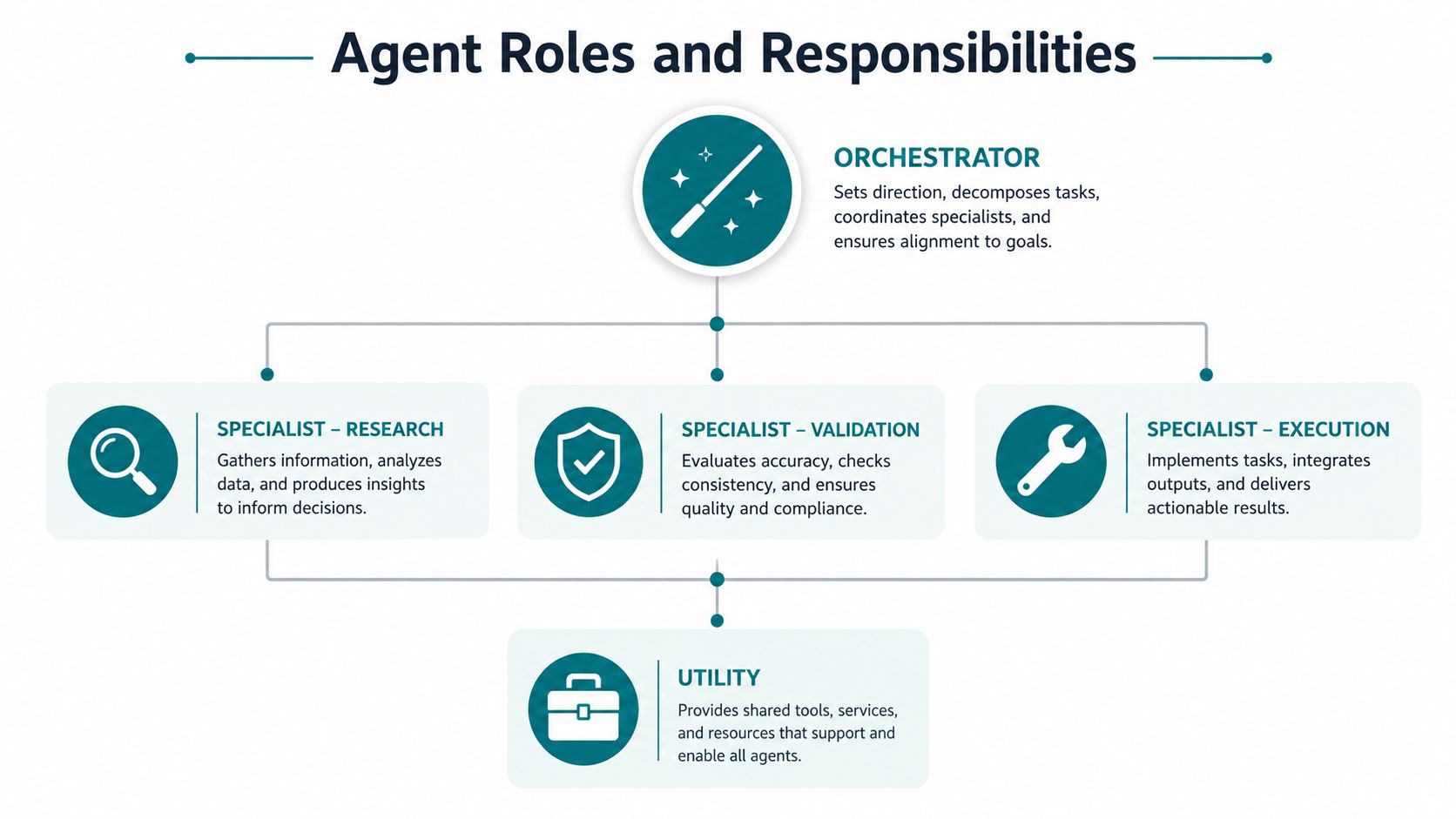
A reliable agent system behaves less like a monolith and more like a team with clear job descriptions. The orchestrator decides what gets done and in what order, specialists handle the actual work, critics check for mistakes, and memory or utility agents keep context or retrieve supporting material. When those roles are fuzzy, the system starts duplicating effort, arguing with itself, or routing the same request through multiple paths.
Start with one owner per decision layer
The orchestrator should own routing and final assembly. Specialists should own narrow, bounded tasks, not broad “helpfulness.” Critics should not also generate primary answers, because then validation gets mixed with drafting and the system stops catching its own errors.
A customer service flow makes this concrete. An intake agent can classify the request, a research agent can pull policy or account data, a response agent can draft the reply, and a validation agent can check tone, policy adherence, and missing fields before anything goes out. That separation reduces overlap, which is the hidden tax in many early systems.
The best role definition is boring. If two agents can both do the same thing, one of them is probably unnecessary.
Match roles to business boundaries
Use specialization when the work really belongs to different knowledge domains, data sources, or control policies. A finance agent shouldn't need the same prompt history as a support agent if the two functions answer different questions under different constraints. That's where role separation becomes more than an architecture preference, it becomes a governance mechanism.
The same principle applies to utility agents. A memory agent, retrieval agent, or formatter may never talk directly to the user, but it can remove friction from the workflow by keeping state consistent and surfacing the right context at the right moment. The goal isn't to maximize the number of agents. The goal is to make each one easy to reason about.
If your team is mapping an agent team to a product workflow, the custom AI agent build guide is a useful reference point for thinking through boundaries, scope, and ownership.
Coordination Patterns That Work in Production
Architecture choice changes the operating profile of the system, not just the code shape. In a financial document benchmark spanning 10,000 SEC filings and 25 extraction field types, researchers compared sequential, parallel fan-out/merge, hierarchical supervisor-worker, and reflexive self-correcting loop designs across five models, measuring field-level F1, document-level accuracy, latency, cost per document, and token efficiency in the benchmark abstract. The practical lesson is blunt. The orchestration pattern directly alters the accuracy-cost-latency tradeoff.
Sequential pipelines
Sequential chains work when one step depends on the last. They're easy to understand, easy to log, and often the least surprising option for compliance-heavy workflows. The downside is obvious. Each step inherits the prior step's mistakes, so a weak early decision can poison the rest of the pipeline.
Parallel fan-out and merge
Use fan-out when subtasks don't depend on each other. One agent can research policy, another can inspect the document, and another can check edge cases, then a merge step reconciles the output. This pattern usually makes the most sense when speed matters and the work can be divided cleanly without repeated context sharing.
Hierarchical supervisor-worker
Hierarchies are the most natural fit when tasks need decomposition, routing, and controlled escalation. They're also the pattern enterprise teams reach for when different subdomains need different skill sets but one policy layer must stay in charge. The tradeoff is complexity. You gain structure, but you also add a layer that can become a bottleneck if it's overused.
Reflexive self-correcting loops
These help when output quality matters more than raw speed. A critic agent can challenge the draft, ask for missing evidence, or re-run a subtask before approval. The extra pass is worth it when false confidence is expensive.
| Coordination Pattern Comparison | Best For | Latency | Cost | Complexity |
|---|---|---|---|---|
| Sequential pipeline | Linear workflows with strong dependency | Moderate to high | Moderate | Low |
| Parallel fan-out and merge | Independent subtasks, synthesis-heavy work | Low to moderate | Moderate | Moderate |
| Hierarchical supervisor-worker | Complex branching and policy control | Moderate | Moderate to high | High |
| Reflexive loop | Quality-critical review and correction | Higher | Higher | High |
For teams choosing between orchestration approaches, the AI orchestration platforms guide is worth reading alongside the benchmark results. In production, pattern choice is less about elegance and more about which failure mode you can tolerate.
Communication Protocols and State Management
The hardest part of multi agent architecture isn't the model calls. It's the plumbing between them. Once multiple agents start handing work back and forth, you need a durable protocol for messages, a clear rule for who owns state, and a recovery path when a task stalls or gets corrupted. Without those pieces, the system feels smart in demos and brittle under load.
The strongest evidence here comes from a clinical-scale evaluation of LLM orchestration. Multi-agent runs preserved performance far better under load than a single-agent baseline, with pooled accuracy staying at 90.6% at 5 tasks and 65.3% at 80 tasks, while the single-agent system dropped from 73.1% to 16.6% in the study. The same work reported that task isolation reduced context interference and cut token usage by up to 65-fold. That's not just a model win, it's a design win.
Separate transport from memory
Agent communication should be asynchronous wherever possible. Message queues, event buses, or task inboxes help prevent one slow agent from blocking the rest of the system. Shared memory still matters, but it should hold the minimum state needed for continuity, not every intermediate thought each agent produced.
Keep context local unless there's a reason not to
A common failure pattern is letting every agent see everything. That looks simpler at first, then it causes accidental contamination, irrelevant context buildup, and confusing handoffs. The better pattern is narrow inputs, explicit outputs, and a shared state object that records only what downstream agents need.
If an agent needs the full transcript to function, the workflow probably hasn't been decomposed well enough.
Design for recovery
Every multi-agent workflow should assume one component will fail or return something unusable. That means retries, timeouts, audit logs, and explicit fallback states. It also means the system has to distinguish between “no answer yet” and “answer rejected by validator,” because those are operationally different conditions.
For teams building toward retrieval-heavy workflows, the agentic RAG integration guide is a practical companion piece. The main idea is simple, state is a control plane, not a dumping ground. If state management is sloppy, even good agents will look unreliable.
Real World Applications Across Industries
The best multi-agent systems show up in places where one workflow contains several kinds of work, not one kind of work at scale. In healthcare, specialist agents can separate intake, evidence retrieval, and drafting so clinicians don't have to hold the entire context in one prompt. In fintech, one agent can pull transaction context, another can verify policy, and another can prepare the customer-facing response. In legal and manufacturing, the same logic applies, review, compare, validate, route, then escalate only when needed.
The point isn't that every industry should adopt the same architecture. It's that the business shape matters more than the label. Insurance claims, for example, often involve document intake, policy lookup, exception handling, and approval routing, which is exactly the kind of work that benefits from separated responsibilities. Contract review has a similar profile, one agent extracts clauses, another flags risk, and a third checks for missing language before the matter moves forward.
Where the pattern tends to fit
- Healthcare operations: use multiple agents when triage, retrieval, summarization, and review all happen in the same flow.
- Fintech support and operations: use specialist agents when policy interpretation and response generation should stay separated.
- Legal review: use one agent for extraction, one for risk assessment, and one for validation.
- Manufacturing coordination: use agents when quality checks, scheduling, and exception handling need different decision rules.
AmasaTech's service model includes agentic AI, RAG pipelines, and automation work across regulated industries, which makes it one practical option for teams that need both orchestration design and implementation support. That matters because the hard part is rarely deciding that agents are useful. It's turning that judgment into a workflow that survives production traffic, human review, and policy constraints.
Building Your Adoption Roadmap
Adoption fails less from model choice than from scope creep. Teams add too many agents, then discover that coordination, handoffs, and debugging cost more than the workflow they were trying to improve. Analysts at according to its global AI survey found that 23% of organizations are scaling an agentic AI system in at least one function, 39% are experimenting, and in any given business function no more than 10% are scaling agents. That gap points to where the friction lives, in governance, integration, and change management.
Start with one measurable workflow
Pick one process with clear inputs, clear outputs, and a human owner who can judge quality quickly. Skip the generic “AI assistant” brief. Start with work where review is cheap enough to iterate, but coordination still matters.
Limit the agent count early
Two or three compatible roles are usually enough for a first serious deployment. More than that, and you end up debugging the architecture instead of the workflow. Keep the boundary set narrow until the system can handle real traffic without context bleed.
Instrument everything that can fail
Log routing decisions, message payloads, validation outcomes, retry counts, and escalation points. If the workflow needs a rollback, you should know exactly which agent made the bad turn and what state it touched. That is what separates a pilot from an operating model.
Don't scale the number of agents before you can explain a single request end to end.
For agent integration guidance, see AmasaTech's integration guide. If your team needs architecture choices tied to business outcomes, AmasaTech can help with AI audits, phased deployment, and production automation across regulated workflows. Use that kind of support when the goal is a workflow that survives production traffic and human review, not just a prototype that looks strong in a demo.
Security and Operational Considerations
Multi-agent systems widen the blast radius unless you design them like a controlled environment. Each agent should have a clear identity, scoped permissions, and an auditable trail of what it saw, changed, and passed downstream. Without that, the system can become hard to investigate, hard to secure, and hard to trust when a high-stakes decision goes wrong.
A good operating model starts with least privilege. Agents should only access the data and tools they need for their role, and every cross-agent handoff should be visible in logs. Human review belongs in the loop wherever the decision is sensitive, irreversible, or regulated.
Monitoring matters just as much as access control. Track drift in agent behavior, watch for unusually long chains, and alert when a validator starts rejecting too many drafts or when a specialist begins returning inconsistent outputs. That's how you catch degradation before it becomes visible to customers.
The core lesson is that multi agent architecture is a governance problem as much as a modeling problem. Teams that treat it like a set of prompts usually end up chasing edge cases. Teams that treat it like a production system, with identity, state, validation, and rollback, can keep it stable.
If you're planning a multi-agent rollout and want help separating real coordination value from avoidable complexity, AmasaTech can help you assess the workflow, design the agent boundaries, and implement the operating model around them. Visit AmasaTech to explore AI audits, orchestration strategy, and production deployment support for agentic systems.