
Insurers were projected to spend $184 million on robotic process automation in 2019, rising to $634 million by 2024, a 245% increase. That forecast matters because it marked the moment RPA stopped being a pilot-side experiment and became a mainstream operational investment across the largest insurance markets, with underwriting, claims handling, and data processing leading the way Automation Today.
That shift changed the conversation. The question in insurance isn't whether bots can move data between systems, it's whether teams can govern those bots, keep them reliable, and prove business value after the first workflow goes live. Most RPA failures I've seen don't come from bad automation code. They come from weak process design, fuzzy ownership, and no operating model for maintenance.
What RPA Does in Insurance Operations
Robotic process automation in insurance is software that follows preconfigured business rules to move through repetitive work across systems that don't talk to each other well IEEE model reference. In practice, that means the bot takes over the repeatable steps, while adjusters, underwriters, and operations analysts handle judgment calls, edge cases, and escalations.
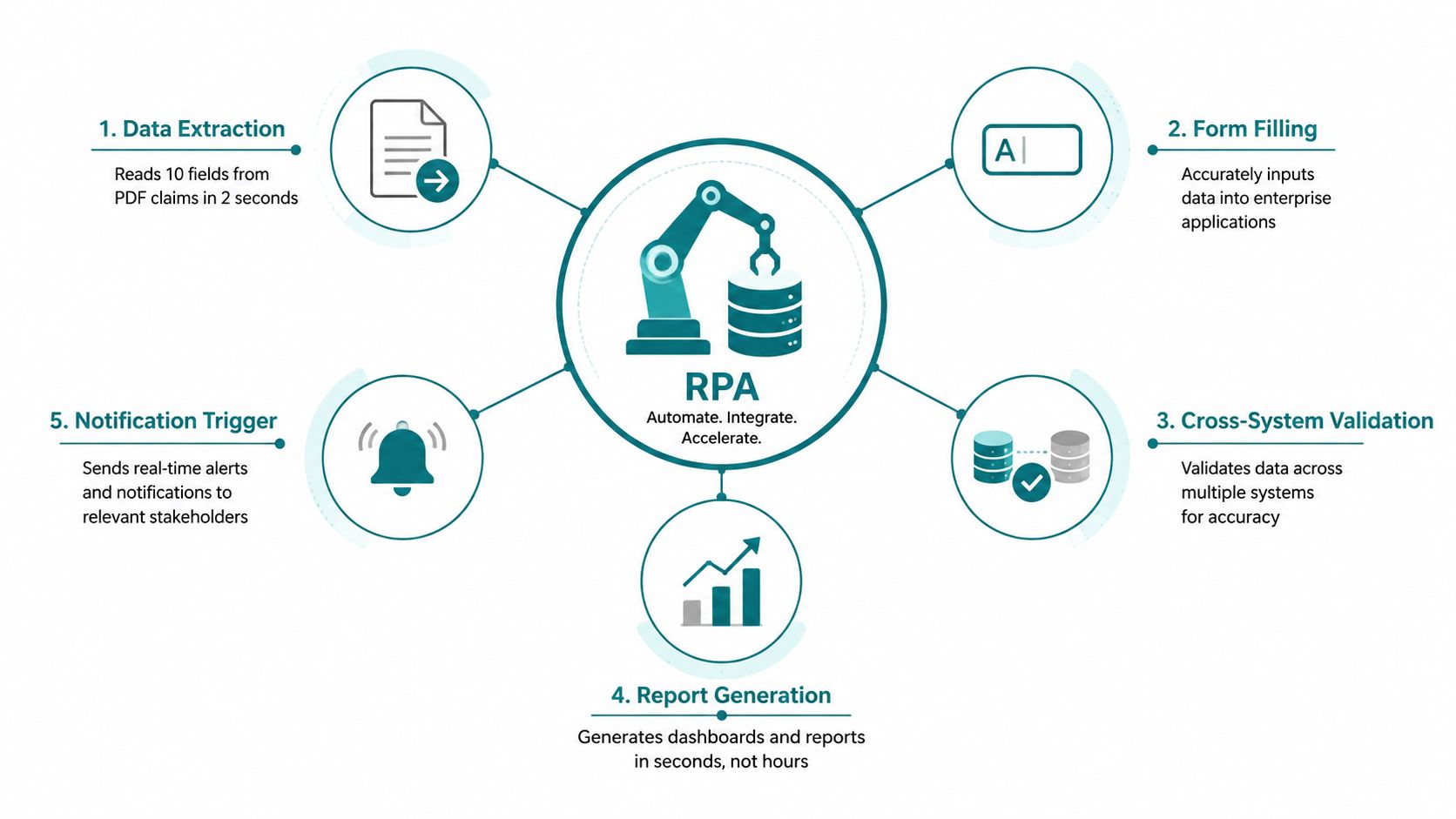
Insurance operations are built on handoffs, and that is where RPA earns its place. A bot can open a claim, copy fields from a portal into a core system, validate a form against a rule set, generate a status update, and trigger a notification. It does that work without forcing a redesign of the legacy stack underneath it.
Where bots fit in the stack
The strongest candidates are structured, repetitive, and rules-driven. Claims intake, policy updates, data transfer between portals, and document indexing are good fits because the inputs are predictable enough for a bot to handle consistently. The bot does not need to understand the business the way a person does. It needs a stable path, clear decision rules, and a clean exception route when the workflow breaks.
Practical rule: if a process already has a written checklist and the same keystrokes happen over and over, RPA is worth evaluating.
That also separates RPA from full AI. AI helps interpret messy language, images, or ambiguous cases. RPA executes the action. In insurance, the strongest programs use RPA as the orchestration layer, with people and other tools handling the parts that require interpretation. That is the operating model behind deployments that stay reliable after go-live.
High-Impact Use Cases Across the Insurance Value Chain
The most visible gains show up where people spend too much time on repetitive handoffs. In claims, one benchmark reports a reduction in processing time from 72 hours to under 5 minutes, about a 90% decrease in turnaround time, along with 40% to 70% cost reductions, 99% accuracy for standard forms, and straight-through processing rates of up to 75% for standard claims IJFMR claims automation research. Those numbers are valuable because they show what happens when the process is standardized enough for automation to carry real operational load.
Claims processing
In claims intake, the bot usually starts with forms, emails, attachments, and portal submissions. It extracts data, validates it against policy rules, and writes the information into the claims platform. When the file matches the expected pattern, the bot pushes it forward. When it doesn't, it routes the item to a human queue with the right context attached.
That's why claims is the natural first win. The work volume is high, the rules are clear, and the cost of delay is visible to customers. If you're mapping candidate workflows, this use-case overview is a useful way to compare claims, underwriting, and policy operations side by side.
Underwriting data collection
Underwriting teams don't need bots to decide risk. They need bots to collect data from scattered sources and prepare a cleaner file for judgment. That can mean pulling information from applicant forms, internal systems, and external portals, then consolidating it into one working record.
The gain here is less about dramatic transformation and more about reduced friction. Underwriters spend less time chasing data and more time on the parts that require judgment, such as reviewing exceptions, pricing nuance, and risk context. The trade-off is that you must define what counts as a complete file before automation starts. If your intake standards are fuzzy, the bot just reproduces the mess faster.
Policy administration
Policy administration often becomes the quietest source of value because it's full of repetitive service work. Renewals, endorsements, cancellations, and data updates all involve rules, confirmations, and system-to-system transfers. A bot can handle those steps reliably when the logic is stable.
A strong automation program doesn't start with the most exciting use case. It starts with the workflow that causes the most repetitive rekeying and the fewest surprises.
The common thread across these use cases is straightforward. RPA works best where the workflow is boring, documented, and anchored in systems that need help talking to each other. It works poorly when people expect it to make judgment calls that the process itself hasn't standardized.
Where RPA Ends and AI-Assisted Automation Begins
Classic RPA works best when the work is repetitive, structured, and predictable. Insurance files often arrive with scans, photos, handwritten notes, missing fields, and exception-heavy context. That is why many insurers pair RPA with OCR, machine learning, computer vision, and agentic AI, as outlined in IBM's insurance automation overview.
The boundary is process stability
A PDF form that needs field extraction and a core-system update fits cleanly into RPA once document intelligence makes the text usable. Ambiguous claims, fraud screening, and underwriting cases that need review call for a different layer. AI-assisted automation belongs there because the workflow itself requires classification, prioritization, or pattern detection before a human makes the final call.
The mistake many teams make is adding AI before the process is ready. They start with exception-heavy work before intake, routing, and ownership are standardized, then ask the model to absorb process chaos. In regulated insurance operations, that creates brittle automation and weak control.
What hybrid automation looks like
A practical hybrid setup usually starts with OCR or document intelligence reading the source material. RPA then moves the structured output through systems and enforces the workflow. ML or AI flags anomalies, sorts exceptions, or prioritizes cases for review. Humans still own the edge cases and the final judgment.
Claims support is a good place to see the model in practice. Teams that want a closer look at that pattern can review AI for insurance claims support automation. The useful part of the design is the handoff. A bot can prefill, route, and queue the claim, while the AI layer helps interpret unstructured evidence and surface the cases that need attention.
A narrow pilot still matters. Start with a workflow that has clear rules and a bounded exception path, then prove that the automation layers hand off cleanly before expanding. The same approach works when insurers move from classic RPA toward more customer-facing automation.
Good automation design keeps humans on the exceptions, not on the repetitive plumbing.
The distinction matters because insurance workflows do not all need the same treatment. Rules-based automation is easier to audit and control, so it should stay in place where the process is stable. AI support belongs at the exception layer when the case mix is too variable for fixed rules alone. The right choice depends on data quality, process maturity, and how much variation the workflow can tolerate without creating compliance risk.
A Phased Implementation Roadmap for Insurance Leaders
The most reliable RPA programs I've seen follow the same pattern, start small, prove control, then expand. That approach fits insurance operations, where a bot that works in one team can still fail when it meets a different queue, a different exception pattern, or a different system owner. Big-bang rollouts usually create more rework than value because the operating model is not ready.
Phase 1 discovery and process assessment
Start by mapping candidate workflows against two filters, business value and process stability. Look for processes with clear rules, frequent handoffs, and enough volume to matter. Skip the urge to choose the most visible workflow first if it is full of special cases and manual judgment.
The output should be a short list of candidates with documented inputs, outputs, exception types, and system touchpoints. Operations, compliance, IT, and process owners should all review the list before anything gets built. That review is where hidden control issues usually surface, and it is cheaper to fix them there than after release.
Phase 2 pilot deployment
Pick one workflow, not five. A pilot should prove that the bot can run reliably, that exceptions are manageable, and that people trust the handoff. Pilot success is not only about whether the bot works in test. It is about whether the workflow holds up when real cases hit production and the queue volume shifts.
Ownership has to be clear from the start. The operations team needs to know what the bot owns, what it does not, and who responds when it stops. If that handoff is vague, adoption stalls and the bot becomes someone else's problem.
Phase 3 scaled rollout
Once the pilot is stable, expand to adjacent workflows that use similar rules or the same systems. Many insurers begin to standardize bot development, release management, and support handoffs at this stage. A practical AI readiness and automation assessment for insurance teams helps determine whether the organization is ready to scale or still needs process cleanup first.
The governance question matters here. If each business unit builds its own bot logic, exception handling, and naming conventions, support gets messy fast. Shared standards keep the program from turning into a patchwork of one-off automations.
Phase 4 continuous optimization
Automation does not stop at go-live. Bots need monitoring, version control, and scheduled review. The process changes, the systems change, and employees find workarounds if the bot becomes a bottleneck.
Treat the first deployment as the start of operations, not the end of the project.
If you budget only for build work, the program will drift. If you budget for lifecycle management, you can keep the automation useful long after the first release. That is where the business value shows up, because reliability, auditability, and exception handling matter as much as the original automation design.
Measuring True Business Value Beyond Labor Savings
A lot of business cases for RPA still lean too hard on FTE reduction. That's too narrow for insurance, where service speed, accuracy, rework, auditability, and customer impact matter just as much as headcount. A more useful post-deployment model tracks the metrics that show whether the workflow is healthier Cognizant insurance RPA glossary.
Essential RPA Performance Metrics for Insurance Operations
| KPI Category | Specific Metric | Target Benchmark | Measurement Frequency |
|---|---|---|---|
| Speed | Average handling time | Lower than baseline and stable | Daily or weekly |
| Throughput | Straight-through processing rate | Higher than baseline | Weekly |
| Quality | Error and rework rate | Lower than baseline | Weekly |
| Reliability | Bot uptime and downtime during changes | Minimal disruption | Daily |
| Compliance | Audit findings and control exceptions | Zero unresolved issues | Monthly |
| Workforce impact | FTE cost reduction and manual workload shift | Measured against baseline | Monthly |
| Customer impact | Claim response or service turnaround | Faster than baseline | Weekly |
The point of the table isn't to turn operations into a dashboard museum. It's to force a broader definition of value. If the bot saves labor but creates rework, you haven't improved the process. You've moved the work around.
What to measure before and after
Baseline the workflow before automation goes live. Track how long it takes, how often work bounces back, how many exceptions appear, and where compliance reviews slow things down. After deployment, watch for degradation signals such as rising rework, longer exception queues, or bot downtime after patching.
That's the overlooked governance gap. Teams measure the launch. Few teams measure the operating life of the bot with enough discipline to spot decay early. If you want an ROI model that reflects the whole picture, this ROI calculator resource is a good reference point for building a more complete business case.
Common Pitfalls and How to Avoid Them
Most RPA failures in insurance are predictable. The problem isn't usually the tool. It's the order of operations. Teams automate a messy process, ignore exceptions, and then act surprised when the bot amplifies bad habits instead of removing them.
The five mistakes that cause trouble
- Automating a broken process first. If the workflow has too many workarounds, the bot inherits them. Clean the process before you automate it.
- Underestimating exception handling. Insurance work always has edge cases. Build a human review path that doesn't become a bottleneck.
- Skipping maintenance planning. Applications change, credentials expire, and layouts shift. Bots need ownership just like any other production asset.
- Failing to bring operations staff along. If the team thinks automation is a headcount threat, they'll resist it or route work around it.
- Leaving compliance documentation thin. Regulators need traceability. Every bot action should be auditable.
The warning signs are easy to spot once you know where to look. If a bot works in test but fails after UI changes, your environment is too brittle. If exceptions pile up in a shared inbox, your escalation design is weak. If no one can explain who owns the bot after launch, the program doesn't have an operating model.
What good mitigation looks like
Start with process standardization, not bot scripting. Document the workflow, define inputs and outputs, and assign ownership before automation begins. Then build a support model that includes patch testing, change control, and exception triage.
Compliance teams should review the audit trail early, not after the first issue. That reduces rework and keeps governance from becoming an afterthought. If your organization needs a framework for automated controls and documentation, AmasaTech's governance guidance fits naturally into that planning conversation.
Making the Decision: Is RPA Right for Your Insurance Operation?
A bot can be a good investment when the work is repetitive, the inputs are structured, the rules are clear, and the workflow moves across multiple systems. It is a poor fit when the process changes often, the data arrives in inconsistent formats, or every file requires judgment before anything can proceed. That simple screen prevents a lot of wasted effort.
A practical go no-go checklist
- Process clarity: Is the current workflow documented well enough that two people would describe it the same way?
- Exception profile: Are exceptions rare enough that humans can handle them without slowing the queue?
- System access: Can the bot interact with the required systems without fragile workarounds?
- Ownership: Is there a named business owner, not just an IT contact?
- Control requirements: Can compliance and audit teams trace what the bot did and why?
If several answers are “no,” pause before building. That does not rule out automation. It means the process may need cleanup first, or a different approach such as document intelligence or AI-assisted decisioning may fit better.
The first move is usually process discipline, then automation scale.
A realistic business case must account for implementation effort, support, retraining, and maintenance costs alongside labor savings. If those costs stay hidden at the start, the ROI picture becomes too optimistic and the program is harder to defend later. Insurers that manage automation as an operating capability tend to get more durable results because they budget for upkeep, ownership, and change control from the start.
AmasaTech works with insurance teams that need more than a one-off bot build. It helps organizations assess data readiness, design phased automation strategies, and connect workflow automation to measurable outcomes like throughput, accuracy, and compliance. If you are evaluating robotic process automation in insurance and want a partner that can help with implementation and lifecycle governance, visit AmasaTech.