
You're staring at a blank project plan, the leadership team wants an AI roadmap, and the one question that keeps hanging over every meeting is simple, how long will this take? The pressure is real because the answer isn't just about dates, it affects budget, hiring, vendor selection, and whether the first launch creates momentum or frustration.
A realistic implementation timeline for AI is never a neat line from kickoff to go-live. It has to account for messy data, shifting priorities, integration work, user training, and the adaptation period after launch. That's the difference between a plan that looks good in a slide deck and one that survives the first month of execution.
Crafting a Resilient AI Implementation Timeline
The first mistake leaders make is treating the timeline like a calendar exercise. They pick a target launch date, then hope discovery, data work, model development, and training will fit inside it. In practice, that creates the same problem that shows up in enterprise rollouts again and again, the plan is built around optimism, not dependencies.
A better implementation timeline starts with what has to be true before any model can ship. That means clarifying the business outcome, the data requirements, the operating owner, and the decision points that can stop the project early if the risk is too high. Once those constraints are visible, the timeline becomes a management tool instead of a guess.
Practical rule: If a phase can't be tied to a deliverable, an owner, and a business result, it's not ready to sit on the timeline.
The goal isn't to make the project sound slower. The goal is to make the plan believable enough that finance, operations, and the technical team can commit to it. A resilient timeline gives founders room to handle reality without turning every delay into a crisis.
Laying the Foundation Before You Start the Clock
The most expensive timeline failures usually happen before the project starts. Teams commit to dates before they know whether the data is usable, the integrations are accessible, or the business owners agree on what success looks like. That's how an AI project drifts from a focused initiative into a long, expensive cleanup effort.
Start with readiness, not enthusiasm
A proper AI readiness audit should cover data maturity, infrastructure, security constraints, workflow fit, and team capability. If the source data lives in multiple systems, contains inconsistent labels, or depends on manual cleanup, that work needs to be scheduled up front, not hidden inside “development.” If the internal team can't maintain the system after launch, the timeline also needs time for knowledge transfer and operating design.
Use the audit to surface blockers early. That includes access approvals, missing data owners, compliance review, and the possibility that the use case is weaker than it looked in the original pitch. If those issues show up in week one, you can adjust. If they show up after build has started, they cost weeks.
Define the outcome before the build
A strong timeline needs a business case with specific KPIs, not a vague promise to “use AI.” Measure what matters to the company, whether that's response time, throughput, accuracy, cost reduction, or revenue support. That KPI choice shapes the implementation path because it tells the team which data to prioritize, which systems must integrate, and which trade-offs are acceptable.
Stakeholder alignment matters just as much. If the operations lead wants speed, the compliance lead wants control, and the customer team wants flexibility, the timeline needs explicit sign-offs at each gate. The easiest way to avoid late-stage conflict is to define go/no-go criteria before the dates are locked.
A timeline should reveal risk early enough to change the plan, not hide risk until everyone is already committed.
The foundation work is where you protect the rest of the schedule. A good starting point is a structured readiness review like the one in AmasaTech's AI readiness checklist, then a dependency map that shows who must approve what and when. That approach also makes it easier to assign one accountable owner per task, which is a core reason implementation planning becomes more reliable when teams define clear criteria and map dependencies before locking dates, with buffer time added for approvals, migrations, and external handoffs, the usual sources of delay and rework (project implementation timeline guidance).
Mapping the Core Phases of Your AI Project
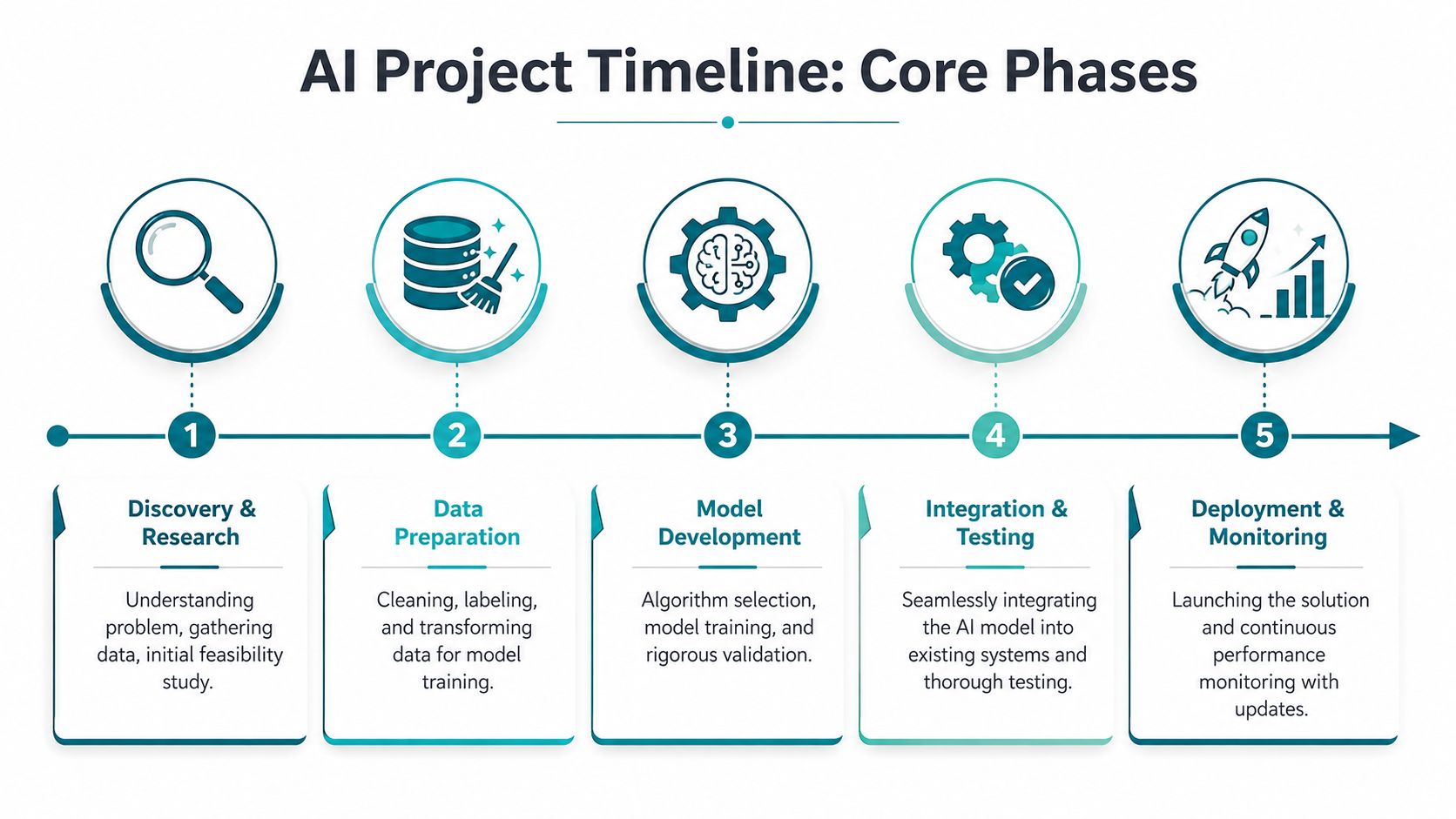
A phase-based structure is far more useful than a long task list. It keeps related work together, shows where one team's output becomes another team's input, and makes it easier to explain progress to nontechnical stakeholders. That's why the most dependable implementation timeline is built around phases, not departments.
Discovery and strategy
This phase is where the business problem gets sharpened. The team confirms the use case, defines what success means, and decides whether the opportunity is worth pursuing at all. For many projects, this stage is short, but it should never be rushed because every later decision depends on it.
Deliverables usually include a problem statement, a data inventory, and a first-pass architecture or workflow outline. If the project can't answer basic questions about feasibility, ownership, and value, it shouldn't move forward.
Data preparation and model development
Timelines often stretch. Data preparation can take longer than expected because teams uncover missing labels, inconsistent formatting, poor historical records, or access problems that weren't visible during planning. Model development then depends on that cleanup being done well, not just done quickly.
This phase should end with a validated dataset, a training approach, and a model candidate that can meet the business requirement. If you're building something custom, this is also where your timeline starts to reflect the complexity of the use case rather than the optimism of the original pitch.
Integration and testing
A model that works in isolation can still fail inside a real workflow. Integration connects the AI system to the tools people use, and testing checks how it behaves under realistic conditions. That includes functional testing, edge cases, permissions, handoffs, and error handling.
The deliverable here is confidence, not perfection. The team needs proof that the model, interfaces, and process all work together well enough to move into a controlled release.
Deployment and training
Deployment is a business event, not just a technical one. Users need to understand what changed, what stays manual, when to trust the system, and who to contact when something looks wrong. If training comes too late, adoption suffers even when the technology is sound.
A good deployment phase includes final cutover, user enablement, and a support plan for the first days of live use. This is also where tools like AmasaTech's AI adoption roadmap fit naturally, because launch readiness is as much about behavior change as it is about technical readiness.
Post-launch monitoring
The last phase is often ignored in slide decks, but it's where the business case is proven. Monitoring checks whether performance holds up, whether users trust the output, and whether the system is drifting away from its intended behavior. Without this phase, launch becomes the end of the project instead of the beginning of value realization.
A strong timeline ends only when the system has settled into operating rhythm. In practice, that means review cycles, issue triage, and a plan for improvement based on how the organization really uses the tool.
Sample Timelines Quick Wins vs Strategic Initiatives
The right timeline depends on what you're building. A simple AI chatbot and a custom computer vision system do not move through the same kind of schedule, even if both are “AI projects.” The trade-off is straightforward, fast wins are easier to launch, while strategic systems usually demand more data work, more integration effort, and more change management.
| Phase | Quick Win, AI Chatbot | Strategic Initiative, Custom Vision Model |
|---|---|---|
| Discovery | Define the support use case, data sources, and guardrails quickly | Confirm the production problem, data availability, and quality requirements in depth |
| Data preparation | Curate documents, FAQs, and escalation paths for retrieval | Collect, clean, label, and validate image data before training can begin |
| Model development | Configure a retrieval pipeline and test prompts or routing logic | Train, tune, and validate a custom model against real operational conditions |
| Integration and testing | Connect to support channels, test handoffs, and verify response behavior | Integrate into production systems, test workflow fit, and validate edge cases |
| Deployment and monitoring | Controlled launch with support review and prompt adjustments | Broader rollout with tighter oversight, retraining planning, and monitoring |
A quick win may fit into a short delivery window because the underlying model work is lighter and the data surface area is smaller. A strategic initiative usually needs more time because the organization is asking the system to interact with core operations, not just answer a narrow question.
That pattern also explains why enterprise schedules slip. In a benchmark analysis of 100 ERP projects, vendors quoted an average implementation timeline of 4 to 6 months, but the actual average time to go live was 7 to 9 months. Only 23% of projects met the original schedule, while 41% slipped by 3 or more months, which shows how quickly optimism gets overtaken by integration, data, and coordination work (ERP implementation benchmark).
The more a project touches live operations, the less useful a generic date becomes.
That's why AmasaTech's AI implementation strategy is usually framed around phased delivery rather than a single finish line. The useful question isn't “How fast can we start?” It's “Which pieces create value early, and which ones need more runway because the risk is higher?”
Anticipating and Mitigating Common Timeline Killers
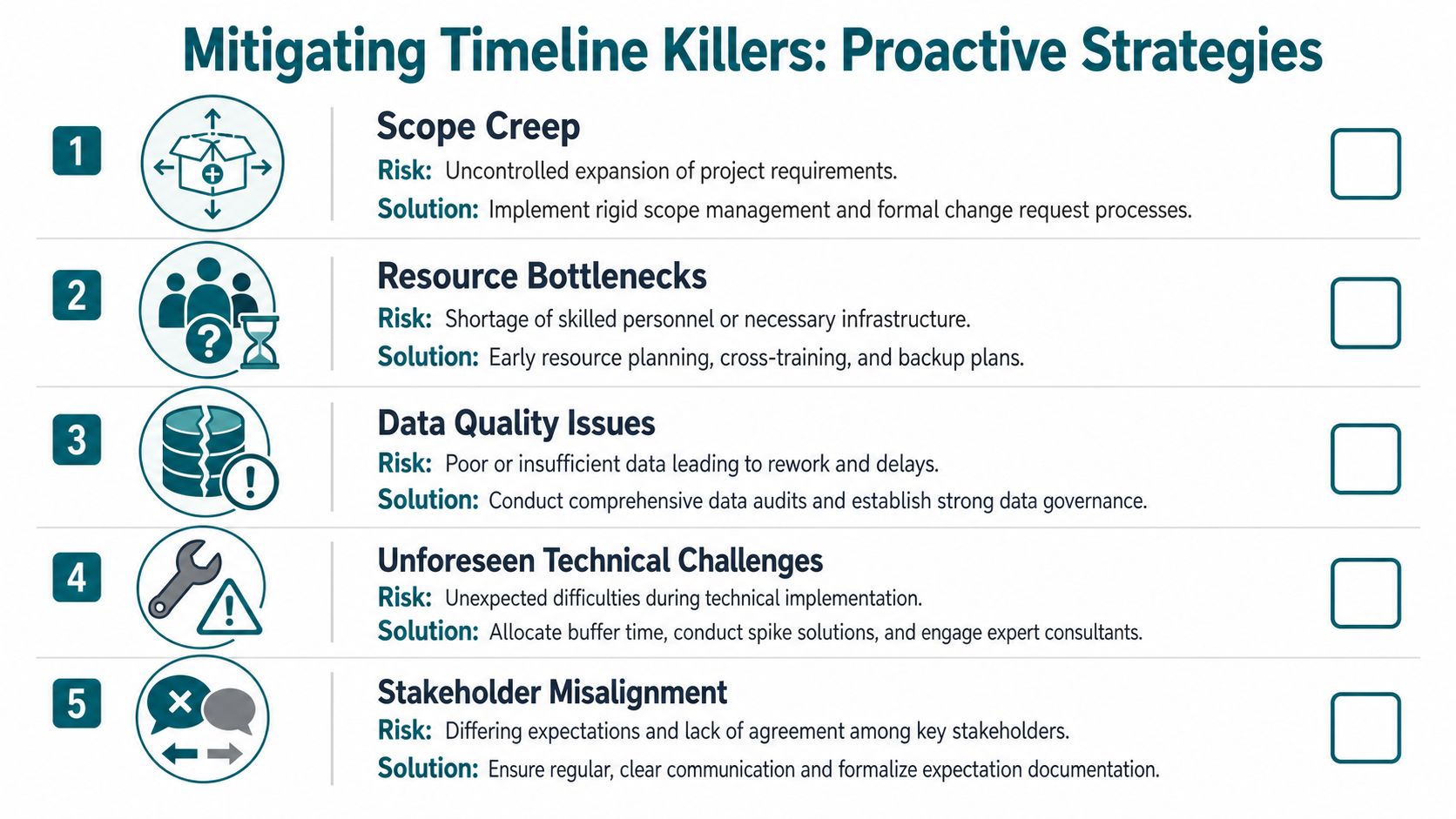
AI projects rarely slip because of one dramatic failure. They slip because small blockers stack up, each one nibbling at the schedule until a clean plan turns into a scramble. The most common killers are data quality, access delays, scope creep, and weak change management.
Data and access problems
Poor data rarely shows up as one obvious defect. It shows up as repeated cleanup, re-labeling, reformatting, and rework after the model team has already started. The fix is to build validation sprints into the plan and treat data readiness as a formal milestone, not a background task.
External approvals create the same problem. If a system needs legal review, vendor access, or a security sign-off, those steps need buffer time and an owner. Waiting until the build is done to ask for approval is one of the fastest ways to blow the schedule.
Scope and adoption issues
Scope creep usually begins with a reasonable request, then expands into extra workflows, extra dashboards, and extra edge cases that weren't in the original brief. A formal change-control process helps protect the timeline because every new request gets judged against cost, timing, and business value.
Change management matters just as much. Users don't adopt new systems because the model is good, they adopt them because the workflow makes sense, training is clear, and the transition doesn't feel risky. When you bring training into the schedule early, the launch becomes much easier to absorb.
A frequently underanswered angle on the implementation timeline is how to handle work that depends on external approvals, data readiness, and organizational change rather than just task sequencing. Real timelines are constrained by policy, compliance, and cross-team readiness, which is why AmasaTech's AI governance best practices belong in the planning phase, not after deployment.
Beyond Go Live Measuring Success and Optimizing
Go-live is a milestone, not a finish line. If the timeline ends at launch, leadership loses sight of the stretch where real users, real exceptions, and real business pressure test the system. That period decides whether the AI initiative becomes a durable asset or another tool people stop trusting.
A realistic implementation timeline extends past launch into stabilization, monitoring, and expansion. Public implementation roadmaps show how design, initial implementation, and expansion can sit inside a broader multi-year window, which is a useful reminder that adoption often takes longer than deployment (multi-year implementation narrative).
A founder should also connect this phase to AI transformation progress monitoring, because the goal is to track value realization, not just project completion.
Build a stabilization period into the plan
The first post-launch phase should focus on issue resolution, user feedback, and operational tuning. Teams often call this hypercare, and it gives everyone room to fix workflow friction before small problems turn into habits. It also keeps the launch team close enough to catch issues that a test environment will not reveal.
Monitoring should cover technical health and business outcomes together. Model performance, drift, response time, and user adoption all matter, but only because they connect back to the KPI defined at the start. If the system is fast but irrelevant, the timeline has not delivered value.
Treat optimization as part of delivery
A strong implementation timeline leaves room for iteration because the first release is rarely the final one. New data can change behavior, user feedback can expose edge cases, and business priorities can shift once teams see the tool in use. The practical move is to plan for adaptation instead of pretending the first launch ends the work.
That mindset separates real operating change from a one-time technical project. It also gives founders a cleaner way to judge success, because the question becomes whether the system is improving the business over time, not just whether it went live on schedule.